


Toyota this week announced that the next-generation Hilux will be available as a battery-electric vehicle (BEV), confirming rumours that have been circulating for well over a year.
The Hilux BEV will go into production towards the tail end of 2025 at the automaker’s Thailand factory, Pras Ganesh, executive vice president of Toyota Motor Asia, told Reuters.
This validates previous reports that the upcoming Hilux will make its global debut next year before reaching dealers in early 2026.
The battery-incentivised bakkie will be primarily pitched to the Thai market but the executive said that Toyota is mulling over exporting it to other countries.
At present, it is unclear whether South Africa will receive the Hilux BEV considering the vehicle is also produced locally at Toyota’s Prospecton, Durban plant so a Thai import may not be financially feasible.
However, given that the Hilux is the best-selling vehicle in the country and the BEV will be built in right-hand drive, combined with the fact that Toyota plans to roll out a range of other electric rides in South Africa, it is looking likely that the battery-powered bakkie will eventually land on our roads.
It is a growing segment after all, and Toyota isn’t one to let an opportunity to dominate yet another category slip through its hands.

2022 Toyota Hilux Revo BEV Concept
Everything we know
Toyota has played its cards close to its chest regarding the next-gen Hilux so there is little information out there on what the upcoming bakkie will offer.
Back in 2022, Toyota’s Thai division unveiled the Hilux Revo BEV Concept which was the first time a Hilux was completely driven by batteries.
It wore a fashionable ventless grille with blue accents in the LED headlight clusters, with an interior switchgear taken straight from the automaker’s electric BZ4x SUV.
At the time, Toyota didn’t divulge any powertrain specifics but said the bakkie is capable of “about 200km” of range and that it would be used to lay the foundations of its new-energy powertrains of the future.
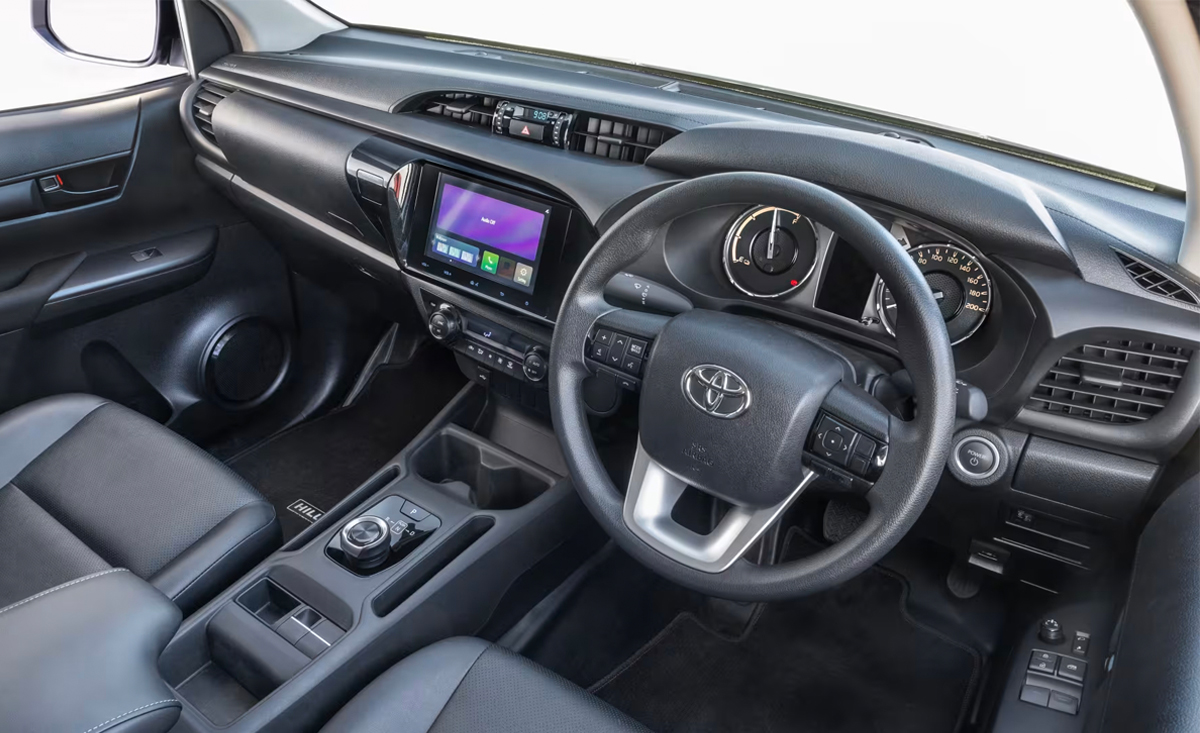
2022 Toyota Hilux Revo BEV Concept
It is expected that the production Hilux BEV will take design cues from the concept and similarly feature a closed-off front fascia with blue highlights denoting its eco-friendly underpinnings.
Given that 200km is hardly enough range for the average bakkie buyer, it is safe to assume that the production model will also be capable of quite a bit more than this.
Most modern EVs boast ranges within the high-300km and low-400km range, which will likely be what Toyota is aiming for, similar to its rival, the Isuzu D-Max BEV.
The new Hilux will be larger than the current-generation model courtesy of its upgraded architecture, and battery tech has made significant leaps in recent years, meaning there will be more space available in the new bakkie and a higher-density power pack to fill it with, so we anticipate at least 400km of potential out of the electric Toyota.

2025 Isuzu D-Max BEV Prototype
Balancing range with weight has been one of the engineers’ biggest challenges in developing the BEV.
“The more range I have to put on it, the more battery I have to put on it, which means the weight of the vehicle also becomes significantly heavier, which means the loading can be much less,” said Toyota Thailand’s Ganesh.
“So ‘Is it going to meet the customer’s usage needs?’ is always our biggest issue. We are always trying to understand what they do.”
The automaker is currently testing the Hilux BEV for various use cases in multiple road and temperature conditions to ensure it meets customer demands before it is officially unwrapped late next year.




 Loading ...
-2026.10.webp)

-2026.10.webp)