Around March last year, VW had settled on a hard-won plan to cut 50,000 jobs to revive profits and shore up its troubled German operations.
Just over a year and a series of setbacks later, workers at Europe’s biggest automaker face the prospect of that number potentially doubling to 100,000.
The plan, first reported by Manager Magazin, needs approval from the supervisory board, where labour representatives hold powerful sway.
Still, it’s reflective of a growing urgency in boardrooms across Germany, which risks losing its industrial edge to nimbler rivals from abroad.
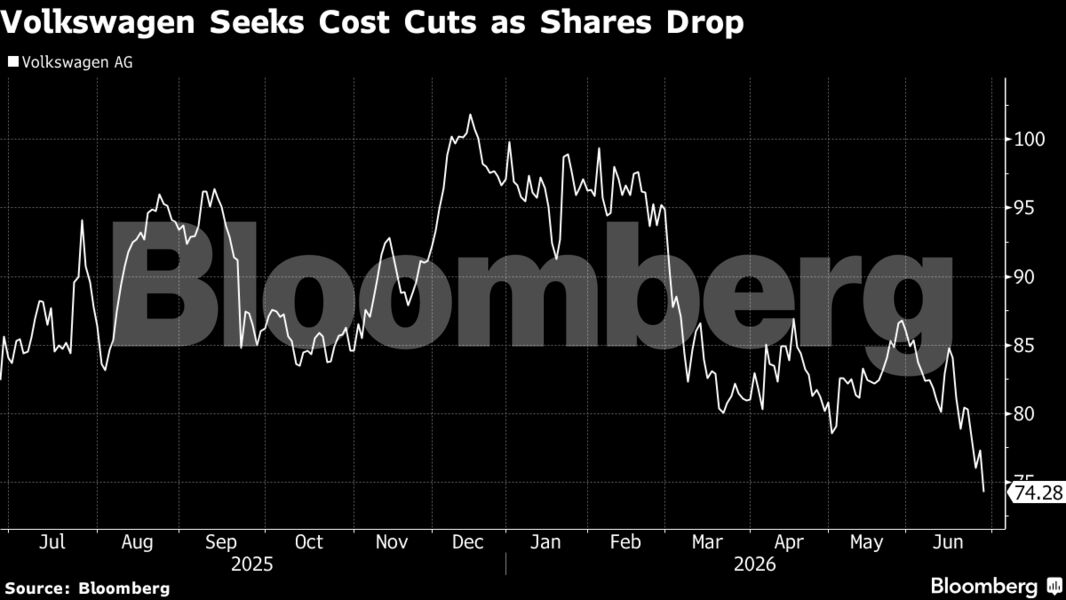
The situation in the auto industry is especially dire, with BMW and Mercedes-Benz also weighing cost cuts as the sector grapples with US tariffs, waning sales in China and high energy and labour costs.
The malaise is trickling down to parts makers Bosch, Schaeffler and Aumovio, which are closing sites and eliminating staff.
On Friday, Bosch announced that its CEO, Stefan Hartung, would leave the world’s biggest automotive supplier at the end of this month after getting started on some 18,500 job reductions.
The moves coincide with a rough patch for the German economy. After a strong start to the year, the Bundesbank predicts that output will stagnate in the current quarter amid headwinds from the war in the Middle East.
Chancellor Friedrich Merz’s government is also struggling to push through much-needed reforms as demographic change undermines the nation’s pension system.
“This would align with the ongoing decline in industrial employment and highlight the structural challenges confronting German car manufacturers,” said economist Martin Ademmer
“We expect only subdued economic activity in the sector in the coming quarters, with the energy price surge triggered by the Iran war providing an additional drag.”
Volkswagen’s renewed restructuring push includes a plan to shutter as many as four factories in Germany, something labour leaders were able to take off the table before.
WirtschaftsWoche reported on Friday that Manager Magazin was overstating the company’s planned total job cuts, saying they’d come in at no more than 80,000.
Either way, Chief Executive Officer Oliver Blume has been warning that the carmaker’s way of operating was essentially broken.
“Developing a ‘world car’ in Germany, producing it in Europe and selling it worldwide: Our business model, which has been successful for decades, no longer works today,” Blume said at the company’s annual general meeting earlier this month.
Days earlier, BMW, until then one of the few resilient automakers, drastically cut back its profit expectations.
The maker of the iX3 singled out a downturn in China and consumers keeping their purses shut as they worry about the Middle East conflict fanning inflation.
Meanwhile, fast-moving rivals from China are gaining traction in Europe with affordable electric and hybrid models, intensifying the competition.
“The once-consistent German industry must adapt to new market realities; otherwise, it will simply fail,” said Matthias Schmidt, an independent auto analyst based near Hamburg.
“German companies can no longer sit back and rely on their high-cost, made-in-Germany seal.”
While Renault and Stellantis rely mainly on sales in Europe and the Americas, Germany’s carmakers for years generated much of their income in China.
But with the market there shifting rapidly to EVs, they’re being increasingly priced out by local brands such as BYD and Xiaomi.
Germany’s manufacturers, who provide well-paying jobs to some 700,000 people and guarantee thousands more at companies supplying them, are also on the back foot elsewhere.
US import levies undermine the likes of Porsche and Audi, which don’t produce in the country. In Europe, total annual car sales remain some 16% below levels from before the pandemic.
The challenges may prompt additional measures. Already, Volkswagen’s Blume suggested he may be willing to allow Chinese partners to make cars at underused sites in Europe.
He’s now also floated the idea of separating the group’s namesake brand, according to Manager Magazin.
Simplifying Volkswagen’s corporate structures may make sense. The group owns luxury brands such as Audi and Porsche, but also more budget-friendly nameplates such as Seat and Skoda.
Its VW brand is positioned between those two extremes, and for years has been struggling with low profitability.
Spinning off the VW nameplate could be a step toward the group getting more credit for its individual assets, Citigroup analyst Harald Hendrikse said in a note.
We “applaud VW management — these are steps we would not have thought possible just five years ago,” Hendrikse said.
“It also highlights how tough the situation has become given EU industrial policy and how much restructuring needs to be done.”



 Loading ...