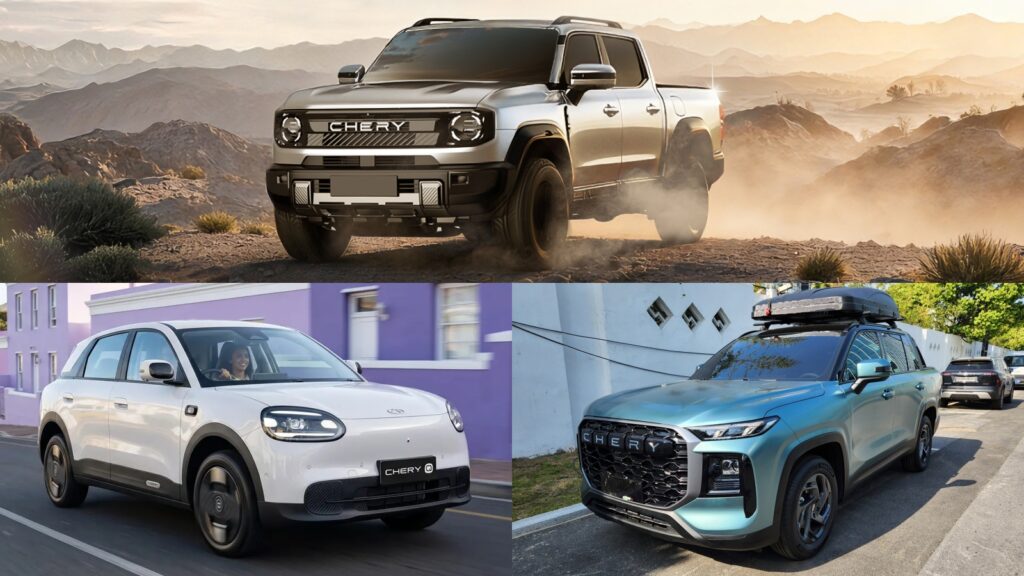
Since moving into its new local base, Chery South Africa has unveiled three new models it will introduce to our market in due course.
The “future-focused” new energy vehicles (NEVs) – the Chery Q, Tiggo V and KP31 – were previewed during the Chinese auto giant’s New Energy Vehicle Night, held at the Chery Rosslyn Plant in Pretoria.
During the unveiling, the carmaker highlighted its approach to electrified mobility in South Africa and its intention to offer products suited to a broad range of local requirements.
Several Chery executives outlined the brand’s NEV direction, presenting the technologies that will support its future model line-up and the brand’s approach to adapting international products for South African conditions.
“The preview of these three models marks an important step in the brand’s local new energy vehicle planning,” the carmaker said.
“It also reflects the company’s focus on understanding South African driving conditions, customer expectations and usage patterns before introducing products to the market.”
The brand confirmed it plans to offer vehicles that combine global technology with practical relevance for South African motorists, especially as the local market explores electrified mobility.
Each of the three models previewed at the event represents a different part of Chery’s future NEV offering.
Chery Q

The fully electric Chery Q is a compact hatchback designed with city mobility in mind, with the Chinese automaker claiming its compact size makes it easy to use in urban environments.
It also offers expansive cargo space, despite its small size, with an expandable boot capacity from 375 litres to 1,450 litres, a 70-litre front trunk (“frunk”), and additional storage areas for everyday use.
While Chery has yet to confirm its local performance and pricing, it is expected to be an entry-level offering competing with small EVs like the BYD Dolphin Surf and the Geely E2.
The electric hatch received a Red Dot Design Award and is equipped with intelligent driver-assistance and automatic-parking systems.
Chery has opened pre-orders for the Q, which includes a seven-year/150,000 km vehicle warranty, a home charging wallbox and portable charging equipment, as well as a discount or equivalent charging card and complimentary electric tailgate upgrade.
Chery Tiggo V

Next up is the Tiggo V, which stands for “Versatile” and not “5”, breaking the Chery number-based naming convention.
This is because it has been designed with a flexible three-row, seven-seat cabin and a 2,800mm wheelbase, which can be utilised as an SUV, MPV, and bakkie.
The standard model is a 5-seater family SUV, but a 7-seater with a 2+2+3 seating configuration MPV will also be available, as will a bakkie version, which replaces the boot with a load bed.
According to Chery, the model features a body structure made of 76% high-strength steel and aluminium, and driver assistance systems including Forward Collision Warning (FCW) and Autonomous Emergency Braking (AEB).
The Tiggo V’s power will be provided by Chery’s sixth-generation CSH hybrid system – which is currently in its fifth generation – with local performance yet to be confirmed.
Other factory-fit lifestyle accessories include an in-vehicle refrigerator and roof tent, which will also be available.
Chery KP31
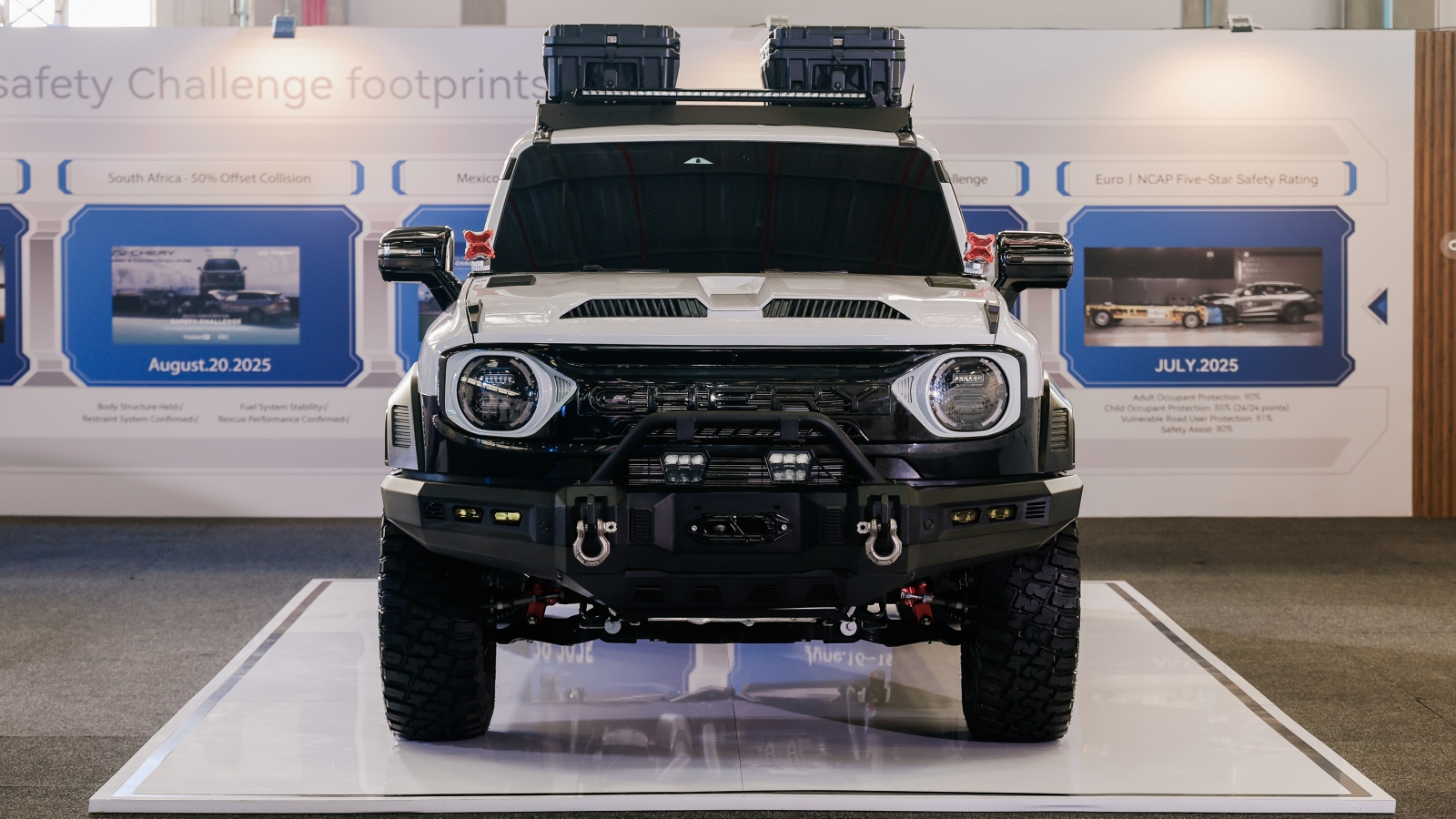
Chery also previewed the KP31 diesel-hybrid bakkie (known in Australia as the Stockman).
The bakkie was initially announced with a plug-in hybrid (PHEV) powertrain, combining a 2.5-litre turbocharged diesel engine with an electric motor.
This includes Vehicle-to-Load (V2L) external power supply functionality, which will allow it to power camping equipment, tools and other external devices.
In Australia, a market remarkably similar to our own, the KP31 will also be available with a 2.0-litre turbo-petrol PHEV powertrain, though it remains to be seen if South Africa will receive this option.
According to CarNewsChina, the diesel model produces 210kW and 650Nm, powered by a 34kWh battery, which provides an electric driving range of 170km.
The bakkie is expected to feature a low-range transfer case and lockable differentials at the front, centre, and rear, as well as a towing capacity of 3,500 kg and a maximum payload capacity of 1,000kg.




 Loading ...