


Japanese automotive giant and South Africa’s favourite carmaker, Toyota, is looking to revise the prices of its model line-up as it hopes to recover from higher production costs and a more expensive global trading environment.
This was confirmed by the manufacturer’s Chief Accounting Officer, Takanori Azuma, following the release of Toyota’s first-quarter financial results for the year ending March 2027.
According to the report, Toyota faced several headwinds during the first quarter, including significantly higher material costs for RAM and aluminium, and higher shipping costs due to the Middle East conflict.
During a post-presentation Q&A, Azuma was asked about the balance between material costs and pricing for the fiscal year and how the manufacturer intends to respond through its pricing strategy.
“The impact of higher material costs, including measures to strengthen our supplier base, is approximately 1.3 trillion yen (R132 billion),” he said.
“The impact attributable to higher material costs alone is approximately 1.2 trillion yen (R122 billion), and we would like to recover roughly half of that through price revisions.”
According to Azuma, Toyota intends to recover around half of this through price revisions, which will impact its buyers worldwide, including South Africa.
“We do not intend to pass these costs on to customers all at once. Rather, we will continue to carefully consider both the timing and the level of price revisions,” he clarified.
“Since the effects of price revisions also carry over into the following year, we will closely monitor their effectiveness and respond accordingly.”
Despite its plan to pass some of its recovery efforts on to customers, Toyota is focused on its internal discipline to maintain its earning power.
“Even in the face of external factors, we are carrying out company-wide initiatives to overcome them through our own efforts,” confirmed Azuma.
“We are advancing cost reduction activities, carefully reviewing capital expenditures, and placing considerable emphasis on cost discipline, which is also a key topic of discussion at our executive meetings.”
New energy vehicles carry Toyota’s first quarter performance
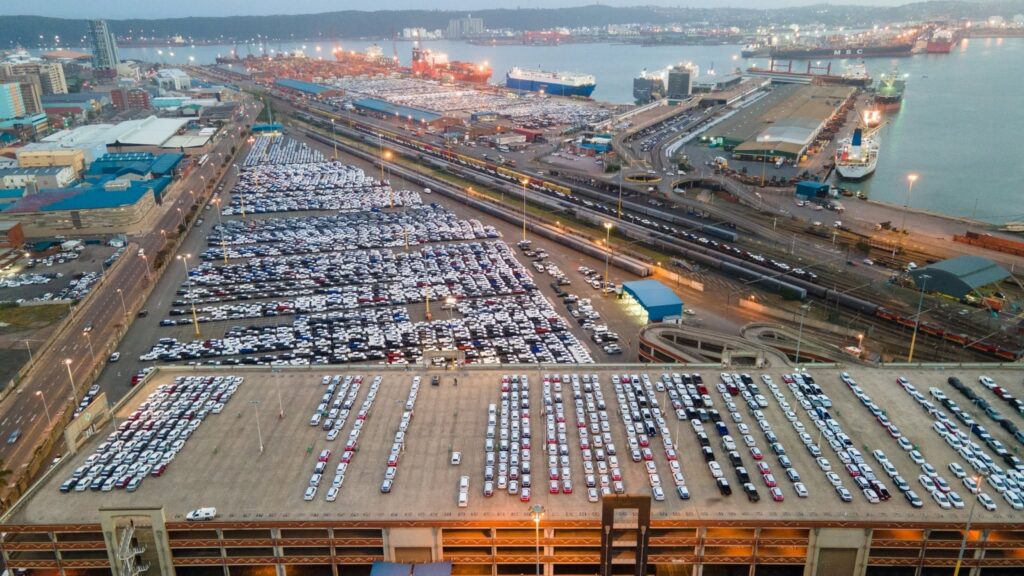
One of the Japanese giant’s biggest setbacks was the shipping disruptions in the Middle East, which forced its vessels around Cape Town and doubled lead times.
“Exports to the Middle East normally amount to approximately 500,000 vehicles annually. We had initially expected the volume impact to be approximately -50%,” said Azuma.
“However, through initiatives such as diversifying logistics routes, we now expect the impact to be limited to around -25% from September onward.”
He further elaborated on how expanding logistics channels helped restore shipping capacity, saying that because shipping via the Cape doubles lead times, the company initially assumed that around half of exports would be affected.
“We have continued exporting through alternative ports and have expanded our logistics routes,” explained Azuma.
“As a result, whereas we had initially assumed transportation capacity would remain at 50%, we now expect it to recover to approximately 75% from September onward.”
Despite these challenges, Toyota still recorded growth in the first quarter of the financial year and reported a respectable financial performance, thanks to the growth of its new energy vehicle (NEV) portfolio.
The manufacturer’s consolidated vehicle sales decreased slightly year-on-year, dropping by 0.7% due to the conflict in the Middle East and the exclusion of 70 companies under the Hino badge.
Looking at the brand’s electrified vehicle portfolio, Toyota fared considerably better in the first quarter of 2026 than the same period last year.
Sales of electrified vehicles continued to expand, increasing 12.4% to 1.41 million in the first quarter, representing 55.3% of all Toyota and Lexus sales, up from 47.4% in the previous year.
Hybrid electric vehicles (HEVs) increased by 6.7% year-on-year to 1.24 million units, battery electric vehicles (BEVs) surged 241.1% to over 114,000 units, and plug-in hybrids (PHEVs) surpassed 58,000 units with 24.5% growth.





 Loading ...
-2026.10.webp)



-2026.10.webp)