
South African annual inflation eased more than expected in July, hardening the argument for the central bank to keep interest rates on hold as it assesses the fallout from the Iran war.
Consumer prices rose 4.3% compared with 5% in June, Pretoria-based Statistics South Africa said in a statement on its website Wednesday.
That was slower than the median estimate of 4.5% in a Bloomberg survey of 18 economists. Month-on-month inflation rose 0.2%, compared with 0.7% in June.
The rand extended its gain to trade 0.5% stronger at R16.1874 per dollar by 10:31 a.m. in Johannesburg.
“It’s a good number,” said Gina Schoeman, Citigroup Inc.’s South Africa economist.
“Our view is for one more 25 basis-point hike in September, determined by data and underlying inflation, or unchanged at higher for longer.”
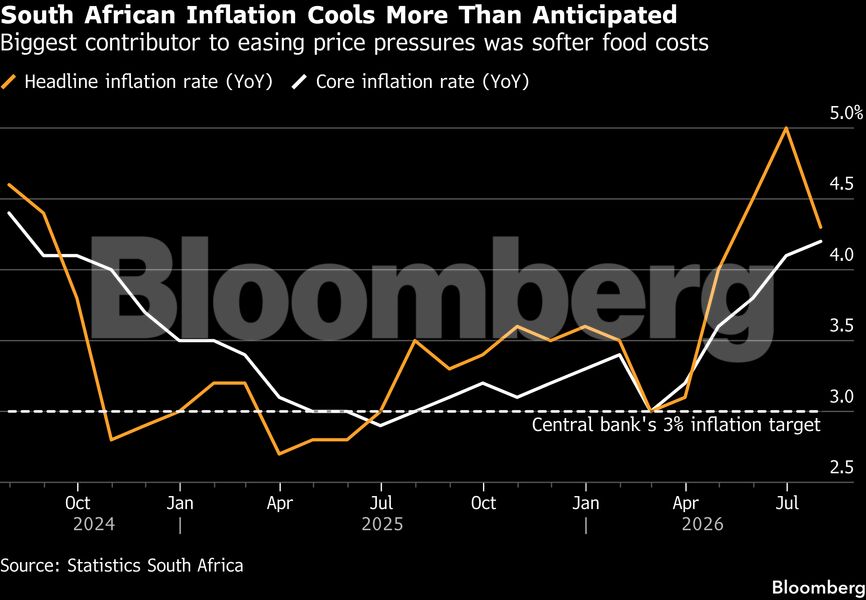
The July inflation report coincided with a decrease in South African petrol prices as the cost of crude oil retreated from highs reached during the early stages of the Middle East conflict, although it remained volatile.
The South African Reserve Bank held interest rates at 7% last month, citing an improved outlook for inflation and confidence that price pressures would return to its 3% target.
It raised rates in May and said that move meant it could be patient while gauging the outlook. The SARB will announce its next policy decision following the conclusion of its meeting on 23 September.
Core inflation, which excludes food, non-alcoholic beverages and energy for a clearer read on underlying price trends, accelerated slightly to 4.2% at an annual rate compared with 4.1% in June, while edging down to 0.5% month-on-month from 0.6%.
According to Investec’s chief economist, Annabel Bishop, fuel price inflation is up 20.6% year-on-year in South Africa, and motorists are paying over R4 more per litre for petrol.
She added that July’s Consumer Price Index (CPI) inflation dropped to 4.3% YoY, down from June’s 5.0% YoY, on a R1.96 per litre petrol price cut, which moderated the inflation outcome by -0.4%.
The impact on diesel is even worse, with prices rising by R5.40 per litre YoY. Bishop explained that, without fuel prices, CPI inflation would only be 3.7% YoY.




 Loading ...