
Ramaphosa wants high-speed trains – South Africa had them 35 years ago


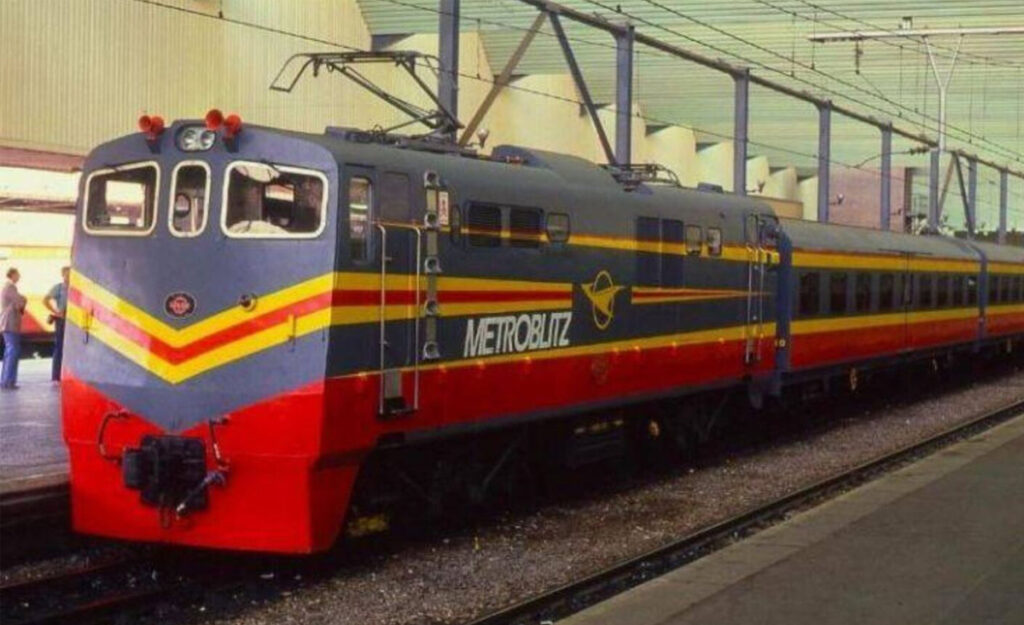
South Africa had a high-speed rail service 35 years before President Cyril Ramaphosa announced his desire to establish a bullet train network in 2019.
Decades ago, South Africa had the MetroBlitz, an experimental narrow-gauge high-speed train that could approach speeds of nearly 250km/h.
During a test run in 1978, the MetroBlitz achieved a top speed of 245km/h, setting a world record for narrow-gauge trains that stands to this day.
The experimental train project began in the 1970s when Herbert Scheffel of the South African Railways, experimented with self-steering bogies (trucks), which paved the way for a high-speed rail service, according to MyBroadband.
The world record was set by one of the Series 4 locomotives – E1525 – which was modified for experiments in high-speed traction.
It achieved the record while hauling a modified suburban coach on a railway between Midway and Westonaria in Gauteng.
Not long after, Union Carriage & Wagon created the 3kV DC Class 12E electric passenger locomotive in Nigel, Transvaal, for South African Railways.
Based on a single-cab version of the Class 6E1 Series 10 locomotive, the new train was designed to haul the MetroBlitz.
Union & Wagon delivered five of the Class 12E locomotives in 1983, each equipped with AEI-283AY traction motives.
The Class 12E hauled specially designed suburban passenger coaches, which rode on air-sprung high-speed Scheffel bogies and used disc brakes.
The MetroBlitz officially entered service in January 1984 with two locomotives per train – one at each end.
It replaced the Jacaranda Express, a commuter service that could cover the 70km route from Pretoria to Johannesburg in roughly an hour. The MetroBlitz did the same in just 42 minutes.
Each coach was air conditioned and fitted with 60 aircraft-type seats in chequered red and grey material, and the floor was covered in plush red carpeting, according to Transportation History.
Railroad writer Bruno Martin, who rode on the train on its first day of operations, described the ride above 160km/h to be extremely smooth and quiet with very little jolting over the points.
A short-lived success

Unfortunately, the project was short-lived, as it failed after a single year of regular service.
One key issue came down to logistics, as the MetroBlitz had to share lines with much slower commuter and freight trains.
These trains were sidelined to allow the MetroBlitz to pass at its much higher speed, but this led to major scheduling issues for Gauteng’s rail network.
The ‘bullet train’ also required significant investments in new infrastructure to support it, something the government was reluctant to commit to.
Cost was another issue, as ticket sales were unable to offset the MetroBlitz’ high operating costs, especially during off-peak hours.
South Africa’s new bullet train ambitions
Ramaphosa reiterated his promise to establish a high-speed rail network during his 2026 State of the Nation Address on Thursday, 12 February.
“We continue preparations for the introduction of high-speed rail in South Africa,” he said.
“I’ve been saying that we would like this to cover, initially, routes such as Johannesburg and Musina, and eThekwini to Johannesburg.”
He remarked that bullet trains would greatly cut down on travel times between South Africa’s major cities.
“It should no longer take five or six hours to travel from eThekwini to Johannesburg, four and a half hours from Johannesburg to Musina, when it can be done in a much shorter space of time,” he said.
The president added that the government is making good progress on this goal, as 30 companies have expressed interest in participating in the creation of South Africa’s high-speed rail corridors.
Ramaphosa said that the government is preparing to send out a Request for Proposals to build a high-speed rail network.
The Gauteng and Limpopo provincial governments are already in talks to establish a new bullet train service that will run from Pretoria through Polokwane to Musina.
In mid-2025, the two parties announced that it had made progress preparing the chosen route for construction, and that it was conducting environmental impact assessments and feasibility studies.
However, one concern is land acquisition, as the project’s leaders will need to negotiate with landowners and communities along the planned route.




 Loading ...

-facelift-2-2025.10.webp)
