


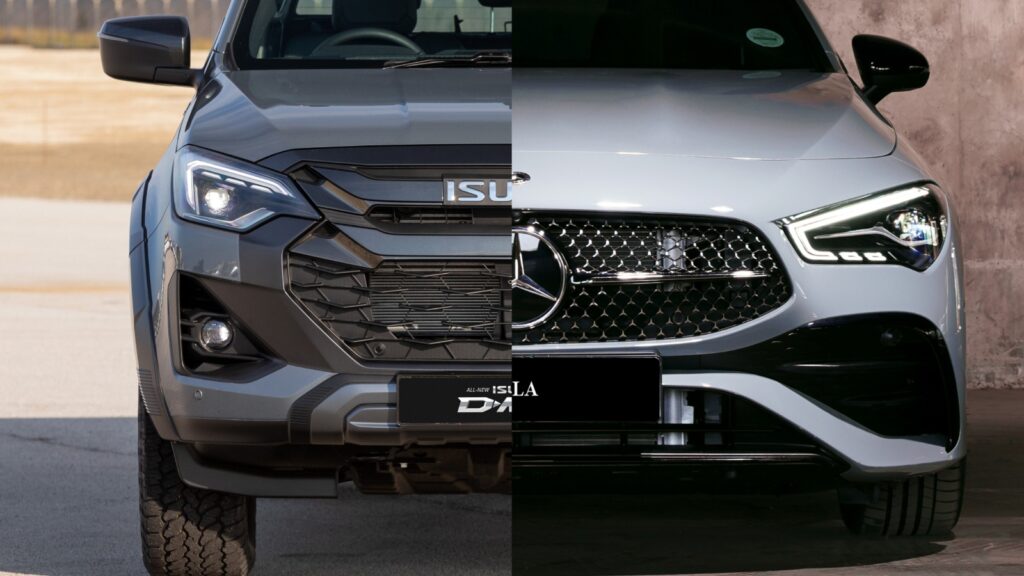
Double-cab bakkies have become one of the most aspirational purchases for motorists, with names like Toyota, Ford, and Isuzu now being considered status brands in South Africa.
This is according to Cars.co.za’s annual industry report for 2026, which identified trends in consumer perception and buying habits within the local auto sector.
It tracked various brands and ranked them on a graph based on their perceived reliability, utility, and prestige among South African car buyers.
The findings showed that Ford, Isuzu, and Toyota are highly rated within the “status + practicality” niche with a prestige ranking comparable to that of luxury German brands like Audi, BMW, or Mercedes-Benz.
It noted that the bakkie segment continues to reinvent itself in response to changing consumer expectations and the rise of new competitors, and that legacy workhorse brands like Toyota are now viewed as status symbols due to the desirability of bakkies and rugged SUVs.
The double-cab category, in particular, has seen an uptick in demand for premium models like the Ford Ranger Wildtrak and Raptor, the Toyota Hilux Raider and Legend, the Isuzu D-Max X-Rider, and the VW Amarok.
Charl Potgieter, Managing Executive at Absa Vehicle and Asset Finance (AVAF), said that the bakkie market is becoming more premium, more double-cab led, and increasingly influenced by new challengers.
He explained that the collapse of the half-tonne bakkie segment has made double-cabs the default configuration for buyers in South Africa.
It was also noted that the traditional “Big Four” bakkie brands (Toyota, Ford, Isuzu, and Nissan) are under pressure from new Chinese competitors, forcing them to adapt their market strategies by focusing more on their premium models.
Chinese penetration into the pickup segment is still relatively low compared to other body types; however, it is growing fast.
GWM is slowly becoming a major player with a 6.5% share of the market, while JAC and Foton are emerging brands. The combined market share of the Big Four brands fell from 84% to 75% over a three-year period.
The plug-in hybrid BYD Shark stood out as one of the fastest-growing bakkies on Cars.co.za, posting a 130% lead-share growth in the R700,000 to R1 million bracket.
This indicates that premium models with new-energy powertrains have seen a massive uptick in interest over the last year, likely driven in part by rising petrol and diesel costs resulting from the war in the Middle East.
Single cabs still make up the majority of bakkie purchases in South Africa; however, these are mainly purchased by commercial users and are not reflective of the buying habits of private motorists.
Redefining the automotive status symbol in South Africa

The report goes on to talk about the redefinition of the automotive status symbol in South Africa, highlighting that German cars have seen a massive drop in desirability over the last decade.
In 2016, 83.73% of inquiries on Cars.co.za for vehicles in the R700,000 to R1 million bracket were for German cars. A decade later, and this figure has dropped to 63.91%.
The largest drop occurred during the COVID-19 years in 2020 and 2021, falling to 59.37%, and rebounded to 68.04% in 2022. A similar trend is seen in the R1 million to R1.4 million bracket.
However, the last four years have seen a more gradual decline, which is attributed to market caution and affordability pressures, as well as the rise of the flagship lifestyle double-cab bakkie.
German brands like BMW clearly still hold sway in South Africa, but at the same time, it is evident that motorists are starting to look at other options.
The main non-German recipient of BMW customer inquiries on the platform was for American cars, which in a South African context, almost certainly refers to Ford.
Interestingly, among Mercedes-Benz shoppers, the main alternative wasn’t American brands but Japanese ones, most likely Toyota.
Affordability is one of the main reasons for this shift, as mid-range German cars like the BMW 3 Series or Mercedes-Benz C-Class can now fetch prices over R1 million.
For the same money, you can now get a top-of-the-range high-rider with features previously associated with ultra-luxurious models like a 7 Series.
Flagship bakkies like the Hilux Legend or Ranger Wildtrak now come with heated and ventilated leather seats, large infotainment screens, premium sound systems, and a full Advanced Driver Assistance System (ADAS) suite with functions like adaptive cruise control, blind-spot detection, lane-keep assist, and a 360-degree camera system.
The fact that you can get all of these nice-to-haves on a vehicle that is generally seen to be more practical and better-suited to South African road conditions means that the appeal of German sedans and SUVs is slowly being diminished.




 Loading ...
Conversation
4 commentsA body on frame vehicle will never handle as well as a unibody. This SUV trend only proves that people see driving as a chore. The mundane means of getting from A to B and no more.
I want a car that is stylish, a tad unique, above average power to weight ratio and design attention devoted to handling.