
The R1,900 difference between filling your car with petrol vs gas


South African motorists willing to convert their cars to run on Liquefied Petroleum Gas (LP Autogas) could save R1,877.63 per month by refuelling with the petrol alternative instead.
LP Autogas, or LPG, comprises hydrocarbon compounds like petrol and diesel, but its main components are propane and butane.
These are released when extracting oil and natural gas and refining crude oil, so compressing them converts them to a liquid state and creates LPG, which is cleaner and cheaper than petrol and diesel
That said, those motorists looking to benefit from the alternative fuel will need to convert their car to run on LPG – which requires significant investment.
Another consideration is that a litre of gas has less chemical energy than a litre of liquid, meaning an engine needs more fuel to produce similar power.
A converted vehicle will see increased fuel consumption of 15% to 25% on LPG compared to petrol. For example, a car consuming 7.5l/100km on petrol will typically consume 8.8 to 9.4l/100km on LPG.
Despite this higher average fuel consumption, LP Autogas delivers substantial savings, especially for South African motorists, due to the country’s various fuel taxes.
Retail petrol prices in South Africa carry substantial levies, including the General Fuel Levy (GFL), Road Accident Fund (RAF) levy, and customs and excise surcharges.
Autogas is exempt from several of these transport-specific fuel surcharges, making it significantly cheaper per litre at the pump.
As a result, LP Autogas typically sells for 30% to 40% less per litre than retail petrol, but thanks to current sky-high petrol and diesel prices, that is closer to 50%.
Factoring in the 20% higher volumetric fuel burn, the net cost per kilometre driven on LPG is 20% and 30% less than on petrol, representing substantial savings for local motorists.
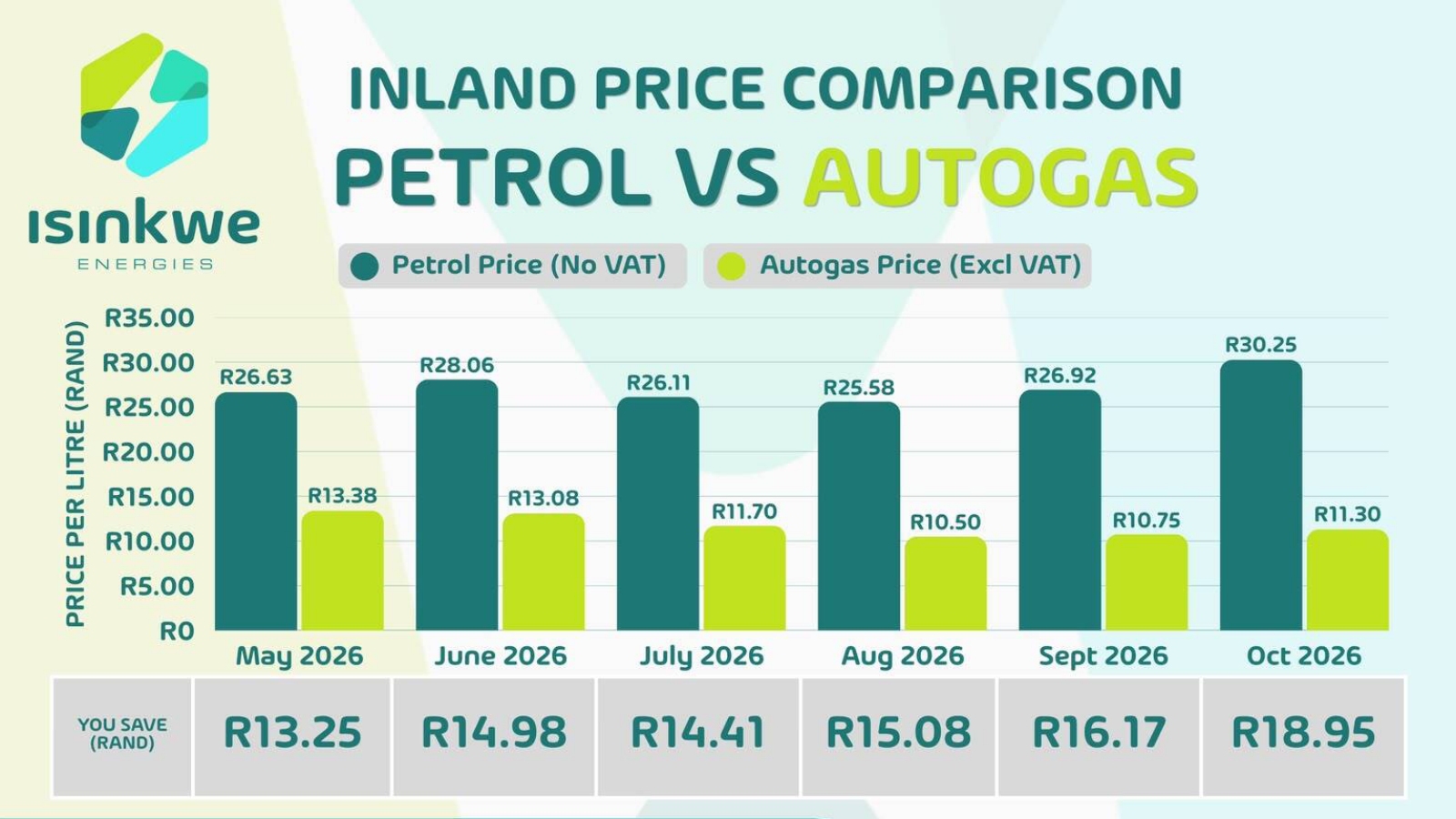
Below is a breakdown of inland petrol vs LP Autogas prices in South Africa over the past six months, provided by local automotive fuel conversion solutions provider, Isinkwe Energies:
Saving over R20,000 per year
The average passenger car LP Autogas tank has a gross capacity of 45 to 65 litres, though the exact size depends on the tank geometry and the car’s available space.
The standard “doughnut” shaped tanks are installed in the spare-wheel well beneath the boot floor and have a gross capacity of between 40 and 60 litres.
Larger cylindrical tanks can also be mounted against the back of the rear seats in the boot or along the chassis rails of bakkies or other light commercial vehicles, and offer expanded capacity up to 90 litres.
International safety regulations also require LPG tanks to be fitted with an automatic Overfill Prevention Device (OPD) that stops filling at 80% capacity.
Below is a breakdown of how this affects LPG car fuel capacity:
| Tank style | Gross volume | Usable fuel (at 80%) | Typical driving range |
| Compact | 42l | 33.5l | 300 – 380km |
| Standard | 55l | 44l | 400 – 500km |
| Cylindrical | 75l | 60l | 550 – 700km |
Considering this, the average South African motorist driving 1,500km per month on LP Autogas can expect to refuel two to three times a month depending on their vehicle and tank choice.
A motorist driving a petrol vehicle consuming 7.5l/100km over 1,500km per month uses 112.5 litres of Unleaded 95. At an inland price of R30.25 per litre, this results in a monthly fuel bill of R3,403.13.
Switching to LP Autogas increases fuel consumption by 20% to 9.0l/100km, requiring 135 litres of gas to cover the same distance.
However, at R11.30 per litre, monthly LPG spend drops to R1,525.50 – an immediate monthly saving of R1,877.63.
Below is a breakdown of what these savings figures look like over 12 months, provided petrol and LPG prices remain unchanged:
| Metric (1,500 km/month) | Inland 95 | Inland LP Autogas | Difference |
| Fuel Consumption | 7.5l/100 km | 9.0l/100km | +1.5l/100 km |
| Fuel Required | 112.5l | 135.0l | +22.5l |
| Price per Litre | R30.25 | R11.30 | -R18.95/l |
| Running Cost per km | R2.27/km | R1.02/km | -R1.25/km |
| Monthly Fuel Spend | R3,403.13 | R1,525.50 | -R1,877.63 |
| Annual Fuel Spend | R40,837.50 | R18,306.00 | -R22,531.50 |
Depending on what type of LPG conversion a motorist opts for, the more than R20,000 cost savings could cover the cost of conversion within 12 months.




 Loading ...



Conversation
9 commentsI had a colleague who drove an LPG converted car in the UK. This was back around 2005 and he was driving an LPG converted late 1990s Vauxhall Astra (like the Opel Kadett in SA). At the time LPG was around half of the price of unleaded petrol in the UK. I can answer some questions and make some comments about the pros and cons of LPG vehicles based on my colleague’s experience.
@Sipho Mhaga you asked about the original fuel tank. The answer isthe original fuel tank remains in place. These vehicles are dual fuel – petrol and LPG. My colleague needed to start his car using ordinary unleaded fuel and then switched over to gas once the engine had warmed up a little.
@Kobus de Kock LPG is considered more hazardous than unleaded and diesel and it carrying a fire extinguisher was mandatory. LPG has about 20% lower energy density. If your vehicle uses 10l/100km on unleaded, it would use 12l/100km on LPG. The LPG tanks are also fairly small. My colleague had a circa 50 mile (80km) journey to work each way. He needed to fill up his LPG tank every 2-3 days. When he crunched the numbers his fuel costs were the equivalent of him getting almost 60MPG (4.7l/100km). My diesel (2002 Skoda Octavia 1.9TDI) did 50-55MPG or roughly 5.4l/100km and I needed to fill up once per week. So you either need an LPG around the corner or on your house to work route, otherwise you are wasting more time/fuel to fill up. One problem in SA is my nearest LPG pump is 8km from my house in an area I don’t normally travel to, so I would need to drive out of my way to get there. My colleague’s car was slightly slower to accellerate on gas. The advantage of gas is it has a much higher octance rating than unleaded and it burns cleaner. This means LPG cars won’t get pre-combustion or engine knocking and they have less internal carbon build-up.
IMO an LPG conversion makes sense if your vehicle has a simple large normally aspirated engine. Say something like an old Volvo with the 3.2l inline 6 or the 4.4l V8. You would save a fortune in fuel costs as long as you drive a reasonable distance to work in 1 trip. LPG isn’t as good for short school runs in town because you start it with unleaded and switch to gas when warm. Just make sure you have a nearby LPG pump or en-route to work and budget extra time each week for refuelling more than usual.