The times your car is most likely to be hijacked in South Africa


According to vehicle tracking and recovery company Tracker, South Africans are most likely to be hijacked between 16:00 and midnight on Fridays.
This was revealed in the company’s latest vehicle crime statistics for January to June 2026, which show that business-owned vehicles remain at greater risk of vehicle crime.
Tracker found that business vehicles are 17% more likely to be targeted than personally owned vehicles, down from 48% a year ago.
Business vehicles are also almost twice as likely to be hijacked as stolen, with this trend even more pronounced in provinces like the Eastern Cape and Mpumalanga.
Business hijackings are nearly five times more prevalent than thefts, while in Mpumalanga they are more than eight times as prevalent.
In contrast, personal vehicles are more likely to be stolen than hijacked nationally, with theft accounting for 55% of incidents compared to 45% for hijackings.
Gauteng and KwaZulu-Natal combined account for 80% of all vehicle crime incidents, but in hotspots like the Eastern Cape hijackings are twice as prevalent as thefts, while in the Western Cape they exceed thefts by 42%.
Most vehicle-related crimes are reported on weekends, with thefts most common on Saturdays between 11:00 and 21:00 and Fridays from 16:00 to 21:00, and hijackings most common on Friday evenings.
Tracker added that a slightly different pattern emerges when focusing on business hijackings, since incidents most commonly occur on weekday afternoons and evenings, between 16:00 and 21:00.
“The data shows that vehicle crime continues to evolve, which means motorists and businesses need to evolve their response too,” said Duma Ngcobo, Chief Operating Officer (COO) at Tracker.
“Understanding where, when and how these crimes occur is one of the most effective ways to reduce risk. For businesses, the impact of vehicle crime extends far beyond the loss of a vehicle.”
He explained that downtime, service disruptions and lost revenue often represent a far greater cost, making prevention, driver safety and rapid recovery critical to business continuity.
To date, Tracker recovered 142,253 vehicles, assisted in 21,461 arrests and helped recover 1,154 firearms, holding a 96% industry recovery rate for the last financial year.
Motorists are less at risk than 30 years ago
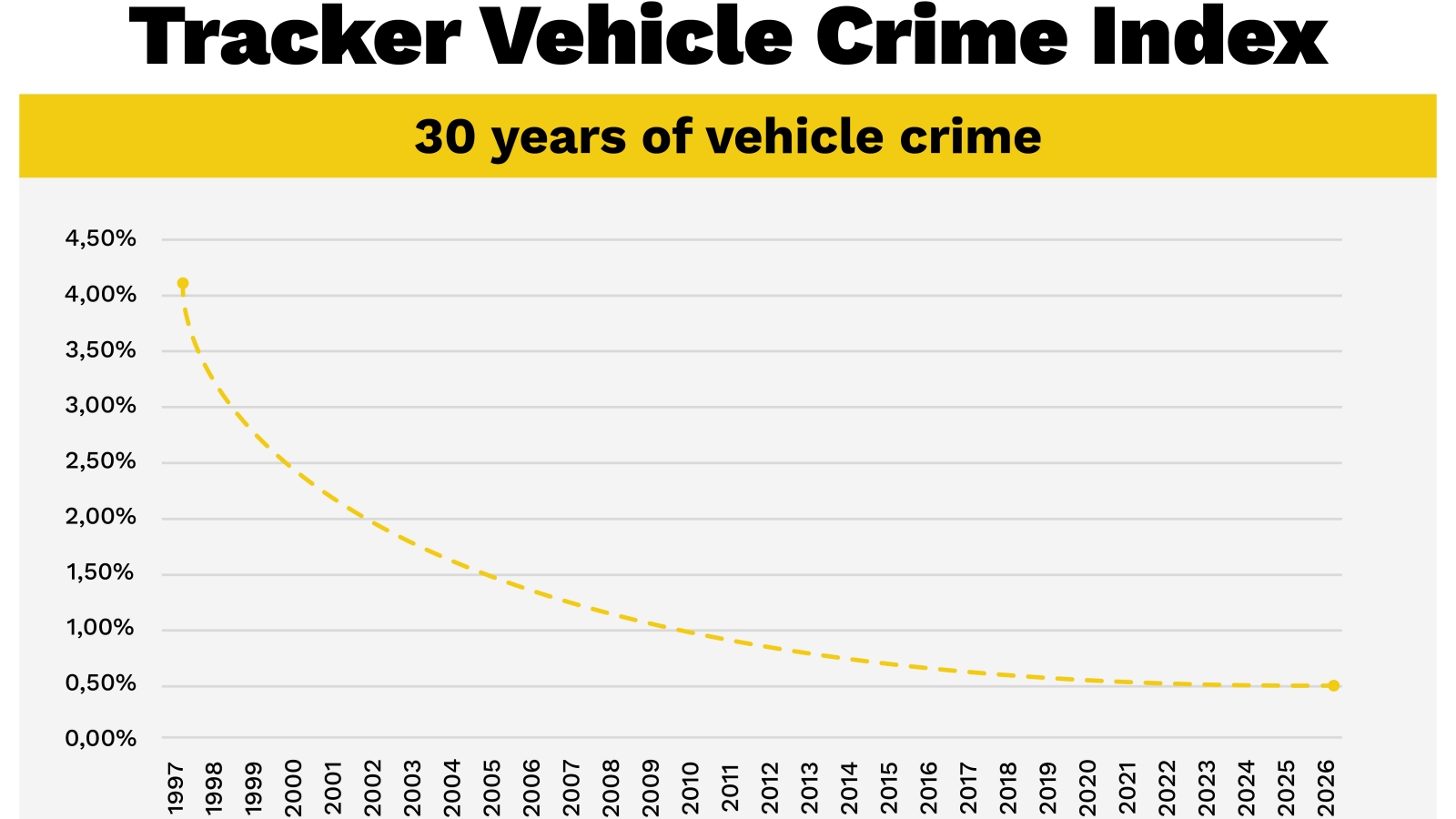
Tracker explained that while vehicle crime remains a reality in South Africa, the risks motorists face today are significantly lower than three decades ago.
Reviewing the company’s historical vehicle crime data revealed that the proportion of Tracker customers affected by vehicle theft and hijacking declined from around 4% in the late 1990s to 0.5%.
It attributed the rate to several industry shifts that fundamentally changed the vehicle tracking market, including the 1990s free-fitment model and insurers offering discounts for vehicles fitted with trackers.
Other notable industry developments included the connected vehicle and the rise of telematics data in the mid- to late-2000s.
These were followed by using data to develop driver-behaviour insights, usage-based insurance models and safety incentive programmes.
Tracker noted that by the 2020s, connectivity and data were being leveraged at scale, with greater focus on managing fleet operations and providing ancillary services through telematics.
“As a pioneer in the South African vehicle tracking and recovery market, established in response to South Africa’s soaring post-apartheid vehicle crime crisis, Tracker has played an active role in the industry’s evolution, helping develop the technologies, partnerships and insights that have reduced vehicle crime risk over the past 30 years,” said Ngcobo.
“Over that time, our role has also expanded beyond recovering stolen vehicles. While vehicle recovery remains at the heart of what we do, we’ve become a trusted source of data-driven insights that help motorists, businesses, insurers and fleet operators better understand risk, improve safety and make more informed decisions.”



 Loading ...