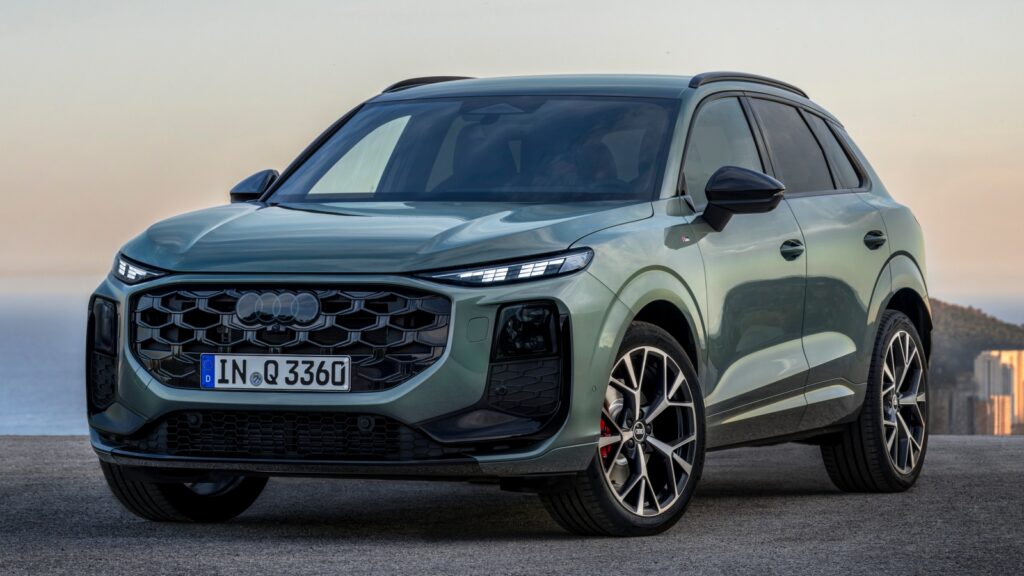
Audi’s popularity has plummeted in South Africa, with sales decreasing by 76% over the last 12 years.
While still widely considered to be a leading luxury brand, Audi’s sales have dramatically declined due to the country’s weak economic growth and the rise of new Chinese competitors.
The German carmaker’s history in South Africa dates back to 1968, when local distributors began selling the Audi 100.
Audi’s operations in South Africa were expanded in the 1980s when the automaker, a member of the Volkswagen Group, began manufacturing the Audi 80 and 100 at VW’s factory in Uitenhage (now Kariega) in the Eastern Cape.
The brand quickly established a reputation for luxurious and high-performance models, with the Audi Quattro proving to be a tour de force in the South African Rally Championship.
Owning the Four Rings soon became an aspirational purchase for many households. Like other German brands, Audi became a status symbol that showed others you had made it in life.
The Audi Quattro, in particular, became one of the hottest items on the South African market, selling over 60,000 units since its launch in the 1970s.
Today, Audi is a wholly owned subsidiary of the Volkswagen Group and operates alongside other brands such as Lamborghini, Porsche, SEAT, Cupra, and Ducati.
In South Africa, Audi falls under Volkswagen Group Africa (VWGA), which includes Audi, VW Passenger Cars, and VW Commercial Vehicles.
VWGA is itself a wholly owned subsidiary of Volkswagen Aktiengesellschaft (VWAG), based in Wolfsburg in Germany.
The carmaker’s local division represents the largest German investment in South Africa and is a major contributor to the South African economy in the form of direct foreign investment, sales, technology transfer, and skills development, according to Daily Investor.
Audi facing tough times in South Africa

Audi expanded its line-up following the 1994 democratic elections, which eased trade restrictions against South Africa.
It launched the A4 and A6, two luxurious sedans that competed against models such as the BMW 3 Series and 5 Series, and the Mercedes-Benz C-Class and E-Class, respectively.
It continued to diversify its catalogue in the 2000s with models like the Q7, marking the brand’s entry to the SUV segment.
Audi’s sales in South Africa peaked in the early 2010s, reaching up to 18,375 sales in 2014 and putting the brand on par with other premium badges like BMW, Mercedes, and Volvo.
However, the carmaker’s sales have plummeted over the last 12 years, chiefly due to South Africa’s stagnant economy.
Weak economic growth meant that consumer spending became more constrained, forcing a market shift towards more affordable brands.
While Audi’s sales have fallen, mass-market nameplates like Suzuki and Mahindra have seen a surge in interest in recent years, particularly after the Covid-19 pandemic.
Exacerbating this shift is the arrival of several new Chinese car brands, many of which offer cars that compete with Audi at significantly lower prices.
For example, Omoda, which is a premium brand under the Chery Group, sells the C9 SUV, which competes against models such as the Audi Q5, BMW X3, and Mercedes-Benz GLC.
The C9 starts at R785,900, while the cheapest Q5 asks for R1,275,000, making it R489,100 more expensive than an equivalent Chinese option.
This stark price gap is one of the main reasons why Chinese cars have taken off in South Africa.
According to Naamsa’s latest sales statistics for October 2026, GWM sold 2,919 units while Chery sold 2,754.
Jetour and Omoda & Jaecoo, two brands under the Chery banner, sold 2,102 and 1,201 units, respectively.
While Audi does not publicly disclose individual sales and its total sales are added to VWGA’s total, industry data indicates that it sells around 450 units per month.
This marks a 76% decline from 12 years ago, which is on par with Mercedes-Benz’s decline of 81%, but noticeably higher than BMW’s, which dropped by 50%.



 Loading ...