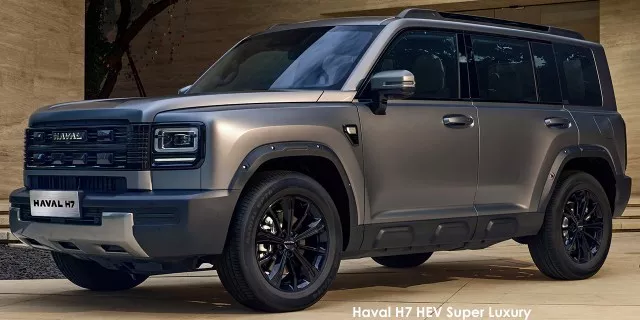
New Chinese SUV that will be built in South Africa unveiled


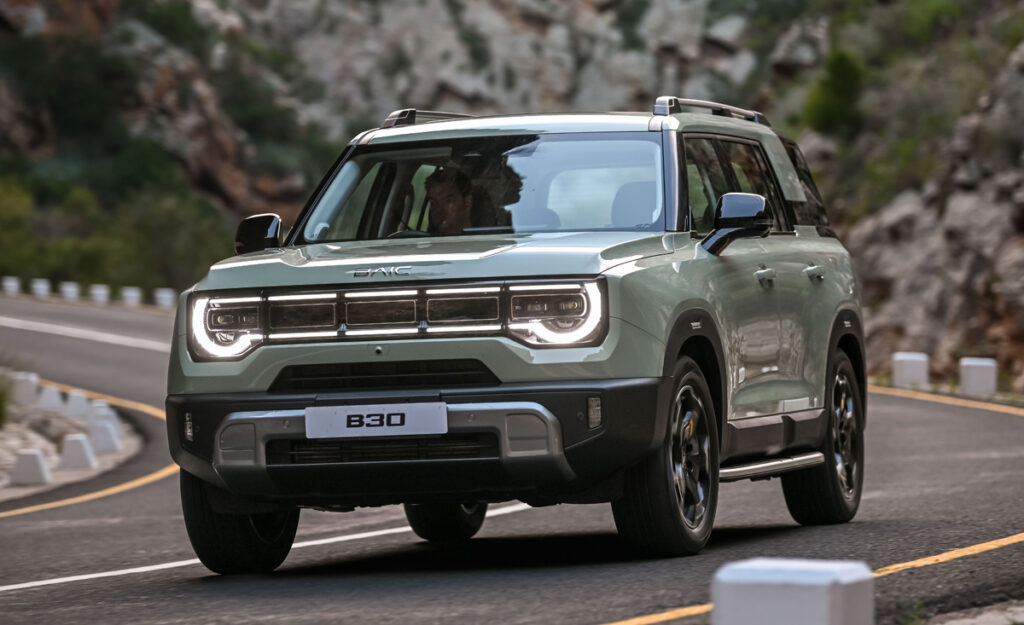
The BAIC B30 is a new Chinese SUV that will be built in South Africa.
It may come as a surprise to some to learn that BAIC has an R11-billion factory in the Coega Special Economic Zone on the outskirts of Gqeberha.
This site currently manufacturers two vehicles – the B40 Plus SUV and the Beijing X55 crossover – but this list will soon be expanded with the addition of the B30.
The B30 is an off-road SUV that is scheduled to launch in South Africa this November, with local production to begin shortly thereafter.
“In line with BAIC’s global “Build Where We Sell” philosophy, the localisation of the B30 strengthens the brand’s supply-chain resilience, reduces import dependency, and opens opportunities for future component sourcing through South African suppliers, said the company.
“Our Coega facility was built to support long-term growth, and the addition of the B30 underscores our confidence in this market and our intention to become a truly local brand.”
Luckily, BAIC has already published the specs for the new model, including its indicative pricing, which states that the entry-level units will start at around R550,000, while the flagship will fetch approximately R700,000.
The carmaker is also running a pre-order programme until 7 November where early adopters will receive:
- Deposit Expansion: A R5,000 deposit secures a R25,000 deduction on the vehicle price if the purchase is finalised within 15 days of launch.
- Trade-In Bonus: Existing BAIC owners receive an extra R10,000 trade-in allowance.
- Launch Experience Lucky Draw: Ten pre-order customers will win an all-expenses-paid trip to Johannesburg to attend the official nationwide launch event in November.
With all that in mind, this is what South Africans will receive later this month.
Performance

The B30 is built on a modular platform and will feature both an internal combustion engine (ICE) and a hybrid electric vehicle (HEV) powertrain.
The first two trim levels, the LV2 and LV3, are fitted with a 1.5-litre turbocharged petrol engine with 138kW and 305Nm.
Gear changes are handled by a seven-speed dual-clutch automatic shifter, which sends power to the front wheels.
Next is the LV4 HEV, which combines the 1.5-litre turbo-petrol engine with an electric motor to produce 180kW (the torque stat has not yet been published).
Last but certainly not least is the LV5 HEV – the flagship of the range – which has all-wheel-drive with a Terrain Management System.
It also has significantly more power than the others, generating an impressive 301kW and 685Nm.
BAIC also claims that the HEV achieves an average fuel consumption of 5.8l/100km.
Features

The B30’s full specification list will only be revealed at launch, but BAIC has provided a list of highlights consumers can look forward to.
Like most 4×4 SUVs released over the last two years, the B30 has a fairly tall, boxy shape.
At the front, there’s a distinctive LED headlight and daytime running light signature that spans the width of the grille, and the vehicle is perched on alloy rims that help to give it a ground clearance of 215mm.
Depending on the trim level, the equipment list includes ambient lighting, flat-folding front seats, a panoramic sunroof, a 14.6-inch infotainment screen with smartphone pairing, a digital instrument cluster, a wireless charging pad, voice commands, dual-zone climate control.
From the LV3 onwards, it will also come with an Advanced Driver Assistance System with functions like adaptive cruise control, lane-keep assist, blind spot detection, hill descent control, and a 360-degree camera system.




 Loading ...