New Audi Q6 e-tron under investigation for South Africa – Details


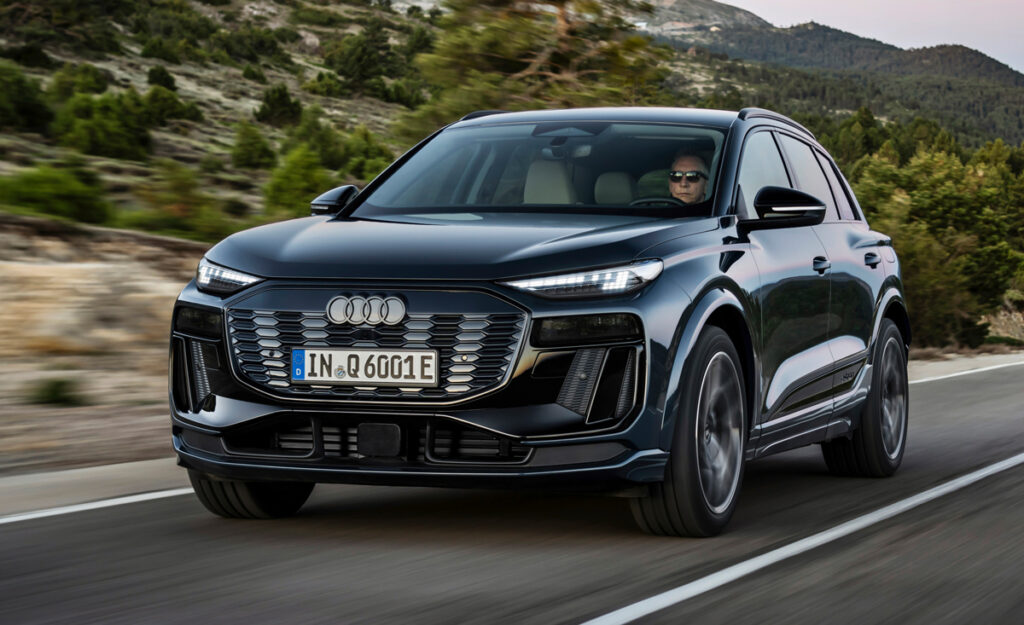
Audi has unveiled its latest electric vehicle (EV) in the form of the Q6 e-tron, which is under investigation for a local introduction anywhere between Q4 2024 and Q1 2025, the German marque confirmed.
The Q6 is the first production model on the automaker’s new Premium Platform Electric (PPE) architecture that was jointly developed with Porsche, signaling the arrival of Audi’s next generation of EVs.
It boasts a refined e-tron design language, new powertrain technologies, and as usual, it is a hotbed of cutting-edge features and abilities.
Two powertrain options
At launch, the new Audi will be available with two powertrain options comprising the standard Q6 which generates 285kW and the SQ6 which puts out a higher 380kW, both of which drive all four wheels through a rear-biased quattro system.
The normal model accelerates to 100km/h in 5.9 seconds and tops out at 210km/h, whereas the SQ6 gets to triple digits in a brisk 4.3 seconds and continues onto a maximum of 230km/h.
Both flavours of the EV are equipped with a 100kWh battery module which affords a maximum driving range of 625km, and can be recharged from 10-80% in around 21 minutes at a 135kW DC plug.
Assisting the Q6’s efficiency is an “advanced” recuperation system that can handle around 95% of everyday braking processes and recover energy at a rate of 220kW.
Later during the SUV’s production cycle, Audi said it will introduce “particularly efficient models with rear-wheel drive designed for range” which will be positioned lower than these quattro variants.

Standing at a length of 4,771mm, a width of 1,993mm, and a height of 1,648mm, the new Q6 sits squarely in the premium mid-size SUV segment, and it boasts a long wheelbase of 2,899mm coupled with short bumper overhangs to give it a sporty look.
At the front, it wears Audi’s hallmark Singleframe octagonal grille in Selenite Silver or Gloss Black, flanked by three-dimensional side air intakes as well as the “world’s first” active digital light signature.
This active digital light signature is created by 12 individual LED segments in the headlights that can dim up and down and provide up to eight configurations for enhanced personalisation.
At the rear, the digital OLED taillights incorporate 360 light segments which generate a new image every 10 milliseconds. For the first time, the taillights can communicate with other road users behind the Q6 using a “communication light” to, for instance, warn them of accidents and breakdown sites on the road.

Like the exterior, Audi has followed a completely new design philosophy in the cabin of the Q6 which is now “orientated towards the needs of the user more than ever,” said the carmaker.
“The three-dimensional and high-contrast design of the interior deliberately places elements in the foreground or background, creating a spatial architecture that is tailored to the occupants in terms of design and ergonomics.”
The passenger cell incorporates a “softwrap” that extends from the doors across the entire cockpit to the centre console to create an enveloping feeling, and the new panoramic display and front passenger screen form a “visually clear digital stage.”
Comfort-focused areas like the armrests and dash are generously sized and wrapped in soft recycled materials, whereas control areas such as the centre console and air vents are in a high-gloss black material.

Standard kit in the new Audi encompasses a curved display on the dash comprising an 11.9-inch instrument cluster and a 14.5-inch infotainment system, ambient lighting, a new self-learning voice assistant that understands over 800 commands, and a 20-speaker Bang & Olufsen Premium sound system.
A 10.9-inch front passenger display with Active Privacy Mode is also included, enabling the front passenger to stream films/video content, assist with navigation, or find a charging station without distracting the driver.
Furthermore, the Q6 is delivered with rear parking assistance, cruise control, lane-departure warning, efficiency assist, active front assist, and a distraction and drowsiness warning system.
It additionally gets the all-new adaptive driving assistant plus, which helps with acceleration, maintaining speed, keeping distance, lane guidance, and improving the vehicle’s handling through high-resolution map data and swarm data from other vehicles aggregated in the cloud.
The EV’s boot then offers 526 litres of storage, expanding to 1,529 litres with the rear seats folded flat, and the front trunk can carry an additional 64 litres of cargo.
Audi Q6 e-tron


Audi SQ6 e-tron





 Loading ...