Congestion charge on the cards for one of South Africa’s biggest cities


The City of Cape Town is thinking of introducing a congestion charge in an attempt to combat the metro’s notorious traffic issues.
Cape Town’s management is currently looking at several measures to address gridlock concerns, reduce emission pollution, and make the central business district (CBD) more friendly to pedestrians and other forms of transport.
The congestion charge is one of the measures highlighted in the city’s draft Travel Demand Management (TDM) Strategy, which outlines a number of regulations, infrastructure improvements, and incentives to influence the travel decisions of commuters.
One of the key goals of the strategy is to reduce road traffic by discouraging private car use while promoting public transport.
“The City is focused on tackling car dependency and mobility habits to enable more sustainable commuting that improves people’s travel time, health, and the climate,” it said in an official statement.
“Our TMD Strategy provides a range of potential measures to influence people’s travel choices by optimising the use of existing transport capacity and infrastructure, and technology.”
In a short video uploaded to social media, Mayoral Committee Member for Urban Mobility Rob Quintas explained that the goal is to make alternate forms of transport more appealing, and to reduce congestion by encouraging people to work remotely or commute outside of peak hours.
Earlier this year, the INRIX Global Traffic Scorecard listed Cape Town as the seventh most congested city in the world, ranking alongside other notorious hubs like New York, London, Los Angeles, and Jakarta.
Cape Town residents lose an average of 94 hours sitting in traffic each year, compared to 55 hours for Johannesburg and 45 hours for Pretoria.
The city’s traffic issues have been exacerbated in recent years by the collapse of the nation’s passenger rail services, and the semigration trend where many South Africans have moved to the Western Cape seeking better service delivery.
As reported by Moneyweb, the TDM Strategy aims to address these concerns using the following measures:
- Public transport priority lanes for buses and minibus taxis
- Dedicated walking and cycling lanes to support active mobility
- Remote or flexible work programmes to reduce peak-hour travel
- Park-and-ride facilities near residential areas, contingent on rail service restoration
- Parking restrictions in the central business district (CBD) and other high-demand areas, while discouraging new parking developments except on the city’s periphery
- Carpooling incentives, including high-occupancy toll lanes that are free or discounted for vehicles with multiple passengers
- A congestion charge, involving fees on vehicles entering high-traffic zones during peak hours, to encourage a shift to public transport or carpooling
The City of Cape Town stressed that implementing a congestion charge would only be done once a reliable public transport system has been established.
Cape Town going carless
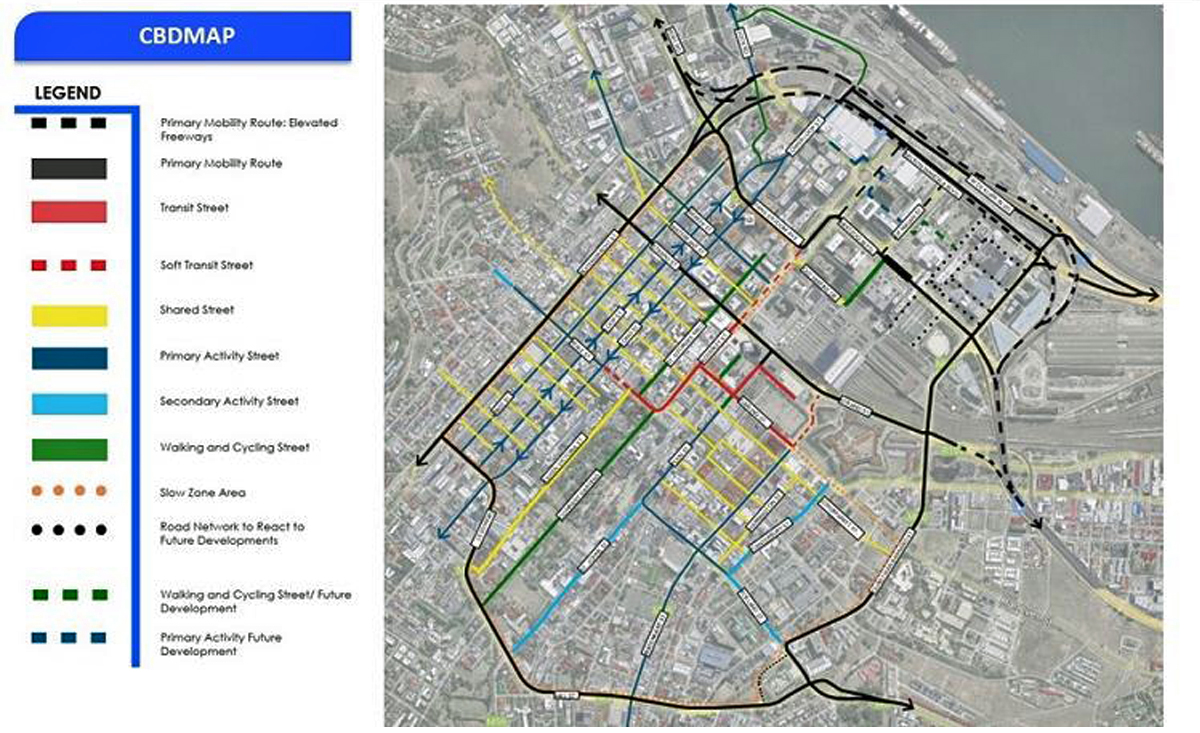
Related to all of this is the Mobility and Access Plan for the Cape Town CBD (CBDMAP), which was first proposed in April.
The proposal aims to replicate the success of cities like Barcelona in Spain, which established car-free zones to create a safe environment for walking and cycling.
To achieve this, the City of Cape Town wants to establish a large decongestion zone in the CBD and divert traffic onto bypass roads.
“[The CBDMAP] proposes some bold interventions to make the CBD more pedestrian friendly and to improve access to and within the area,” said Quintas.
“Ultimately, those who work and live in the CBD, and visitors, must find it easy to get to their destinations and a pleasure to move through the area.”
“The decongestion zone would include superblocks, similar to those in Barcelona, but relevant to the local context.”
The proposal noted that simply adding new roads to alleviate traffic is a short-term solution that ultimately encourages more private car use, and that a different approach is needed to bring about meaningful change in commuter habits.
The draft plan outlines several “street typologies” with definite functions and modal priorities:
- Mobility route: to allow efficient vehicular movement around the CBD for mixed traffic, such as the Foreshore Freeway, Buitengracht, and Christiaan Barnard Street
- Transit street: provides generous space for non-vehicular traffic, while allowing efficient movement of public transport where private vehicles are limited such as Darling and Adderley Streets
- Activity street: supports social and economic uses, prioritises cycling and walking, mixed traffic at low speeds, limited parking such as Bree, Long, and Roeland Streets
- Shared street: provides local access for all modes, prioritises walking and cycling and mixed traffic such as Bloem and Longmarket Streets
- Walking and cycling street: High quality public space with safe movement for pedestrians and cyclists such as St George’s Mall, sections of Waterkant Street and Old Marine Drive
“Thus, the plan proposes a road network plan that identifies the role, function, and typical characteristics of the roads within the CBD study area; emphasising their role to provide access as opposed to mobility, and to contribute to the public realm,” said the city’s management.
“The proposal is for vehicular traffic to travel around the CBD, with access to peripheral parking and to reach their final destination comfortably on foot.”
The CBDMAP proposal has been opened for a second round of public comments, which will close on Sunday, 23 November 2025.
Residents who wish to comment on the proposal can do by clicking the underlined link.



 Loading ...
-facelift-2-2025.10.webp)