


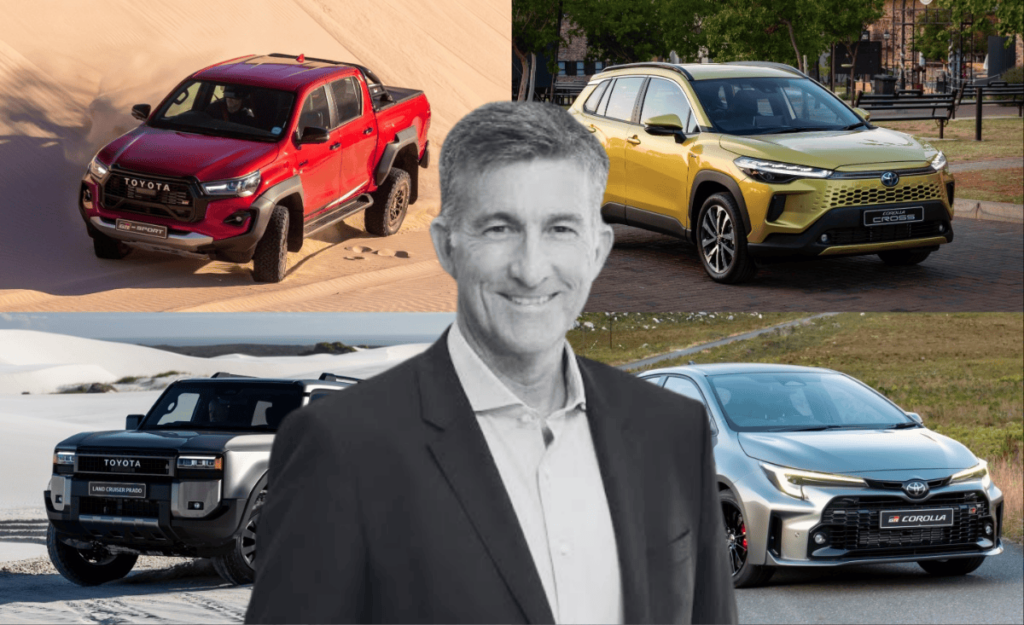
During its ninth annual State of the Motor Industry (SOMI) event, Toyota brought together industry leaders, policymakers, and mobility stakeholders as it outlined its plans for South Africa’s automotive sector.
Toyota’s plans are focused on navigating global volatility, strengthening local industrial competitiveness and accelerating South Africa’s transition to new energy vehicles (NEVs)
Toyota South Africa Motors President and CEO, Andrew Kirby, touched on the challenges and unpredictability within the industry, calling for stakeholders to adapt faster than ever.
“We live in uncertain times – globally and here in South Africa. The question is not whether disruption will come but how we respond to it,” he said.
“Driving through disruption requires resilience, curiosity and continuous innovation.”
Kirby explained that it is crucial for the South African automotive industry to grow its volume, which needs to go hand-in-hand with the growth of completely knocked down kits (CKD).
Toyota notes that despite overall industry growth, CKD has seen a drop off in recent years.
“It is not sufficient to only see volume growth stem from an increase in the entry models, as this does not have a significant GDP impact,” said Kirby.
“We also can’t rely on exports to fill the gap – global regulation and forces will impact where we can export to.”
He highlighted Toyota’s commitment to advancing South Africa’s industrial competitiveness through stable policy, by investing in its local operations and deepening supply-chain localisation.
Kirby did, however, note broader local industrial challenges, which include high energy costs, logistics constraints, high local labour costs, and rising input costs.
Worryingly, he added that South Africa is showing early signs of premature deindustrialisation.
“We cannot become a purely import-driven market. With the right small policy adjustments, we can strengthen competitiveness, attract new investment and grow the economy,” he said.
Looking forward

With Toyota’s Prospecton plant in Durban serving as a major production hub for European exports, Kirby welcomed the European Union’s revision of its 2035 target from a 100% to a 90% emissions reduction for new vehicles.
This will allow internal combustion and hybrid vehicles for export to remain in production beyond 2035 if powered by low‑carbon fuels or have emissions offset through other decarbonisation methods.
“This pragmatic shift recognises multiple viable pathways to net‑zero. However, we cannot rely on one export destination and assume conditions will stay the same,” he said.
“With incoming UK and EU emissions regulations, our future export volumes are at real risk.”
Despite these regulations posing a risk, Kirby noted that it is worrying that South Africa has none at the moment, with additional investment support for battery electric vehicles (BEV) and BEVs and Fuel Cell Electric Vehicles (FCEV) coming into effect in April.
Kirby said that countries are accelerating NEV adoption through clear regulatory signals and targeted incentives.
“South Africa must set clear goals and supportive policies aligned to global trends to accelerate NEV adoption in support of our 2050 net‑zero commitments,” he declared.
“The fastest way to reduce near‑term emissions is with hybrid electric vehicles (HEVs), complemented by plug-in hybrids (PHEVs) and a growing role for BEVs as charging infrastructure and total cost of ownership improve.”
Kirby believes that the right policy frameworks and economic environment can improve South Africa’s automotive sector even further, driving vehicle sales beyond 700,000 units and production beyond 720,000 units.
This would unlock an additional R21 billion in manufacturing value-add, and could potentially create 14,500 additional automotive jobs.
“We must not simply defend what we have – we must grow,” said Kirby.
This industry has built deep capabilities over 100 years. With decisive leadership, collaboration and smart interventions, we can secure the next era of automotive manufacturing in South Africa.”


 Loading ...
-facelift-2-2025.10.webp)
