The Automobile Association (AA) of South Africa has highlighted safety concerns regarding Toyota Starlet models sold locally, following the hatchback’s poor crash-test performance.
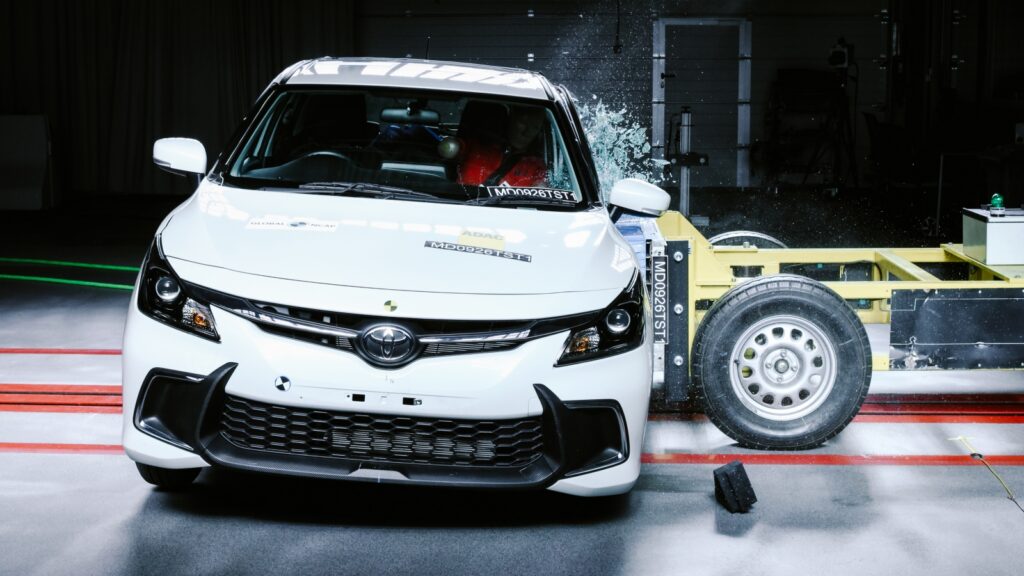
The current-generation Toyota Starlet received a Zero Stars rating for adult occupant protection during testing conducted by the Global New Car Assessment Programme (GNCAP).
These tests were conducted under the AA’s #SaferCarsForAfrica campaign, which, alongside GNCAP, buys entry-level vehicles in South Africa, ships them to Europe and submits them to global standard crash tests.
Testing revealed that the vehicle demonstrated serious failures, particularly during side-impact testing, as it lacks restraint systems like side-body and curtain airbags.
“These findings, in conjunction with a structure that could not provide adequate protection, led to the final Zero Star rating,” reported the AA.
However, it did clarify that the entry-level current-generation Toyota Starlet was equipped with only two airbags, while an updated version, introduced in September 2025, is offered with six airbags as standard across the range.
“Global sales statistics from Toyota indicate that over 20,000 South African customers and their families have purchased the Starlet prior to its upgrade to six airbags,” the AA said.
“Many of these owners may be unaware of the vehicle’s subsequent safety upgrade or that the range faces serious safety concerns.”
In its report on the vehicle crash test rating of the Toyota Starlet, GNCAP noted that:
- In the side-impact test, both head and chest protection were rated as poor. Abdomen protection was rated as adequate.
- The footwell area and bodyshell were found to be unstable and not capable of withstanding further load.
- The side pole test was not conducted as side head protection airbags are not fitted as standard.
- In the frontal impact assessment, the head of the three-year-old dummy made contact with the vehicle interior and the chest protection was rated as low.
- In the side-impact assessment, the head of the three-year-old dummy was exposed to impact.
GNCAP noted that no structural updates are evident post the addition of the four airbags, adding that it would submit the new model with its six airbags to similar testing later this year.
Poor performance by a popular local offering

Global NCAP CEO Richard Woods criticised the Japanese brand for its poor test results, calling the zero-star rating “a shocking result”.
“The Starlet, one of the most popular cars sold in South Africa, had an unstable bodyshell, as well as poor head and chest protection, which are both causes for serious concern,” he said.
Woods noted that Global NCAP welcomes the safety updates introduced by Toyota, adding that the revised model will be put to the test soon.
AA South Africa’s CEO, Bobby Ramagwede, explained that the Starlet is one of the most popular vehicles on our roads, meaning that thousands of owners and their families remain at risk of serious injury during a crash.
“These entry-level vehicles are also readily available in vehicle rental and corporate fleets, which further multiplies the risk to motorists,” he noted.
“Safety equipment and vehicles that are manufactured to a high standard of structural safety should never be an optional extra or a feature that is reserved for markets outside of Africa.”
He added that manufacturers should also not hide behind the lack of stringent vehicle-safety legislation in South Africa.
The AA has advised that Toyota Starlet owners or drivers inspect the vehicle’s roof lining and B-pillar for “SRS Airbag” markings that indicate whether the vehicle is a newer version fitted with additional airbags.
Drivers who receive one as a rental or corporate vehicle have been advised to take the low safety rating into account and request other options that offer better structural and passive safety features.




 Loading ...