Stellantis announced a major investment push focused on four core brands in a broad reset to boost profitability.
The automaking group will spend some €60 billion ($70 billion) through 2030 to launch 60 new models, prioritizing the Jeep, Ram, Peugeot and Fiat brands.
In North America, it plans to add a new compact and midsize pickup truck as well as a new entry-level model for the Dodge brand to help it rebuild after years of sales declines.
Chrysler, which today sells just a minivan, will get three new crossover models with a price range of $25,000 (R421,000) to $35,000 (R590,000).
Stellantis is also targeting 25% revenue growth in North America.
“We can grow, by just showing up in more segments,” Tim Kuniskis, head of brands for the Americas, told investors Thursday.
“That’s key, because the industry isn’t going to help us. It’s expected to be flat through 2030.”
By 2030, Stellantis sees revenue growing to €190 billion (R3.6 trillion) from €154 billion (R2.9 billion) last year.
The company aims to boost adjusted operating income margin to 7% in the same timeframe, including as much as 10% in North America.
The company also expects positive industrial free cash flow next year before rising to €6 billion (R114 billion) in 2030.
The profitability goals compare to a first-quarter operating margin of 2.5%, which disappointed investors because it counted one-time financial gains.
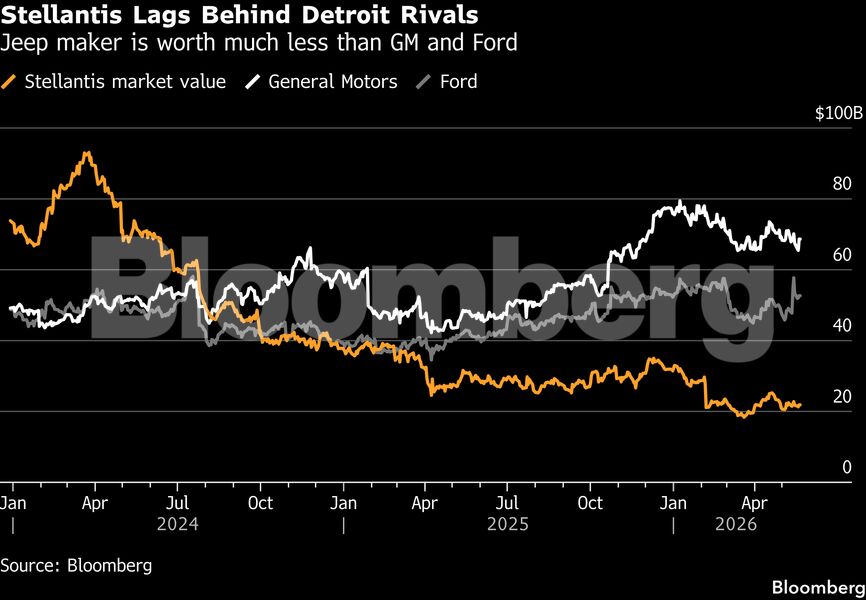
The 14-brand behemoth is trying to move on from a tumultuous period after having lost two-thirds of its stock-market value over the past two years.
Stellantis shares pared declines after releasing more detailed financial targets Thursday afternoon, slipping 1.1% at 1:45 p.m. in New York.
The stock fell as much as 7.4% earlier, suggesting some investors were looking for more aggressive moves to streamline the company’s sprawling portfolio.
Although the company has ambitious goals for the key US market, the plan “doesn’t go far enough to address major industry headwinds and intense competition from the Chinese, particularly in Europe,” Bloomberg Intelligence analysts Michael Dean and Giacomo Reghelin said in a note.
The strategy unveiled at its investor meeting in the US follows a range of setbacks that have triggered unprecedented deals with competitors, including from China.
Investments will support the introduction of new models and a push to unify vehicle underpinnings to cut costs, Stellantis said.
Some 70% of spending will go to the key Jeep, Ram, Peugeot and Fiat divisions.
Other brands such as Dodge and Citroën will take more regional approaches while benefiting from group spending on new platforms, drivetrains and technologies.
Overall, the group aims to targets €6 billion in annual savings by 2028 compared to last year’s level.
A key element will be reducing excess capacity in Europe, where Chinese automakers led by BYD are expanding in a market that hasn’t returned to levels from before the pandemic.
Stellantis, alongside Volkswagen, is most affected by overcapacity in the region.
The company will shrink its European footprint by 800,000 units, it said, in part by retooling factories for other functions, such as in Poissy, France. It also plans to share manufacturing with two Chinese partners.
Dongfeng Motor and Zhejiang Leapmotor Technology will gain access to plants in Spain and France, as the European Union weighs proposed protectionist measures on top of import duties on Chinese-made EVs. Leapmotor, which operates a JV with Stellantis, will also provide competitive EV technology.
The steps mark the deepest cooperation in Europe with Chinese carmakers to date.
Stellantis on Thursday also outlined it’ll partner with India’s Tata in Asia-Pacific, Africa, South America and the Middle East on carmaking and products.
On Wednesday, Stellantis said it’s exploring vehicle development in the US with Tata-owned UK luxury brand Jaguar Land Rover.
For the struggling Maserati luxury nameplate, Stellantis plans to add two new electrified models. It will unveil a road map for the loss-making brand in Modena, Italy, in December, it said.
Stellantis’ many brands were a concern from the get-go of the 2021 merger of Fiat Chrysler and France’s PSA Group.
Back then, executives thought adding scale and bringing greater resources to the EV transition would help rival the returns of VW and Toyota Motor.
The strategy worked for a time. Stellantis generated double-digit returns under then-CEO Carlos Tavares, but his relentless cost-cutting — while raising prices — eventually hit quality and resulted in cars that fell short of the competition.
Jeep endured six years of declining US sales, despite it being coveted by off-road enthusiasts.
Lasting improvements hinge on reviving the Jeep and Ram brands. Stellantis last year pledged to invest $13 billion (R248 billion) in North America to freshen its lineup.
It’s brought back popular choices like the powerful Hemi V-8 engine.
The recovery is patchy so far. While Ram brand sales jumped by a fifth in the first quarter, powered by the return of the Hemi, Jeep deliveries ticked up just 3%.
That’s despite a redesign of the top-selling Grand Cherokee SUV, a more affordable Grand Wagoneer and the launch of the compact Cherokee, back as a hybrid after a three-year absence.
Turning around the business comes against a tough backdrop that’s also hitting competitors. Elevated interest rates and soaring gas prices are holding back buyers, while tariffs undermine profits.
Chief Executive Officer Antonio Filosa had to reassure investors that improvement in North America will continue after lower-than-expected margins sent the stock swooning last month.


 Loading ...