
R18.7 billion company in South Africa betting big on Chinese cars


The Motus Holdings dealership group has seen a massive increase in sales following its decision to increase the number of Chinese car brands it sells in South Africa
This was revealed in the company’s latest annual financial statements, which shows that Motus recorded a 30.89% profit increase during the 2026 financial year.
Its profits before tax increased by R633 million from R2.49 billion in 2025 to R2.682 billion in 2026. Its operating profit, meanwhile, increased by R403 million (11.52%), going from R3.499 billion to R3.902 billion.
Motus noted that the rapid expansion of Chinese car brands is reshaping the competitive automotive landscape in South Africa thanks to their strong value proposition, advanced technology, and rapid production development cycles.
This has placed increasing pressure on established legacy car brands that have generally been slower to adapt to changing consumer preferences.
As a result, Motus has pivoted its business strategy to integrate Chinese and other emerging brands into its operations in South Africa.
This includes the Chinese brands Chery and GWM, as well as Indian brands like Suzuki, Tata, and Mahindra. Note that while Suzuki is a Japanese company, all of the cars sold in South Africa are produced by Maruti Suzuki in India.
In February 2026, Motus acquired the GWM George Multi-Franchise for R10 million, adding the GWM, Haval, and Honda brands to the group.
One month later, in March, it wrapped up its acquisition of the Motus Garfontein Multi-Franchise for R63 million, incorporating Suzuki Menlyn, Chery Menlyn, and Omoda & Jaecoo Menlyn into the fold.
Motus has also expanded its import and distribution segment by securing exclusive distribution rights in certain East African countries for Chinese brands such as GWM, Omoda, Jaecoo, Changan, and Dongfeng.
The company said that this has delivered great results, as the sale of Indian and Chinese cars has increased by over 200% in South Africa over the last year.
This strategy has allowed Motus to establish a resilient business model with strong growth. The Group saw a 20% increase in profit before tax to R4 billion in 2026, up from R3.336 billion in 2025.
40% of car brands in South Africa are now Chinese

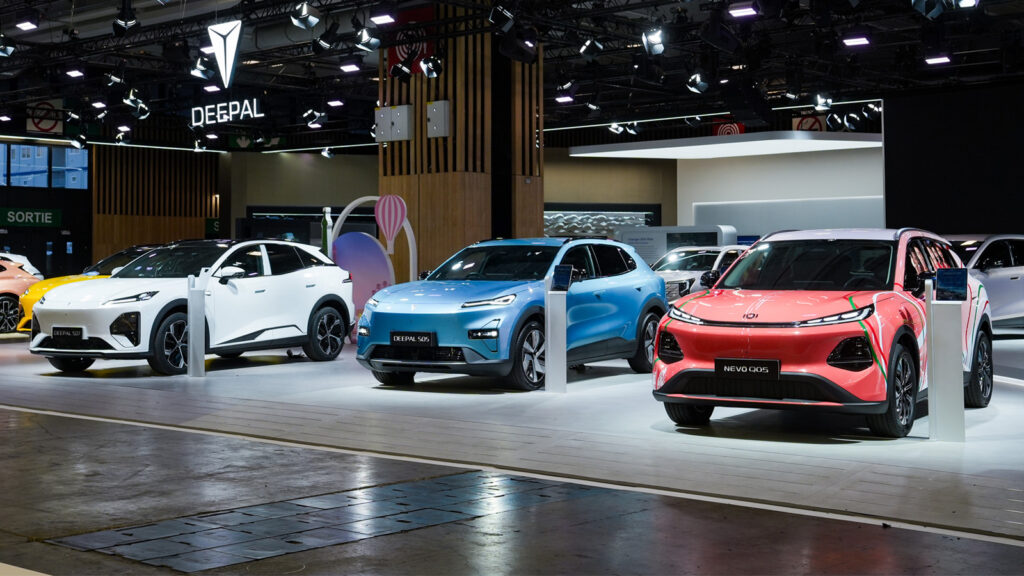
Chinese car brands have exploded onto the South African market over the last five years, primarily driven by the success of two companies, Chery and GWM.
These two brands are now consistently ranked as the sixth and seventh-best-selling marques in the country, outperforming legacy brands such as Kia, BMW, Mercedes-Benz, Opel, and Honda, selling thousands of units per month.
Having proven that Chinese brands are viable in South Africa, this success has led to an influx of new companies like Changan, GAC, MG, BYD, Geely, and Dongfeng.
Chery itself has added five additional brands to its portfolio, including Omoda, Jaecoo, Jetour, Lepas, and iCAUR, while GWM has expanded its own roster with models from its Haval, Tank, and Ora stables.
The result of all these new badges is that roughly 40% of all the car brands available in South Africa now come from the People’s Republic.
While this does include sub-brands like those in the aforementioned Chery Group, it nevertheless underscores the fact that China now represents nearly half of all brands sold here.
That’s not the same as market share, mind you, as Toyota still maintains a massive lead over all its competitors in South Africa. In August 2026, Toyota sold 13,814 units, while Chery and GWM sold 2,763 and 2,594 units.
However, even though Toyota, VW, Ford, and Hyundai are still the top-selling brands in South Africa, it’s hard to understate the fact that GWM and Chery achieved this level of success in just five years.
It shows that they are quickly gaining traction due to their value-for-money proposition at a time when households are struggling with rising car prices, and that dealer groups like Motus are taking advantage of the shift in consumer preferences.

 Loading ...
-2026.10.webp)
-2026.10.webp)
Conversation
5 commentsAnd already one of the Chinese brands that were selling well is falling by the wayside the Baic. 2 dealers have closed already by me. As I said before they dump all these vehicles in SA. There is no really backup service, technicians for the complicated electronics and all these 1.5l are the same and heavy on the fuel.
And here is another reason to add. And that is the reason, why I am dubious to get a Chinese vehicle. Friends of mine and various panel beaters had issues of obtaining parts. They can’t get parts for their vehicles especially electronic parts. And this is even on popular models as every few months some of these models are “upgraded” and the newer version is not compatible with 6 month old vehicles. 2 Friends are out of vehicles for over a year and had to buy cheap 2nd hand vehicles to get around.