
AfriForum fixes ‘monster pothole’ in town where the VW Polo is built


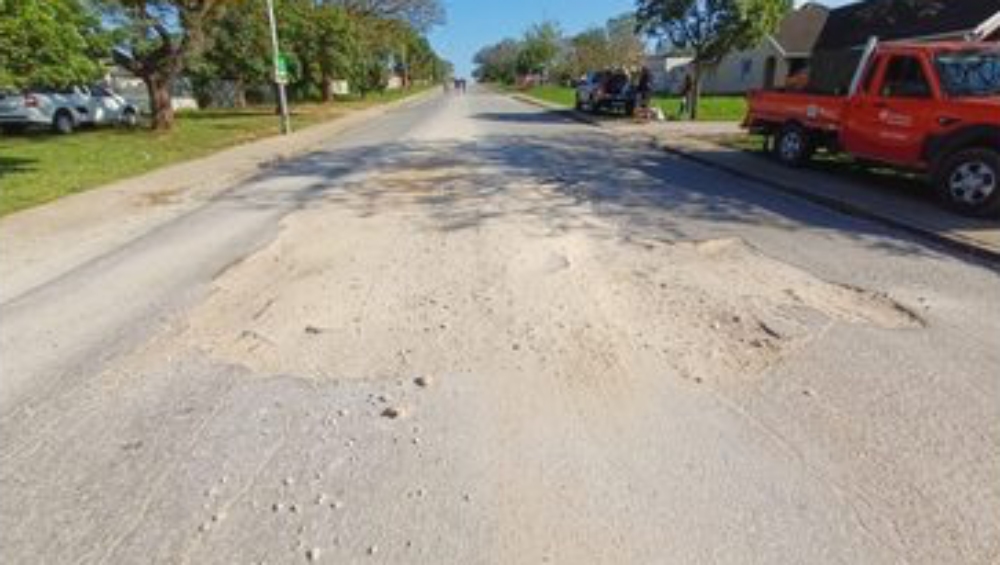
Kariega (formerly Uitenhage) is an Eastern Cape town that is home to VW’s Polo factory and, until recently, had a “monster pothole” on Channer Street.
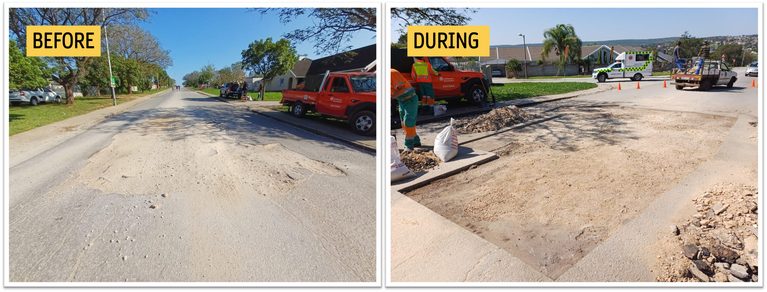
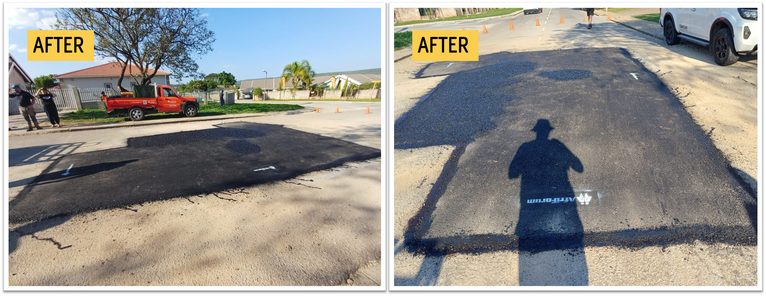
After nine months of unanswered calls to repair the pothole, the civil rights organisation sent a team from Knysna – about 250km away – to assist its local neighbourhood team with the pothole repair.
The organisation explained that repairing the monster-sized pothole required 3.5 tonnes of tar and presented the full-time team with an opportunity to train the Kariega branch in the “finer points” of pothole repair.
According to Marthinus Erasmus, AfriForum’s District Coordinator for the Southern Cape, the “Channer Street monster” pothole is symptomatic of the decay plaguing towns and cities across the country daily.
He added that residents cannot wait for months for the municipality or the government to provide solutions.
“It is therefore essential for communities to organise themselves and start taking responsibility for their local environment,” Erasmus explained.
“When the state – whether at local, provincial, or national level – fails to fulfil its responsibilities, ordinary residents are the first to bear the consequences.”
He added that AfriForum is establishing neighbourhood teams nationwide to empower communities to improve their towns themselves since problems are often ignored for months or even years.
Erasmus explained that the collaboration between the Knysna neighbourhood team and the branch in Kariega is proof that communities can and should work together.
“Where we have the capacity to make a difference, we get to work ourselves. This is how strong, self-reliant communities are built,” he concluded.
In May, AfriForum’s Knysna branch became a major player in the municipality and local government, as it signed a cooperation agreement with the Knysna Local Municipality.
The memorandum of understanding allows AfriForum to assist with upgrading and maintaining infrastructure and to undertake projects to improve public spaces.
South Africa spent millions on unused pothole-fixing machines

The private sector in South Africa has had to take responsibility for fixing potholes after the government spent nearly R30 million on machines to fix potholes, only for them to remain unused five years later.
According to the Minister of Defence and Military Veterans, Angie Motshekga, in 2021, the South African government spent R28 million on 90 machines to fix potholes, but has yet to fix a single one.
“This is because there is no visible project implementation plan that would have informed the procurement process,” she said.
“As per the departmental records, no funds were budgeted or spent by the department on training related to repairs of potholes.”
The matter was referred to the Special Investigating Unit (SIU) for an in-depth investigation and to recover the funds.
“Since the matter is still under investigation, these machines are regarded as evidence and, therefore, cannot be used without authorisation by the investigators,” explained Motshekga.
As a result, organisations like AfriForum and companies like Discovery Insure have taken on the responsibility to repair South Africa’s decaying roads.
In 2021, the same year that the government procured its rollers, Discovery launched the Pothole Patrol initiative, which has since repaired hundreds of thousands of road hazards.
The initiative is a public-private partnership between Discovery Insure, the Johannesburg Roads Agency (JRA), the City of Johannesburg, and Avis Southern Africa.
Since its launch, Pothole Patrol has used more than 100 tonnes of asphalt to repair more than 86,000 square metres of road surface in and around South Africa’s richest city.
Discovery launched the programme after analysing more than 22 billion kilometres of driving data, concluding that poor road conditions were a growing risk for motorists, cyclists, and pedestrians.
Discovery CEO Adrian Gore said the initiative demonstrates what is possible when business, government and residents work together to solve practical problems at scale.
“Fixing potholes may seem like a small intervention, but it has meaningful downstream effects. Fewer potholes lead to fewer accidents, lower insurance claims and a reduced maintenance burden on the City,” he said.
The “Channer Street monster” pothole





 Loading ...
Conversation
1 commentsDo not ask the Government what it’s supposed to for you. Ask yourself what you can do for the Government. And do it. Well done. Keep it up.