


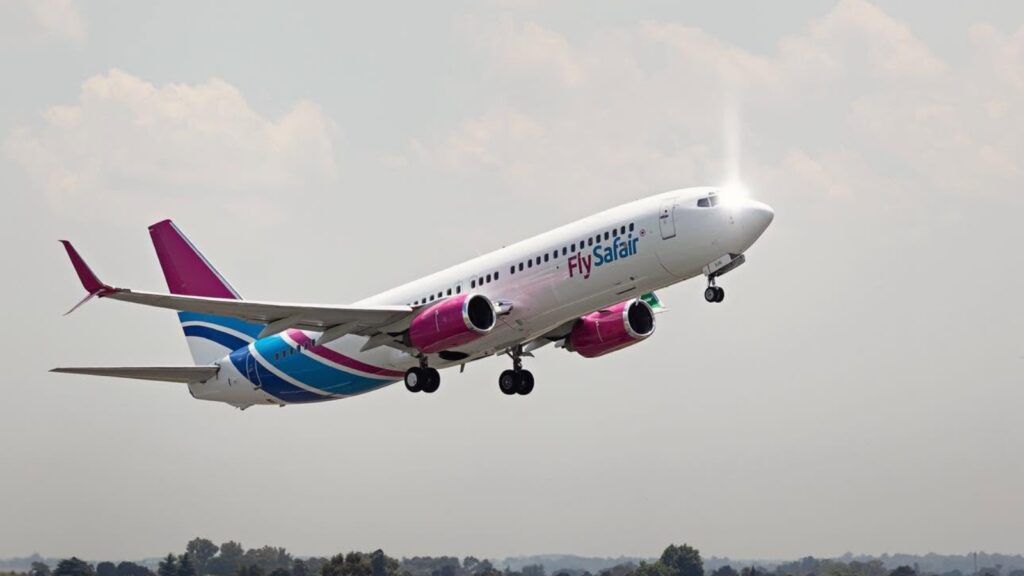
South Africa’s largest airline, FlySafair, has announced a new route from OR Tambo International Airport (ORTIA) to Kenneth Kaunda International Airport in Lusaka, Zambia.
According to the airline, the five weekly flights – Monday, Wednesday, Thursday, Friday and Sunday – have been launched in response to sustained demand on the corridor.
“Zambia has long been on our radar, and Lusaka is a route our customers have been asking about,” said Kirby Gordon, Chief Marketing Officer at FlySafair.
“The Johannesburg–Lusaka corridor carries a significant mix of business and leisure travellers, as well as South Africans and Zambians travelling to see family and friends.”
As the nation’s capital, Lusaka is also one of the region’s fastest-growing cities, with a mix of culture and wildlife drawing leisure travellers, and it also serves as a gateway to Livingstone and Victoria Falls.
The city has also become an increasingly important commercial hub for Southern and Central Africa, as a home to regional banks, mining and telecommunications companies, and pan-African development organisations.
South Africa also remains one of Zambia’s most significant trade and investment partners.
“Our international network has been built on the principle that connecting South Africa with its neighbours should be affordable, not a luxury,” added Gordon.
“When we launched Cape Town to Windhoek, we brought fares down significantly on that corridor, and we intend to do the same on Johannesburg to Lusaka.
He added that Zambia and South Africa have deep ties, and the airline is pleased to make staying connected between the nations easier.
The Johannesburg–Lusaka route operates on Monday, Wednesday, Thursday, Friday and Sunday, departing OR Tambo International Airport at 07:50 and arriving in Lusaka at 09:50.
Return flights depart Kenneth Kaunda International Airport at 10:50 and arrive at OR Tambo at 12:50.
According to the airline, fares from Johannesburg to Lusaka cost R2,800, while return flights are R3,000 per ticket, before fuel surcharges have been added.
Temporary fuel surcharges are still in place
In March, FlySafair announced that it had been forced to add fuel surcharges to its ticket prices for the first time, in hopes of protecting its long-term stability and low-fare offerings.
The carrier is not the only airline to do so, as global Brent crude oil price volatility has driven aviation fuel prices and influenced FlySafair’s and other airlines’ operating costs.
“Airlines worldwide, including Japan Airlines, ANA and several European carriers, apply fuel surcharges tied to benchmark jet fuel prices or long-haul cost structures,” the airline noted.
That said, the measure was meant to be temporary, as it was originally implemented between 12 March 2026 and 12 May 2026, but has since been extended and is still in place today.
“The persistence and scale of these fuel costs have left us with no reasonable alternative,” explained Gordon.
In the weeks after the conflicts erupted in the Middle East on 28 February, the airline absorbed rising fuel costs, shielding passengers from immediate airfare increases.
However, Jet A1 fuel prices at South Africa’s coastal airports rose by nearly 70% in just one week, which forced the airline to pass on some of the costs to passengers.
“We will be specifically itemising this temporary dynamic fuel surcharge on all tickets to ensure fairness and transparency to our customers,” added Gordon, who said the airline remains committed to fair practice.
“Instead of increasing fares across the board or hiding costs, we have chosen to introduce a clearly labelled, temporary surcharge.”
He explained that surcharges vary according to route length, reflecting the fuel consumption required per flight.
“Our teams are modelling fuel prices airport by airport and reviewing potential tankering strategies to ensure the surcharge reflects the minimum required amount,” Gordon said.
“This is not a profit mechanism; it’s a measure to maintain service continuity while being upfront with customers.”






 Loading ...