


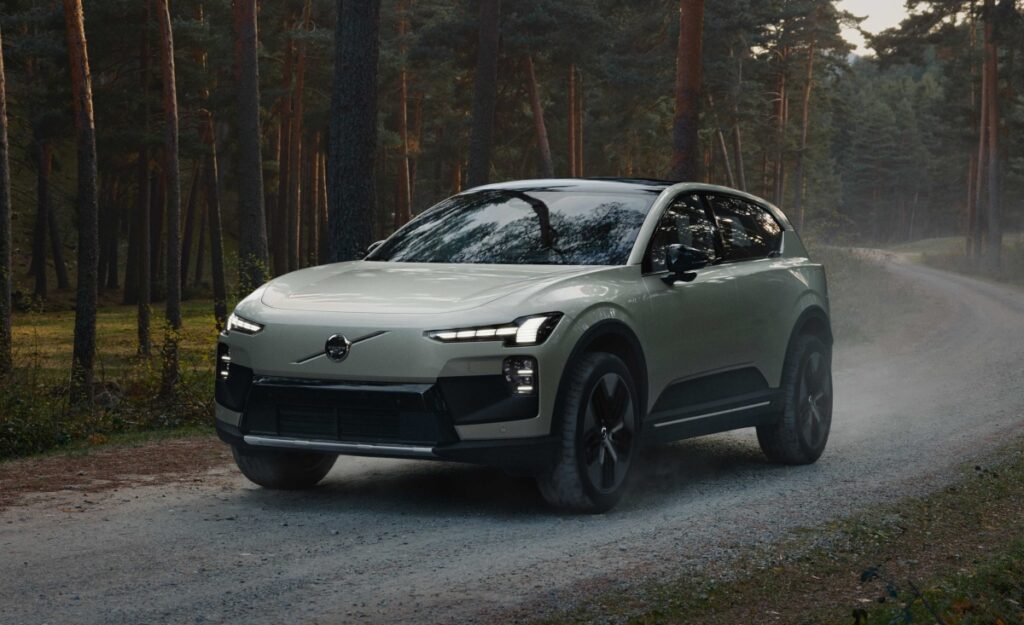
Volvo is reshaping its manufacturing network around five plants dedicated to its namesake brand and two shared with partners, part of an overhaul designed to help it navigate increasingly fierce competition.
The revamp detailed Thursday at an investor presentation in Stockholm also includes the biggest-ever product push by the Swedish manufacturer controlled by China’s Geely.
It plans to introduce seven new cars for Western markets and six for China by the end of the decade in an effort to double its slice of global sales of electric vehicles and plug-in hybrids from around 1.7% currently.
“We need new cars because there is hyper-competition,” Chief Executive Officer Håkan Samuelsson said in an interview.
“It’s not just about cutting costs,” he added. “You have to think about pricing and volumes, and then you need good cars.”
Samuelsson is trying to revive growth at Volvo after a troubled period marked by challenges including US trade tariffs, an ageing product portfolio, low capacity utilisation, and elevated raw-material costs.
Under the CEO, who is set to step down next spring, the automaker is giving hybrids a bigger role due to a slower-than-expected shift to full EVs It’s also adopting a more regional approach to its lineup and deepening its cooperation with its Chinese parent, Geely.
Samuelsson said Volvo is abandoning the idea that broadly identical global models can satisfy customers in Europe, China and the US with increasingly divergent demands.
“One global car won’t work, and just adapting it with different colours or trim will not be enough,” he told investors.
Closer cooperation with Geely will allow Volvo to share platforms and components while keeping Western and Chinese software and customer data separate, he added.
The overhaul will create a company capable of generating an EBIT margin above 8%, Samuelsson said, without naming a deadline.
Even though Volvo’s factories are underused, no plant closures are being considered, he said, even as some competitors pursue that path.
The shares rose as much as 4.2% in early trading Thursday before paring most of the gain. They’re down around 40% this year.
Regarding a potential successor, Samuelsson said a decision should be announced before the end of the year.
The new CEO should be someone from within the industry who “understands Swedish culture,” a relatively limited pool, he added.
Volvo sold just over 710,000 vehicles last year, roughly 1% of worldwide market share, according to S&P Global Mobility data.
By comparison, Europe’s biggest carmaker, Volkswagen, took roughly 10% of passenger-car sales during the same period.
On Tuesday, Volvo announced it will introduce long-range hybrid versions of its popular XC60 and XC90 in Europe and the US, betting demand for cars that combine combustion engines with larger batteries will persist well into the next decade.
Asked on Thursday how long Volvo will continue using combustion engines in some form, Samuelsson said probably until “toward the end of the 2030s.”
The Gothenburg-based manufacturer has already tested that approach in China, where the XC70 extended-range plug-in hybrid launched last year has become its best-selling model.
The car has helped cushion a broader slump in the world’s largest auto market.
Volvo abandoned a goal in 2024 to sell only fully electric cars by 2030 after the transition proved slower than expected. It still aims to eventually become fully electric, but no longer has a deadline.




 Loading ...

-2026.10.webp)
Conversation
3 commentsHere in Kimberley, are still a few Volvos but old ones. I hardly seen new ones and there is no dealership here but only in Bloemfontein which is around 170km away.
Just like a BMW, they abruptly left for Bloemfontein where they’ve already had another dealership. We are now relying on some expensive RMI workshop that cost an arm and a leg just like a dealership.