Riding horses to avoid R30 per litre petrol prices in South Africa – what the law says


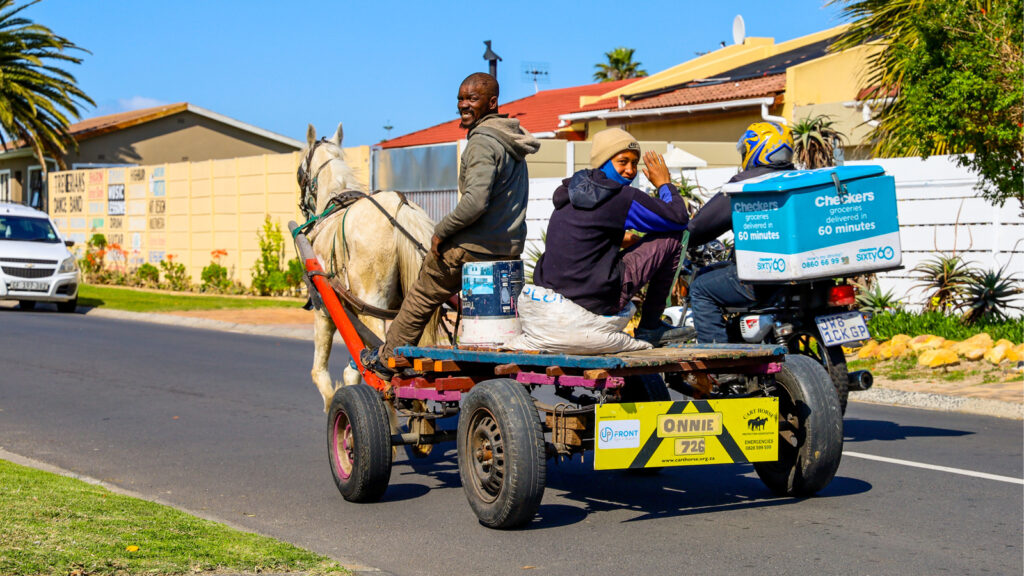
Horse and donkey carts are a sight that most South African motorists have encountered on their journeys, particularly in rural areas.
While the concept is generally seen as quaint and indicative of South Africa’s divided socio-economic landscape, the skyrocketing price of petrol and diesel has left some of us asking whether horse- and donkey-riders may be onto something.
This October saw petrol and diesel prices rise by more than R3 per litre to new record highs of R30.25 and R33.29 per litre, respectively.
Forecourt owners have reported a noticeable drop in fuel sales this year, as motorists are making fewer trips, carpooling, or working from home to avoid the rapidly increasing cost of transport.
Some South Africans have also started looking at electric cars to eliminate their reliance on liquefied dinosaur remains completely, while for other “drivers,” the only running cost they have to worry about is hay.
In all seriousness, South African law does allow certain animals to be used as transport on public roads, though there are important restrictions.
What the law says about animals being used for transport
In South Africa, individuals who ride animals to get around is legally classified as a driver, just like any other form of transport.
Section 1(15) of the National Road Traffic Act of 1006 (NRTA) classifies a driver as “any person who drives or attempts to drive any vehicle or who rides or attempts to ride any pedal cycle or who leads any draught, pack or saddle animal or herd or flock of animals.”
Similarly, the terms “drive” or “driving” have a corresponding meaning across all types of transport in this context.
Section 61 then lays out the specific requirements and duties expected of drivers involved in an accident on a public road in which any other person is killed or injured or suffers damage in respect of any property or animal.
It further clarifies in section 61(5) that an “animal” refers to any bovine animal, horse, ass, mule, sheep, goat, pig, ostrich or dog.
Since individuals who lead or ride an animal on a public road are classified as drivers, general driver obligations apply, including prohibitions against reckless or negligent driving.
In other words, the general rule is that any regulations that apply to drivers of motor vehicles also apply to individuals who use animals as a means of transport.
According to Johannesburg Metropolitan Police Department spokesperson Xolani Fihla, animal-drawn vehicles, such as a horse or donkey cart, are allowed on public roads in South Africa.
However, they must comply with local municipal by-laws, national traffic rules, and animal welfare standards.
One major limitation is that these carts are not allowed on high-speed routes such as national roads and freeways.
Furthermore, since animal-drawn carts are ostensibly seen as vehicles, they are required to have reflector lights for better visibility, particularly during low-light conditions.
“Their operation must not endanger other road users. They must have proper lighting and reflectors and must be driven by competent motorists who obey the rules of the road,” said Fihla.
Leaving an animal unattended in or near a public road where it could wander into oncoming traffic is considered an offence.
Municipal by-laws also play a key role in regulating the use of animal carts. While these can vary between metros, many municipalities have similar restrictions in place.
For example, the City of Cape Town requires that owners hold a valid E53 Cart Horse Operator’s Permit, which is issued after completing a training workshop covering traffic laws, road signs, and animal care.
Individuals must be at least 18 years old to apply for a permit, and the horse and cart must be registered and wear identification plates.
The cart itself must also be roadworthy and comply with regulations, which includes the harness used to attach the animal to the cart.
Lastly, animals used in a working role are governed by the Animal Protection Act in South Africa, which prohibits abuse and acts of cruelty.
It is an offence to overload, overdrive, ill-treat, neglect, infuriate, torture, maim, or cruelly beat, kick, goad, or terrify any animal.
All working animals must be fit to work or drive, meaning it is illegal to work an animal that is diseased, exhausted, or injured.
Additionally, the Act prohibits the use of harnesses or other equipment that causes harm or unnecessary suffering to the animal.
Anyone who violates the provisions of this Act may be found guilty of an offence and liable to conviction of a fine not exceeding R4,000 or imprisonment for a period not exceeding 12 months.




 Loading ...