The South African government has proposed to implement new restrictions on all new vehicles to improve efficiency levels and cut back on wasteful energy expenditure.
The Department of Electricity and Energy published its draft National Energy Efficiency Strategy (NEES), which outlines new strategies to improve energy consumption across various sectors in South Africa.
This includes the transport industry, which the NEES identified as the second-largest energy consumer in the country, accounting for 35% of total energy usage (mostly via liquid petroleum fuels).
The NEES has therefore set a headline national target to reduce the transport industry’s energy usage by 43.3 petajoules (PJ).
“This establishes a clear national signal that energy savings must be planned, measured, and delivered with the same commitment afforded to new supply,” the draft states.
It stated that transport measures to reduce energy consumption must focus on vehicle efficiency and a modal shift for greater adoption of public transport services.
To this end, section 3.4 of the NEES outlines new policies aimed at achieving its objective of reducing energy usage within the transport sector.
Section 3.4.1 proposes to implement new mandatory light-vehicle fuel economy standards with the dual purpose of improving efficiency while ensuring South Africa’s manufacturing industry remains competitive.
South Africa is home to several original equipment manufacturers (OEMs) with car factories, including Ford, Toyota, VW, BMW, Mercedes-Benz, Isuzu, and Chery (the latter of which recently acquired its factory from Nissan).
The draft notes that South Africa needs to improve the fuel efficiency standards of domestically produced cars to ensure that they remain competitive in export markets.
Regions like the European Union are tightening their emission restrictions on new cars, which means South Africa could potentially lose access to its biggest markets if it fails to produce models that can be exported in the years to come.
“To sustain competitiveness in international markets, by not being phased out from export markets where fuel efficiency standards exist, South Africa needs mandatory fuel economy standards,” it states.
“The Department of Transport and the Department of Energy should jointly commission a feasibility/calibration study, then use its findings to introduce CO₂-equivalent fuel-economy standards for light vehicles, aligned with current international norms.”
“Standards should apply to all new vehicle sales and be progressively tightened every three years based on technology cost analysis, with exemptions for manufacturers.”
Secondly, the NEES proposes to expand the vehicle CO₂ levy into a new ‘feebate’ system. It notes that the existing levy does not incentivise efficiency across the market.
The new system would restructure the levy into a revenue-neutral feebate that pays rebates for efficient cars that fall below emission targets.
These rebates would be funded by levies imposed on inefficient cars that exceed the country’s emission restrictions.
It also stated that the feebate system should be transparent with annual threshold adjustments, and that it should include incentives for new-energy vehicles such as hybrid and electric models.
New targets for the transport sector

Other transport sector targets listed in the NEES include a freight modal shift from road to rail, which offers a 60% energy saving, and a passenger modal shift for more widespread public transport adoption.
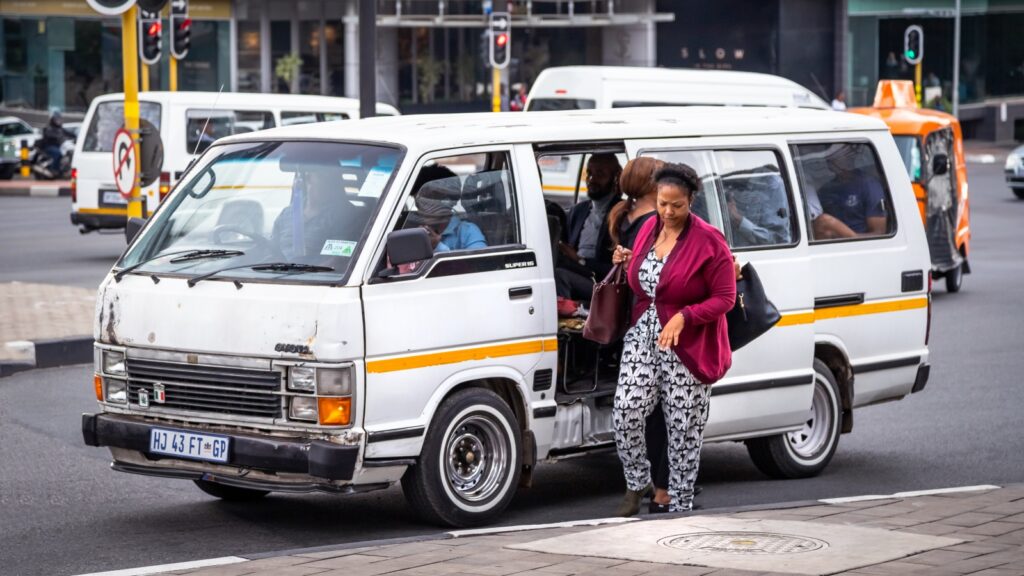
It emphasized that public transport needs to be made more affordable to improve uptake, and calls for a comprehensive public-transit acceleration programme to shift commuters from private vehicles to bus and commuter rail systems.
It suggested introducing affordability mechanisms like income-adjusted fares or transit subsidies for low-income users.
Section 3.4.5 then proposes to introduce new education modules into the national driving licence curriculum to improve driver behaviour.
It notes that a person’s driving style can raise fuel consumption by 15% to 20% and that an eco-driving module should be added to the national driving licence and professional driver certificate programmes.
Lastly, the NEES calls to restructure automotive incentives to prioritise new-energy vehicles to support the shift to decarbonise transport.
“The Department of Trade, Industry and Competition should revamp existing automotive manufacturing incentives to specifically accommodate NEV and hybrid production, including local assembly incentives, component development support, and preferential government procurement targets,” it said.
“The restructuring should align with industrial policy goals for green manufacturing competitiveness.”




 Loading ...