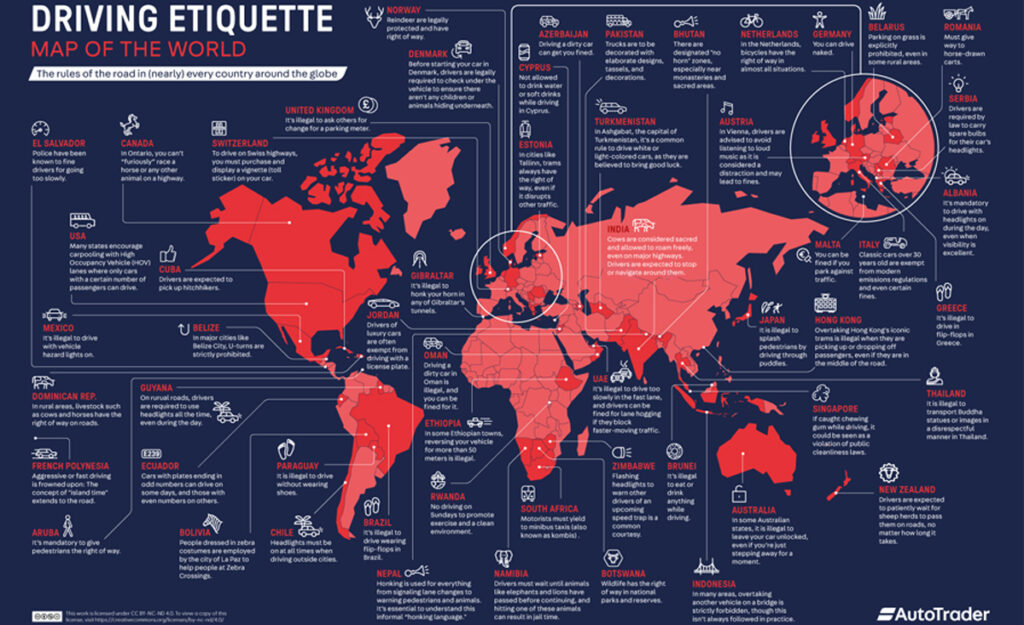
From not being allowed to eat or drink in your car to being forbidden from “furiously” racing horses or other animals on the freeway, there are some pretty weird road rules in countries around the world.
While they may sound strange by today’s standards, many of these laws and practices were enacted ages ago and were simply forgotten in the rulebook as times changed.
AutoTrader UK has done the dirty work and combed through dozens of countries’ customs and legislation to uncover the most peculiar dos and don’ts on roads around the world.
“The way we navigate the roads and communicate with other drivers is completely different from country to country,” said the company.
“Your legal obligations to carry essential health and safety equipment, how you travel with pets, and even which animals you should give way to all change across borders.”
Africa
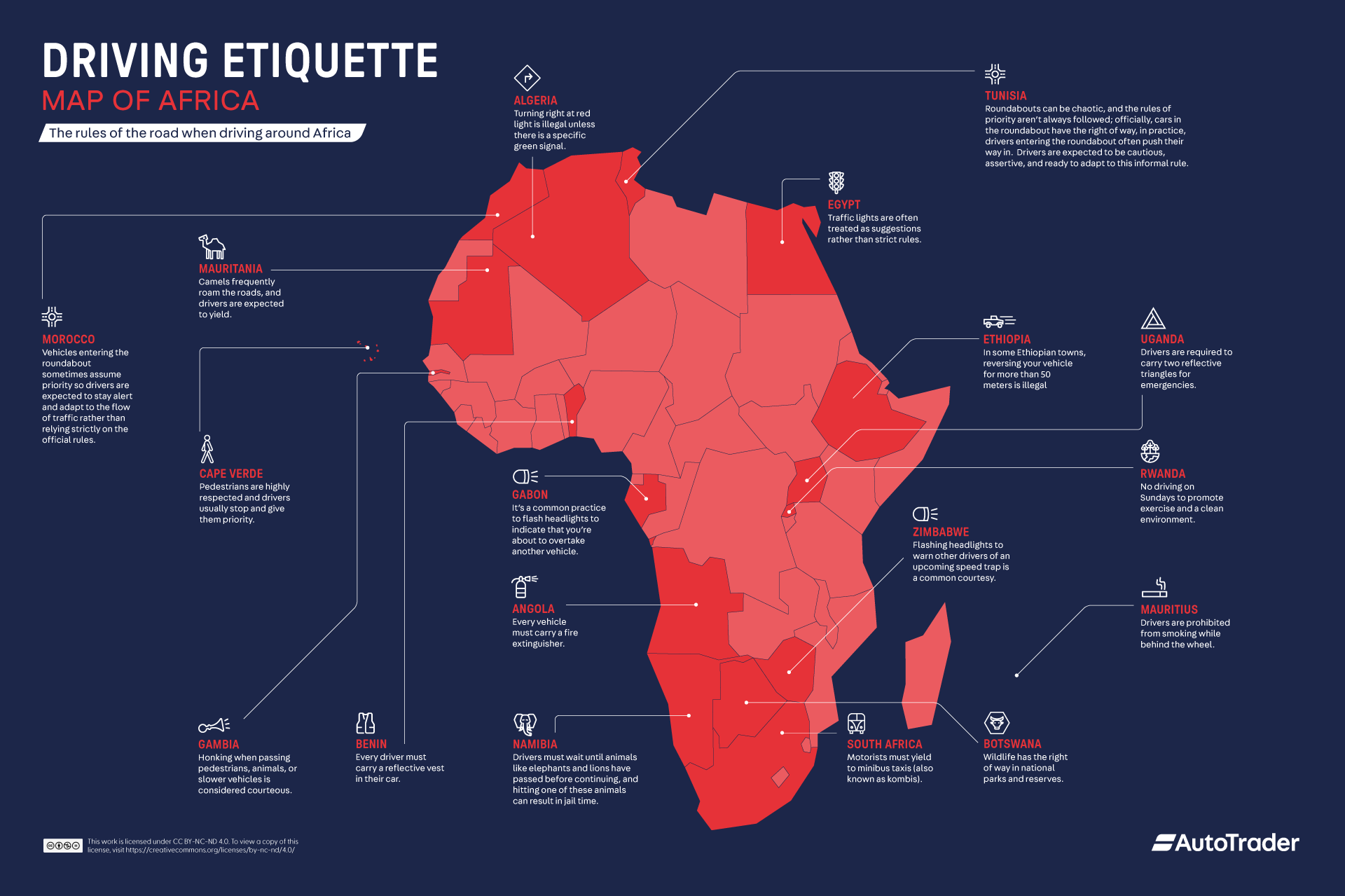
African nations have a plethora of different driving habits and legal requirements.
In Botswana, a country home to some of the highest concentrations of lion, giraffe, hippo, wildebeest and buffalo in Africa, plus around 450 bird species, wildlife has the right of way over drivers in national parks and reserves.
This rule is also in place in Namibia, where hitting an animal can lead to jail time.
Likewise, in Mauritania, camels frequently roam the roads and drivers are expected to yield.
Some of the more random driving laws in the continent include it being illegal to reverse for more than 50 metres in Ethiopia, and in Rwanda, there is no driving on Sundays.
There are also plenty of regulations around carrying safety equipment in many African countries.
Angola requires drivers to carry a fire extinguisher; in Uganda, you must have two reflective triangles for emergencies; and in Benin, you always need a reflective vest in your car.
AutoTrader UK also notes that in South Africa, drivers “must yield to minibus taxis.”
Admittedly, we regularly do give way to them not because the law says so, but because we prefer to keep our cars scratch and dent-free.
Asia
In many Asian countries, it is extremely important to keep your car looking like it just came from the factory.
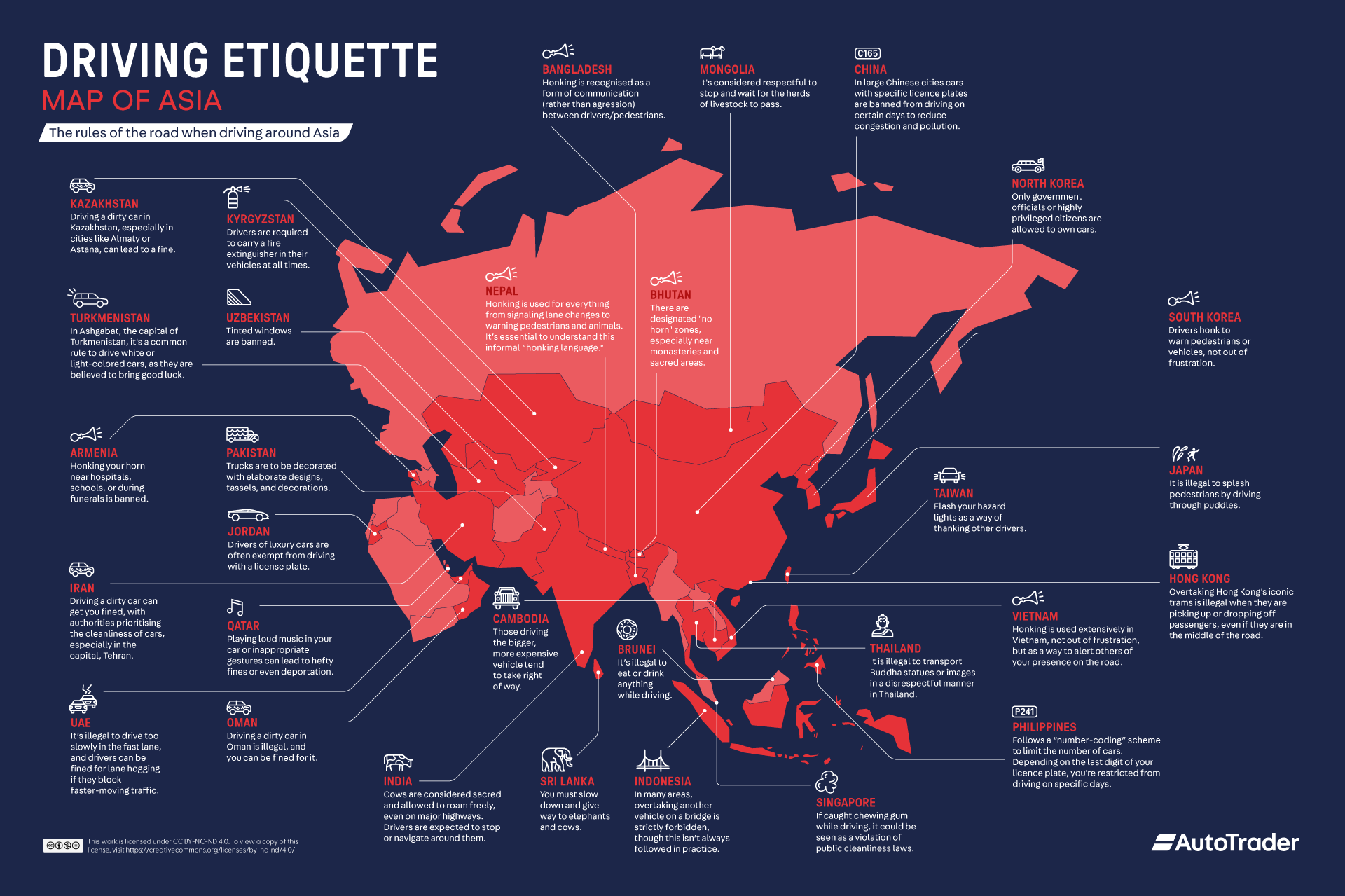
Driving a dirty car in Oman is illegal, and you can be fined for it, which is also the case in Kazakhstan, Iran, and Azerbaijan.
Elsewhere in the region, some of the rules and regulations may take drivers by surprise.
In Thailand, it is illegal to disrespectfully transport Buddha statues or images as it is considered offensive.
In Ashgabat, the capital of Turkmenistan, it’s a common rule to drive white or light-coloured cars, as these colours are believed to bring good luck.
Meanwhile, cows are considered sacred and allowed to roam freely in India, even on major highways, so drivers must stop or navigate around them.
If you ever find yourself behind the wheel in the United Arab Emirates, be aware that it’s illegal to drive too slowly in the fast lane, and drivers can be fined for lane hogging if they block faster-moving traffic.
Interestingly, in Jordan, luxury cars are more likely to get away with breaking the rules.
In fact, drivers of luxury cars are often exempt from driving with a licence plate – which is a legal requirement for everyone else.
Europe
When it comes to driving in Europe, the motto is ‘Be prepared’.
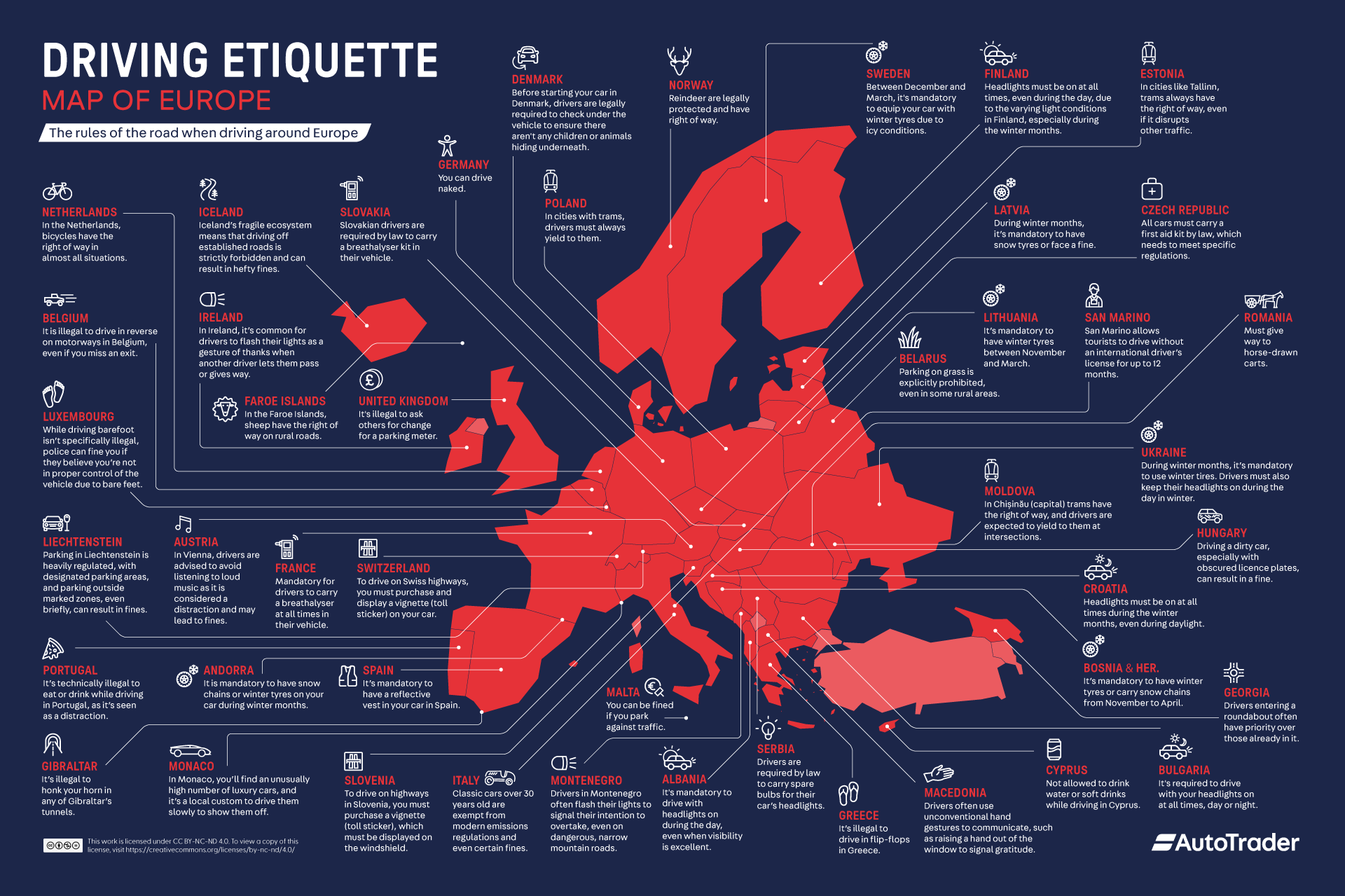
In Andorra, Latvia, and certain regions of Italy, snow tyres are mandatory during the winter months, and failing to fit them can result in a hefty fine that can go higher than the cost of a full set of snow rubbers.
For drivers in Serbia, motorists’ legal safety obligation is to carry spare bulbs for their car’s headlights, whilst the French must bring a breathalyser with them at all times.
Among the the quirkier laws in Europe include it being illegal in the UK to ask others for change for a parking meter, whilst in Germany drivers are legally allowed to drive without wearing any clothing, and motorists are not meant to drink water or soft drinks while driving in Cyprus.
There are also many different things that get the right of way over cars in Europe.
In the Netherlands, for example, bicycles get preference in almost all situations. Reindeer are legally protected and have the right of way in Norway; in Romania you must give way to horse-drawn carts; and in the Faroe Islands sheep have the right of way on rural roads.
A curious clause in Italian law that may be of interest to those who admire the design and aesthetic of classic cars is that classic cars over 30 years old are exempt from modern emissions regulations and even certain fines.
A similar law applies in the UK – classic vehicles that were built more than 40 years ago and have a “historic tax” class are exempt from the so-called Ultra Low Emission Zone charge.
Oceania
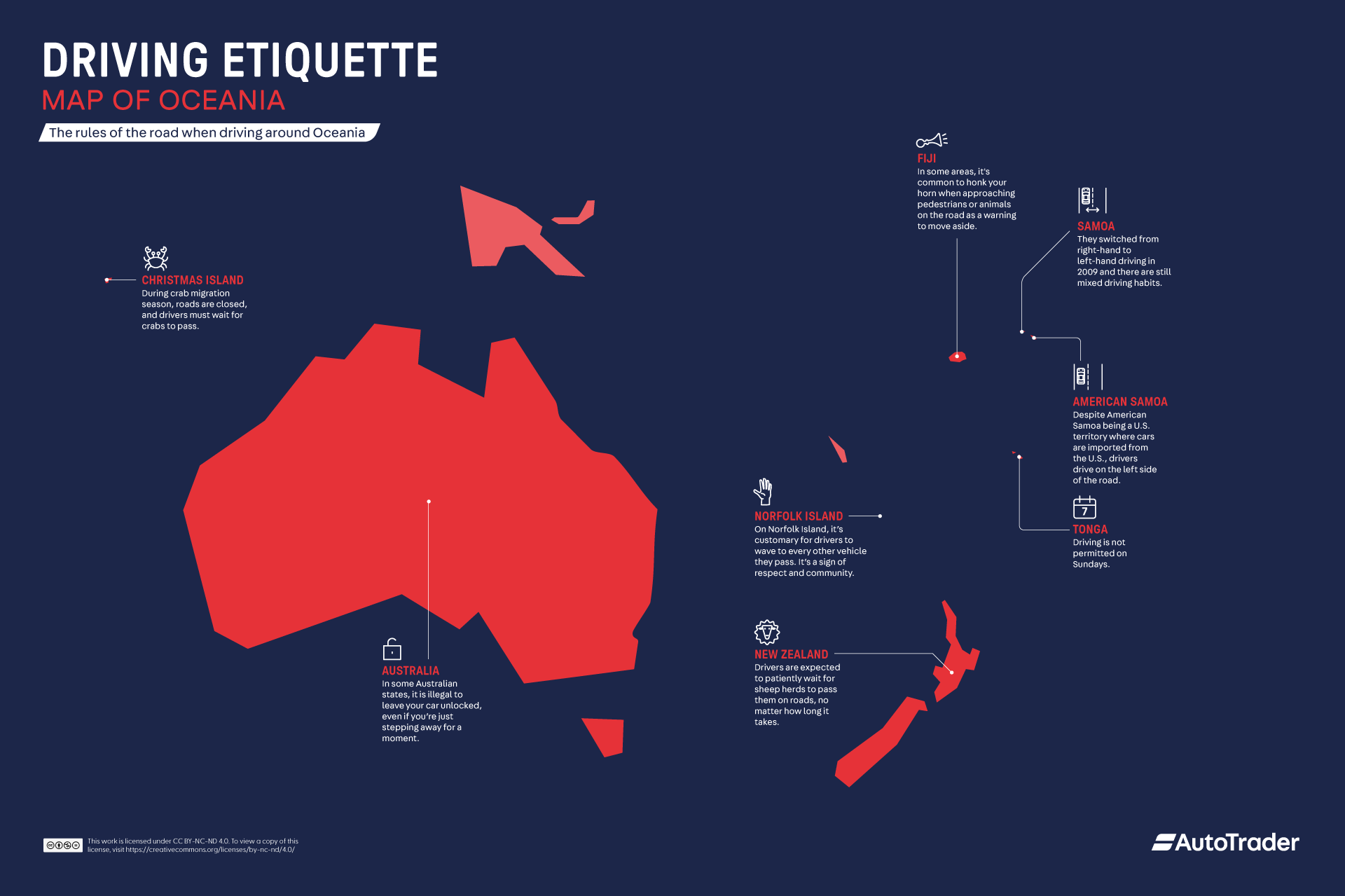
Whilst other countries around the world require drivers to give way to animals, Christmas Island takes it to another level.
During crab migration season, roads on the island are closed and drivers are legally obliged to wait for crabs to pass before continuing with their journey.
In a similar vein, drivers are expected to patiently wait for sheep herds to pass them on roads in New Zealand, no matter how long it takes.
The driving etiquette in some Australian states makes it illegal to leave your car unlocked, even if you’re just stepping away for a moment.
North and Central America
North and Central America is chock full of bizarre driving regulations.
Looking at Canada’s Ontario, you can’t “furiously” race a horse or any other animal on a highway.
Further south to Cuba, drivers are expected to pick up hitchhikers out of common courtesy.
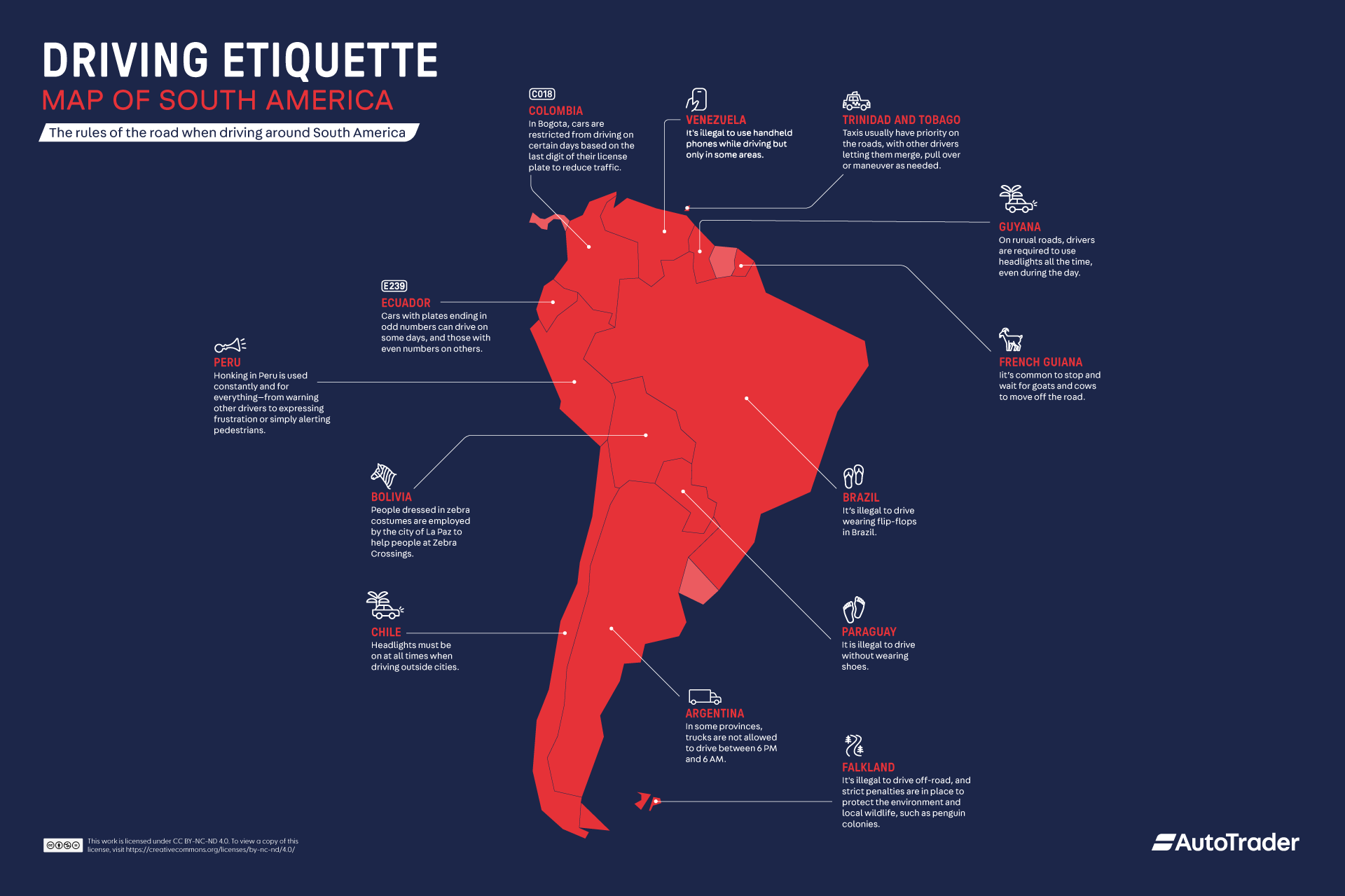
Whatever you do, don’t start driving your car without wearing shoes in Paraguay as this is illegal and you can face fines and even jail time.
Elsewhere in the continent, U-turns are strictly prohibited in major cities like Belize City and it’s mandatory to give pedestrians the right of way in Aruba.

United States of America
Despite being one nation, driving etiquette around the USA differs dramatically from state to state.
In some, you can turn right at an intersection even when the light is red, and in others, you can’t.
Other oddities introduced in states in recent years include the fact that it is illegal to tether a dog to your car while driving in Alaska.
Likewise, driving blindfolded is prohibited in Alabama, but still on the books.
While it may seem obvious, driving without a steering wheel is explicitly illegal in Illinois, whilst in Wyoming it’s illegal to ski while being towed behind a vehicle.
South Carolina threatens its inhabitants with big fines for rude bumper stickers, riding camels on the highway is forbidden in Nevada, and you must have a chaperone when transporting sheep in a vehicle in Montana.
The bizarreness doesn’t stop there – in Derby, Kansas screeching your tyres can lead to a fine and even possible jail time; R-rated movies cannot be shown at drive-in theatres in Delaware; and in Youngstown, Ohio it’s illegal to run out of fuel.

South America
Whilst not a law, don’t panic if you notice someone dressed up as a zebra whilst driving in Bolivia, as the nation’s authorities have employed people in the city of La Paz to help people at zebra crossings.
This has been introduced to make the roads more pedestrian-friendly and to encourage drivers to stop.
In Brazil, it’s illegal to drive wearing flip-flops, whilst in Chile and Guanya, you must have your headlights on at all times, even during the day.
Due to increasing levels of traffic and difficulty managing it, Ecuador introduced a system where cars with plates ending in odd numbers can drive on some days and those with even numbers on others.




 Loading ...
-facelift-2-2025.10.webp)