If you can’t put your car under cover in a hailstorm, the best way to protect it is to park it so that the hail is hitting it from the front and not the back.
This is according to South Africa’s largest short-term insurer, Santam.
The reasoning for the tactic is that windscreens are reinforced to withstand strong forces from the front to provide additional personal protection in an impact.
Consequently, they should be able to withstand hail stones much better than other windows and soft body panels.
Alternatively, try to park your ride under shelter such as at a petrol station or shopping mall with undercover parking if a serious storm is afoot, or cover it with a hail blanket for a layer of soft protection.
If you’re out and about and the storm suddenly strikes, it’s best to pull over in a safe place and wait for the worst to pass.
“Hail falls at very fast speeds and if you continue moving, it will impact the vehicle at a greater speed that may cause more damage,” said Santam.
If it’s not possible to stop, continue driving at a slow speed, preferably no higher than 50km/h.
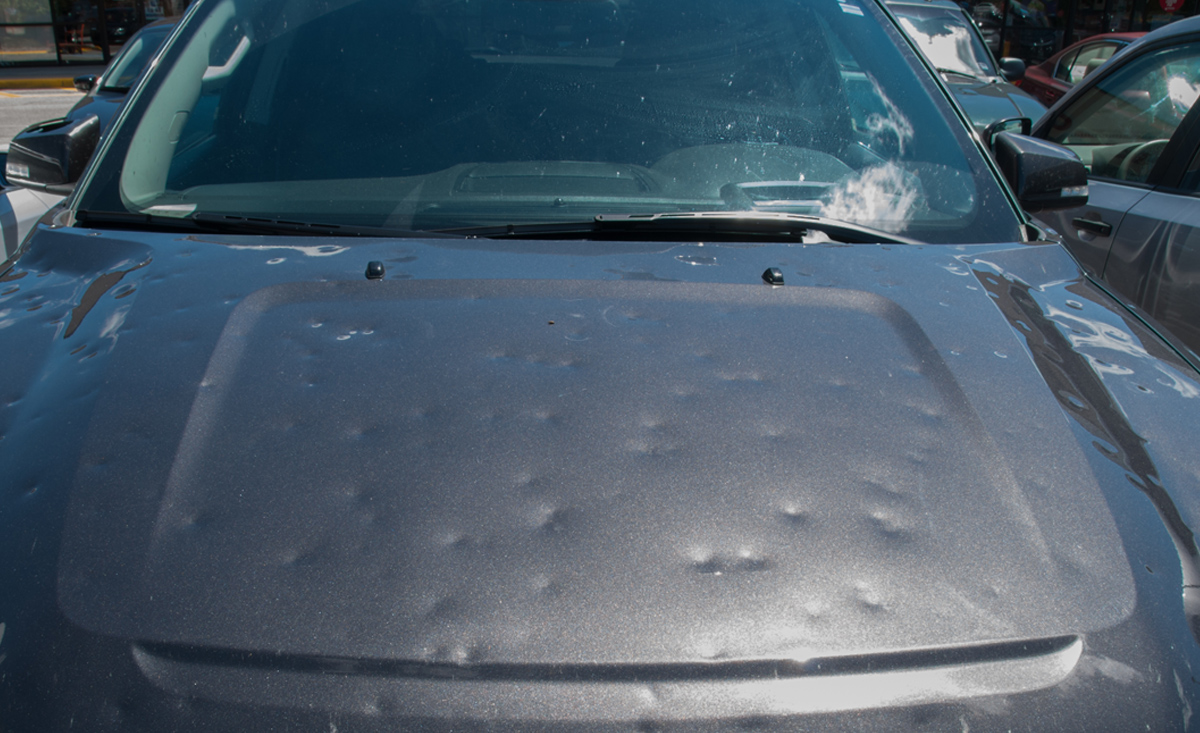
“It doesn’t take hail stones the size of a R5 coin to dent the bonnet or damage the window of your car,” said Santam.
“Even a small hail storm can cause significant damage.”
Every insurance claim is unique
Despite not looking as serious as, for example, a head-on collision, hail damage regularly results in a vehicle being written off as it would be too costly to painstakingly repair every damaged panel.
It’s therefore important to ensure that you are covered for hail damage by your particular insurer, and not to assume that you will be simply because you’ve taken out a comprehensive policy.
Law firm Adams & Adams highlights that you may not be automatically covered in the event of a hail storm as each insurance claim is unique and assessed on its merit.
There are, however, steps that insured parties can take to enhance their chances of successfully claiming.
The first and most important is to ensure whether the policy concerned does cover the hailstorm peril which can be verified with a broker or directly with the insurer. If not, then there is no cover.
“Importantly, if one is not covered for this peril as a result of a broker’s oversight, there may be a possibility of a legal claim against that particular broker,” said Adams & Adams.
“There is also a possibility of being ‘underinsured.’ In this case, again, one may have a claim against the broker.”
The firm emphasises that policy clauses should also be carefully considered, in particular exclusions, limitations, and conditions.
“Insurance policies are ordinarily technical and, therefore, difficult to understand. In fact, there are complex legal rules applicable to the interpretation of insurance contracts,” it said.
“As such, it is recommended that insureds seek legal advice on the interpretation of their policy or consult their broker.”
Other proactive measures one should adopt include:
- Report your claim as soon as possible to your broker/insurer. Most policies have specified time periods within which one should report a claim.
- Have all the necessary documentation and information readily available regarding your policy.
- Take pictures of the damage caused.
- Be cautious not to attend to any repairs yourself unless the insurer has agreed to that.
- Provide all the documentation and information requested by the insurer as soon as you can.
- Be on the lookout for further requests by the insurer.
- Provide truthful and accurate information to the assessor.
“There is no one-size-fits-all approach to the reporting and handling of insurance claims; however, the steps above can place one in a better position to succeed with a claim,” concludes Adams & Adams.
“In conclusion, insureds, when submitting their claims, should always bear in mind their duties towards their insurers. These include acting in good faith; providing truthful and honest information and not being disruptive in the insurer’s investigation; allowing the insurer’s claims handling process to run its course; etc.”






 Loading ...
-facelift-2-2025.10.webp)
-2025.11.webp)