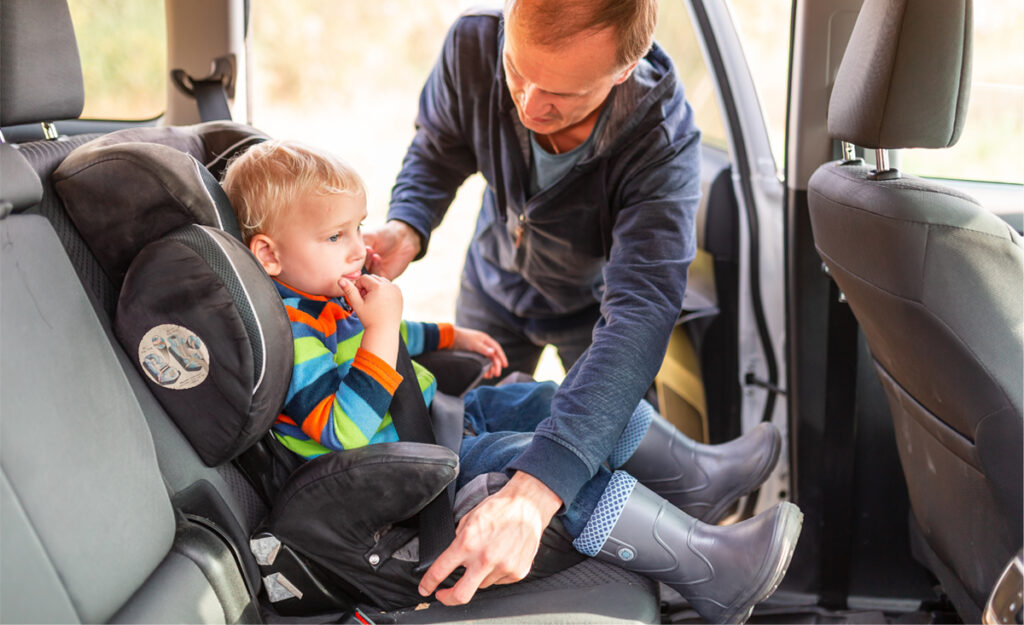
While most people are aware that infants and toddlers need to be strapped into a baby seat in a car, many do not realise that children under the age of 12 should also be using a booster seat.
This week is Child Passenger Safety Week, and several stakeholders have voiced their concerns over the number of children injured in road accidents in South Africa.
According to the Red Cross Children’s Hospital, car crashes are the single biggest killer of healthy children in South Africa, and account for 80% of severe brain injuries.
Research by the African Brain Child initiative has shown that child seats can reduce such injuries by up to 96%.
Child seats are a legal requirement for infants under the age of three in South Africa, but there has been a renewed call for parents to strap their older children into their cars using booster seats, according to IOL.
“Booster seats aren’t optional; they’re an essential step in every child’s journey to safer travel,” said Peter McNaughton, Managing Director of Kelston Motor Group.
“Any child under 150cm tall still needs a booster seat – no matter how grown-up they look.”
Child seat vs booster seat
The terms ‘child seat’ and ‘booster seat’ are sometimes used interchangeably but are meant for different age groups.
Child seats are what most people commonly think of when they hear either term, as these are large enclosed seats that lock into place using a car’s ISOFIX mounts.
These seats usually face forward, though it is increasingly popular to buy a backwards-facing seat for very small infants, as these can provide better protection and force redistribution in a head-on collision.
A booster seat is a stepping stone between a child seat and the car’s regular seat that is meant to protect smaller occupants.
Most children grow to 150cm between the ages of 10 and 12, which is important as this is the height where seatbelts function as intended.
On smaller individuals, the seatbelt doesn’t fit properly as the horizontal strap tends to stretch across the stomach instead of the waist.
The vertical strap tends to cover the neck instead of the shoulder.
Many parents will jump from child seats to regular seats without using a booster, which puts their children at risk of greater injury.
“Many parents see the move from a car seat to a seatbelt as a milestone of independence,” said Debbie Billson from Maxi-Cosi, a child seat manufacturer.
“But the reality is, a standard seatbelt is not built for a child’s body. Skipping the booster step puts children at serious risk.”
She warned that a poorly positioned seatbelt can cause severe internal or spinal injuries in an accident.




 Loading ...
-facelift-2-2025.10.webp)
-2025.11.webp)