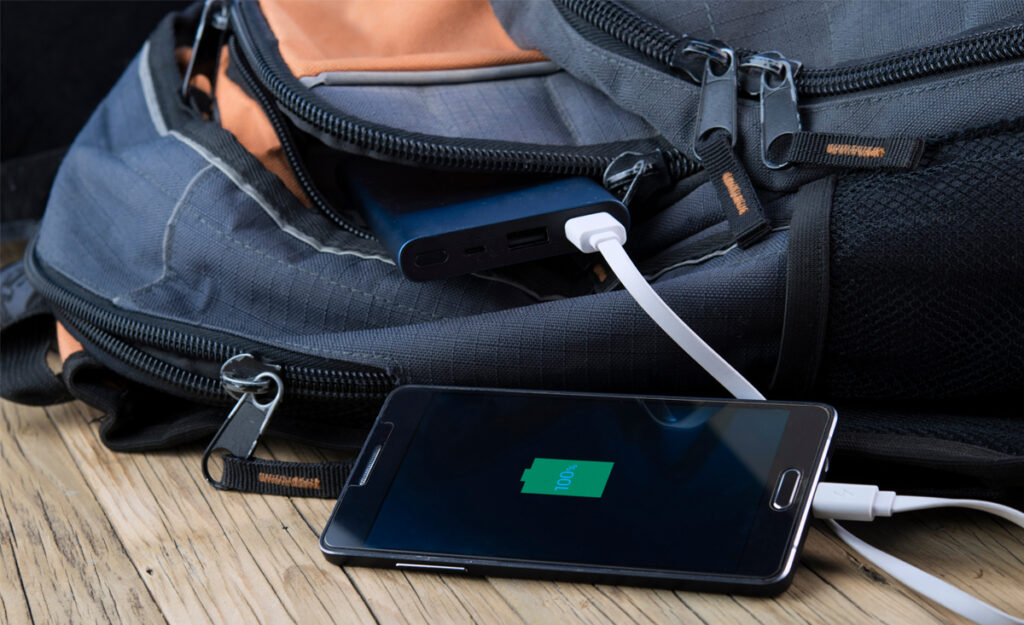
The International Air Transport Association (IATA) has published new regulations for transporting battery-powered devices, such as power banks, on aeroplanes.
The changes are part of IATA’s 2026 editions of key industry manuals for cargo and ground operations, which include around 100 major changes and revisions to align with evolving global standards.
Among these changes are new adjustments for power banks and batteries, which are classified under the Dangerous Good Regulations.
Most electronics nowadays run on lithium-ion cells, including laptops, smartphones, and wearables, and this substance can ignite when improperly handled, leading to fires that are difficult to put out with conventional means.
While incidents involving lithium-ion batteries are extremely rare, relative to how widespread the technology is, the IATA is stepping up regulations in response to issues that have occurred on aircraft.
It explained that the number of lithiu-ion devices transported as cargo via air has surged 25% year on year.
“At the same time, the industry has seen several incidents involving overheating power banks on aircraft, contributing to the need for revised regulations around the shipment of lithium batteries,” it said.
The first rule affecting travelers is that storing spare batteries and power banks in checked luggage is strictly prohibited.
This is because of the risk of a fire breaking out in the cargo hold where it can potentially go unnoticed and spread to other peoples’ luggage.
Several surveys have shown that around half of flying travellers are unaware that they should not carry lithium-ion batteries in their checked luggage despite airlines’ warnings, reported MyBroadband.
The new regulations also state that batteries and power banks cannot be charged using in-flight power, such as the outlets found in the cabin seats.
Additionally, they must not be used to charge other portable electronic devices during taxi, takeoff, or landings.
Power banks and batteries cannot be stored in the overhead luggage bins; instead, they must be kept under the seat in front of the owner or another easily-accessible location like a seat pocket.
The regulations also state that lithium-ion power banks with a capacity of 20 watt-hour (Wh) or higher, and batteries with 100Wh or more that are stored with other equipment must have a charge of 30% or less.
In countries like China, airport security will even confiscate any power banks with a rating over 20,000 mAh (milliampere-hour).
Zero cases recorded in South Africa

Over the past few years, international air carriers like Emirates, KLM Royal Dutch Airlines, and Singapore Airlines have started to ban charging and discharging power banks during flights.
Several companies also recommend that passengers use the onboard outlets to charge their smartphones instead of a power bank.
Even though foreign airlines have reported an increase in battery fires, South Africa’s three biggest domestic air carriers have not recorded a single incident to date.
Airlink, Lift, and FlySafair all confirmed to MyBroadband that they still allow customers to charge and discharge their power banks in flight.
Even so, these companies follow the IATA regulations when it comes to handling electronic devices.
In other words, South Africans can expect stricter rules regarding power bank use in the near future.
Lift already requires that passengers keep a close eye on their devices during flights to ensure they aren’t generating excessive heat.
“Should the device generate heat, pose a risk, or interfere with the aircraft’s electrical systems, cabin crew will request passengers to disconnect the device,” said Lift.
“In the unlikely event something did overheat, it would trigger a diversion, which is standard safety protocol.”
All commercial airline cabin crews are trained to contain, extinguish, and dispose of malfunctioning electronic devices.





 Loading ...
-facelift-2-2025.10.webp)
-2025.11.webp)