The most fuel-efficient bakkie in South Africa – But there’s a catch


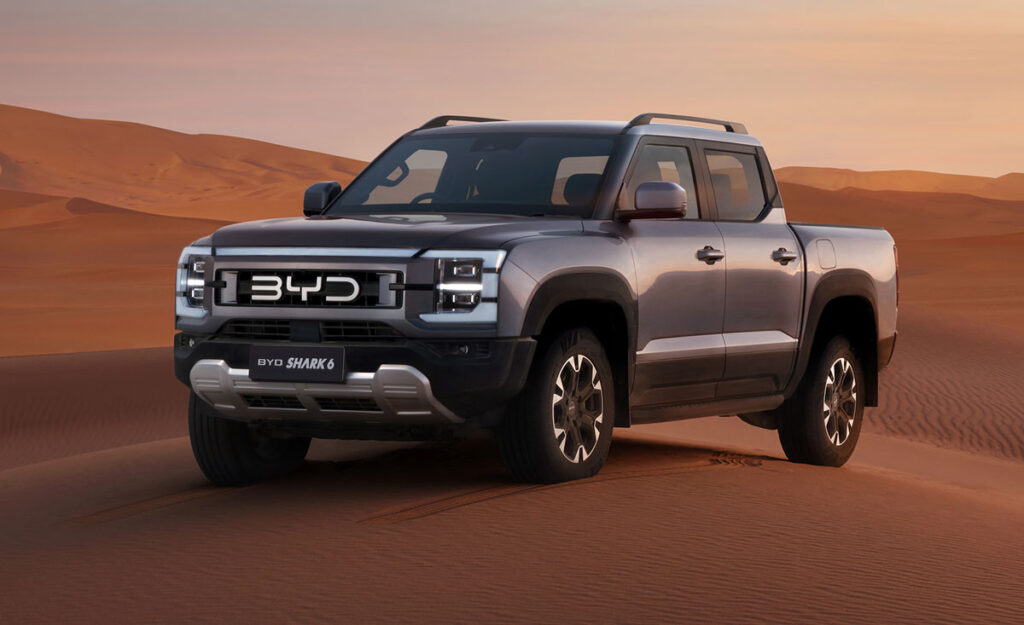
The most economical bakkie you can buy in South Africa is the BYD Shark, but only if you use make use of its biggest selling point.
The Shark is a plug-in hybrid (PHEV), which means it can be driven as either a petrol vehicle or a fully-electric one.
At its core is a 1.5-litre turbocharged petrol engine, which is assisted by two electric motors.
This gives it an impressive power output of 321kW and 650Nm – even more than the Ford Ranger Raptor – but the main advantage of this setup is that the e-motors can run the bakkie by themselves.
The e-motors are powered by a 29.59kWh battery, which is large enough to afford an electric driving range of 85km.
While this is considerably less than what you’d get from an all-electric vehicle like a Tesla, it’s more than enough to cover what a typical owner will travel on a daily basis.
For most people, their daily routine consists of driving to work, dropping and picking up the kids from school, and visiting the gym or the shops – all of which are usually in the same general area.
With this in mind, a PHEV like the Shark can be used as an electric vehicle for the vast majority of its trips, provided the owner remembers to charge it every night.
For this reason, car manufacturers claim that PHEVs have exceptionally low fuel consumption, though this comes with several caveats.
What to be aware of

In the case of the Shark, BYD states that the pickup has a combined fuel consumption of just 2.0l/100km.
For reference, most diesel bakkies consume between 7.0l and 9.0l/100km.
This figure should not be taken at face value, however, as the word “combined” is doing a lot of heavy lifting in this context.
Carmakers use the term “combined fuel consumption” in their advertising because this figure is calculated based on real-world test conditions that determine a model’s lowest and highest usage stats, taking an average between the two.
Vehicles are more efficient on empty highways than on congested city streets, and a combined fuel consumption calculation tends to weigh the latter more heavily since most owners will spend more time driving in urban conditions.
When it comes to PHEVs, companies factor in the electric driving mode in these calculations, as it is assumed that anyone who buys a PHEV will use the electric mode for their daily commute.
Consequently, the advertised fuel consumption stats for these vehicles tend to be very low.
In essence, when BYD says the Shark averages 2.0l/100km, what they’re saying is that you’ll spend 85km driving on the battery and the remaining 15km using the petrol tank.
Put another way, the Shark uses two litres of petrol (R42,24 as of November 2025) to do 100km, working out to a cost of 42c per kilometre.
Of course, electricity isn’t free, but it is cheaper than petrol, costing approximately R88.74 to top up the battery with the cheapest rates via a home charger.
Combining the electricity and petrol prices gives us a bill of R130.98, which works out to R1.3 per kilometre.
This type of marketing something unique to BYD, mind you, as this is an industry-wide practice used by everyone from BMW to Toyota and Jaguar Land Rover.
If you were to rely almost exclusively on the Shark’s combustion engine, its fuel consumption would be closer to 9.6l/100km, which is actually on the high end for most bakkies.
It has a 59-litre fuel tank and a petrol range of 585km, which is extended to 670km when the battery is taken into account.
PHEVs are often considered to be the best of both worlds as they offer the functionality of an electric vehicle while retaining the practicality of a combustion model.
The downside is that they are very expensive, as you are effectively paying for a car with two powertrains.
This Shark costs R959,900, so unless you can already afford one to begin with, it’s not worth over-extending your budget to purchase one if fuel savings are the only thing you are concerned about.
For anyone who prefers a “normal” bakkie without any hybrid assistance, your best bet is either the Ford Ranger or the VW Amarok, as these two models consume 6.9l/100km, provided you get the 2.0-litre single-turbo diesel option.




 Loading ...
-facelift-2-2025.10.webp)
-2025.11.webp)