The automotive industry comprises numerous brands and makes, having evolved over a period of more than a hundred years.
However, among the various bands, there is one that holds the title for the oldest carmaker, which has been making cars to this very day.
Most people, at this stage, would assume the carmaker being discussed is Ford, which is among the oldest still in operation; however, this isn’t the case.
The carmaker in question is Peugeot, the lion-headed carmaker that began in France and which has since established itself as a well-known, global brand.
While Peugeot wasn’t the first to begin making cars, it is currently the oldest company that began producing vehicles still in operation, having built its first car in 1889.
This initial vehicle was a steam-powered car designed by Léon Serpollet, and four examples of the vehicle were made.
However, it should be noted that these four steam-powered vehicles were more akin to a proof of concept than a mass-market product.
Since then, the company has significantly expanded its operations and is now one of many modern brands producing cars worldwide.
Additionally, the first gasoline-powered car was created by Mercedes-Benz, with Karl Benz’s 1886 Patent-Motorwagen.
However, Peugeot is the older company and therefore takes first place in this context.
Early days
Peugeot did not begin as a carmaker; instead, it was founded in 1810 as a steel foundry, manufacturing saws and other hand tools.
This was later followed by an expansion to produce coffee grinders in 1840, pepper grinders in 1874, and bicycles in 1880.
As it happens, the family-owned Peugeot Saveurs, an offshoot of the main group that shifted its attention to cars, still manufactures grinders and other kitchen and table-service equipment to this day.
First cars
The first car built by Peugeot was a three-wheeled, steam-powered car designed by Léon Serpollet.
However, steam power was heavy and cumbersome to apply to something as relatively compact as a car, rather than a train, so only four examples were made before Peugeot abandoned the idea and shifted to a petrol design.
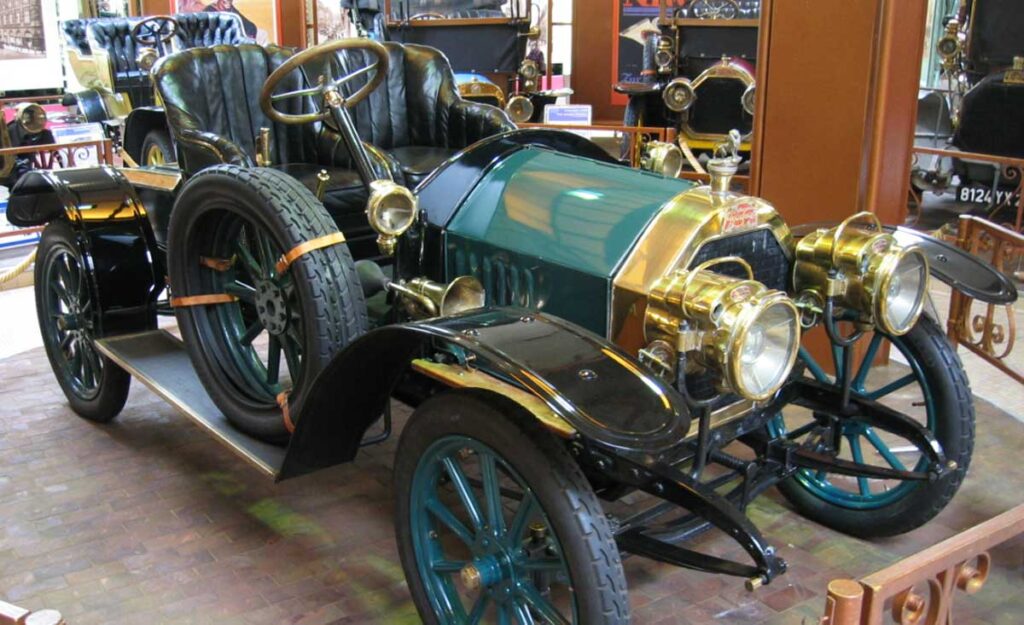
This shift occurred after a meeting with Daimler and Émile Levassor in 1890, leading to the creation of a four-wheeled car with a petrol-fueled internal combustion engine built by Panhard under Daimler’s licence.
The car was more sophisticated than others on the market at the time, with a three-point suspension and a sliding-gear transmission.
This new model proved quite popular, and over the next decade or so, Peugeot would steadily increase production numbers, going from only 29 being built in 1892 to 300 in 1899.
Peugeot was also the first manufacturer to fit rubber tyres (solid rather than pneumatic) to a petrol-powered car, and was a pioneer in motoring racing.
This is as Albert Lemaître won the world’s first motor race, the Paris-Rouen, in a 3 hp Peugeot.
Later, in 1896, the first Peugeot engines were produced, marking the end of reliance on Daimler and the beginning of a long history of car manufacturing.




 Loading ...

-2026.10.webp)