Despite imminent fuel price relief in South Africa, there are still many controllable and uncontrollable factors that continue to affect the way fuel prices are calculated, and some are lesser-known than others.
The Basic Fuel Price (BFP) is heavily dependent on uncontrollable international factors, including crude oil prices, international supply and demand for petroleum products, and the strength of the US dollar.
Other factors that have a knock-on effect on local fuel prices include the market-related costs of importing a large quantity of South Africa’s liquid fuel requirements from overseas refining centres.
The current rand/US dollar exchange rate, therefore, has a major impact on local fuel prices, as the petrol price at petroleum refining centres in the Mediterranean, Arab Gulf, and Singapore are quoted in US dollars.
According to the Department of Mineral and Petroleum Resources (DMR), the BFP principle is an elegant, arms-length method of basic fuel price determination to ensure that local refineries compete with international counterparts.
Shipping fuel from international hubs also affects domestic pricing, with rates determined by the London Tanker Brokers Panel annually, adjusted monthly in line with the Average Freight Rate Assessment.
When loading and unloading petroleum products, ships may spend a limited amount of time in port before a demurrage penalty is issued, at a rate published by the World Scale Association.
Insurance and ocean loss allowances also impact the price of fuel, including costs such as letters of credit, surveyors’ and agents’ fees and laboratory costs.
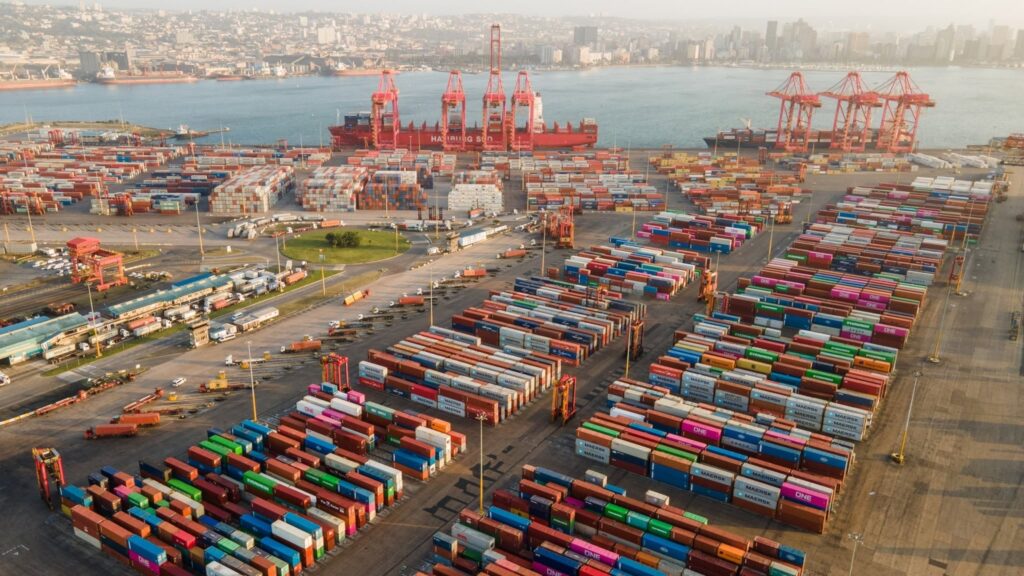
South African harbour facilities are utilised to offload petroleum products into onshore storage facilities. Fees for these facilities are based on tariffs set by the National Ports Authority of South Africa.
These storage and handling facilities also take their cut.
Local taxes and levies

According to the DMR’s Fuel Price Structure, several local factors also have a major effect on fuel prices.
Merely transporting fuel inland plays a role in fuel prices, leading to higher prices for inland provinces compared to those along the coast.
Over the last month, that difference was 87 cents per litre for both 93 and 95 octane petrol, as well as 0.005% and 0.05% diesel.
Wholesale and retail margins also come into play, as fuel, after all, is a product that needs to be purchased, and not something given away for free.
Wholesale margins accounted for 67 cents per litre of petrol and 99 cents per litre of diesel, while retail margins accounted for R3.15 of every litre of petrol.
Secondary storage and secondary distribution costs are also paid for by the consumer, at 39 cents per litre to store all fuel grades, and 19 cents per litre for secondary distribution.
For diesel products, an almost negligible half a cent per litre is spent on IP tracer dye, which is used curtail the unlawful mixing of diesel and illuminating paraffin.
These are the levies and taxes implemented in South Africa that affect the fuel price:
| Fuel tax | Petrol 93 | Petrol 95 | Diesel 0.05% | Diesel 0.005% |
|---|---|---|---|---|
| Fuel levy | R4.15 p/l | R4.15 p/l | R4.02 p/l | R4.02 p/l |
| Customs and excise duty | 4c p/l | 4c p/l | 4c p/l | 4c p/l |
| Road Accident Fund levy | R2.18 p/l | R2.18 p/l | R2.18 p/l | R2.18 p/l |
| Petroleum Products levy | 0.33c p/l | 0.33c p/l | 0.33c p/l | 0.33c p/l |
| Total | R6.70 p/l | R6.70 p/l | R6.57 pl | R6.57 pl |
By these calculations, nearly R7 of every litre of fuel goes towards taxes, duties, and levies.
When adding the additional costs of transport, profit margins, and storage fees, the average South African is paying between R9 and R12 per litre more than the Basic Fuel Price.
Over the last month, the BFP ranged between R9 and R10 per litre depending on fuel type and grade.





 Loading ...
-facelift-2-2025.10.webp)
-2025.11.webp)