
How to avoid accidents with motorbike delivery riders in South Africa


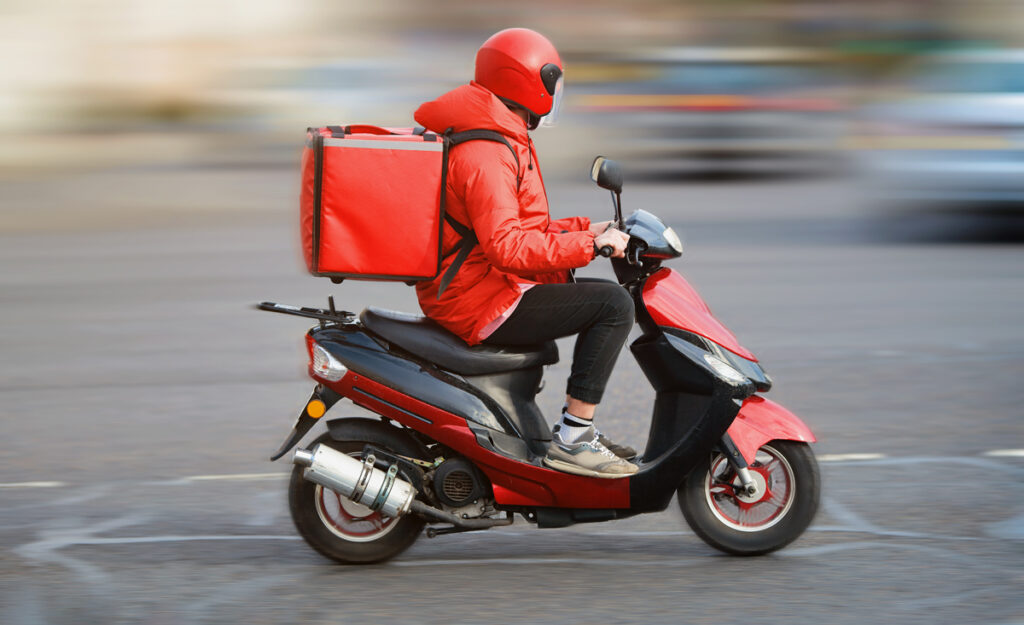
The rapid rise of grocery-on-demand services and take-away deliveries in South Africa has led to an increase in delivery bikes on the road, requiring greater driver and rider vigilance to avoid collisions.
Often, delivery riders are young and inexperienced riders looking to make a living, but are not given proper training or gear.
According to Hein Jonker, Founder and Chief Instructor at the Motorcycle Safety Institute, they are shown the basics by other riders, and put on the roads with a mere learner’s licence.
In terms of safety gear, riders are often given nothing more than a R500-R600 helmet, which offers no real protection, and a high-visibility vest or rain suit.
Jonker told Arrive Alive that companies that employ delivery drivers often buy the cheapest bikes they can afford, reflecting a short-term and inconsiderate attitude toward the lives of riders.
He also explained that, while the type of bike used depends on the rider’s status, as well as the employer’s requirements, riders often exceed the motorcycle’s performance boundaries.
“Expecting a rider to operate a motorcycle beyond its performance limits will not only push the motorcycle to destruction, but also stretch the rider and his/her abilities outside their comfort zone,” Jonker said.
“Further to this, it is proven that small-diameter wheeled scooters are prone to a higher accident rate.”
He highlighted four distinct accidents that delivery drivers are involved in, noting that these are no different from what regular daily commuter bikers experience.
The first type of accident these riders may be involved in is rear-ending another road user, due to their own lack of anticipation.
Conversely, riders are also prone to being rear-ended due to cutting and braking.
Jonker explained that bikers are at risk of being pushed off the road due to a lack of anticipation and awareness, either their own or another road user’s.
Lastly, delivery drivers are also at risk of being involved in a T-bone accident, whether they hit another road user or get hit, due to ignorance or a lack of concentration.
Avoiding collisions

In his own blog, Bike Talk, Jonker noted that every motorcycle rider dreads hearing the words “I didn’t see you”.
He did, however, clarify that while it sounds like a cheap excuse for negligence, there is a physiological and psychological reason why this happens.
Road users are conditioned to look for threats capable of harming them, only scanning for vehicles of the same size or larger than the one they are travelling in.
Because of this, spotting a motorcycle does not trigger the same “warning” in a driver’s subconscious.
The bike’s small profile makes it difficult for drivers and other motorcyclists to accurately judge a bike’s approach speed.
Jonker explains that the most critical psychological factor lies in how drivers move their heads.
“When a driver arrives at an intersection and looks left and right too quickly, their eyes do not record a smooth, continuous video of the scene,” he said.
“Instead, the brain captures a series of separate, static images like snapshots with gaps in between them.
In this gap, the motorcycle disappears, thanks to its narrow profile.
“It can easily fit entirely within the blind spot created between two of these mental snapshots. The driver’s brain stitches the images together to create the illusion of an empty road,” added Jonker.
Should a driver move his or her head more slowly, the gap between images would decrease, creating a panoramic view in which no vehicle is small enough to hide.
Jonker’s tips for drivers of other vehicles:
- Check your blind spots: Motorcycles are smaller and can easily disappear in a car’s blind spot. Always double-check before changing lanes or making turns.
- Give motorcycles space: Treat motorcycles as you would any other vehicle and avoid tailgating or cutting them off. When passing, ensure there is ample space before returning to their lane.
- Be cautious at intersections: Practice caution at intersections, and look twice for motorcycles before proceeding, as they can be harder to see than larger vehicles.
- Watch for turning signals: Motorcycles’ turn signals may not be as visible as those on larger vehicles. Keep an eye out for hand signals and be prepared for sudden changes in direction.
- Be mindful of road conditions: Motorcycles are more sensitive to road conditions, such as potholes, gravel, or wet surfaces. Give them extra space and time to manoeuvre in these situations.
“Sharing the road safely with motorcycle riders requires a combination of awareness, understanding, and patience from all road users,” said Jonker.
“By recognising the unique challenges faced by motorcyclists and adopting responsible driving habits, we can work together to create a safer environment for everyone on the road.”



 Loading ...