As a result of the ongoing conflict in the Middle East, which has seen oil refineries and petroleum handling ports targeted and the Strait of Hormuz closed, fears over global fuel supply are growing.
However, South Africans may not need to be as worried as other countries, as Iran’s Ambassador to South Africa said the Strait of Hormuz is open to the country’s allies.
According to eNCA, Mansour Shakib Mehr said on Wednesday that the strait, through which much of the world’s oil and petrol products are transported, is closed only to the United States and its allies.
He explained that Iran had not completely closed the Strait of Hormuz, and is instead vetting vessels from countries considered friendly, which include China and India.
These countries have seen their ships allowed to pass, while ships carrying cargo linked to the US and Israel were being stopped.
Shakim Mehr noted that Iran is prepared to extend this agreement to South Africa, should the country request assistance in moving freight or oil shipments through the region.
eNCA further reported that at least five ships exited the Strait via Iranian waters this week.
“The new route illustrates how Iran’s selective blockade has evolved to allow allies and supporters to transit”, maritime intelligence firm Windward said, citing its tracking as “rising evidence that Iran is exerting permission-based transit and control of the strait”.
According to Natasha Kaneva, a commodities analyst at JPMorgan bank, at least four ships had been tracked exiting the strait via the Larak–Qeshm Channel, near the Iranian coast.
“This is not a standard route for vessels and could reflect a process designed to confirm vessel ownership and cargo, enabling passage for ships that are not affiliated with the US or its allies,” she said.
Several countries have since opened talks with Iran in hopes of securing safe passage for their vessels, while the US has pushed its allies to provide military protection for shipping in the region.
Not an immediate solution

Since the start of the conflicts, global oil prices have increased by more than 55% as a result of targeted oil refineries and massively decreased shipments from the Persian Gulf.
Freight News reports that South Africa only receives around 24% of its crude oil from Saudi Arabia, with Nigeria and Angola providing two-thirds of the country’s oil demand.
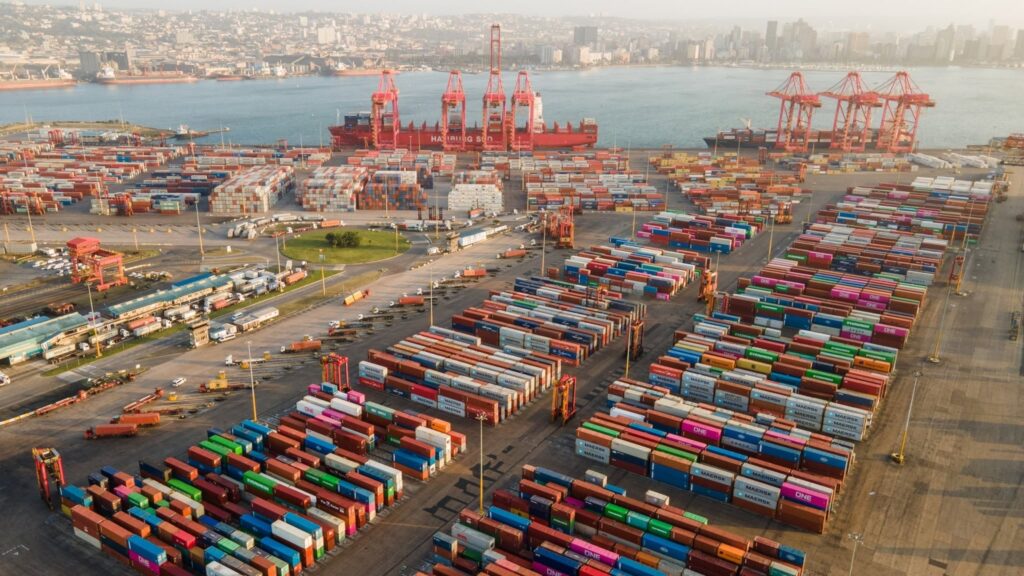
Refined oil and petroleum products shipped to South Africa come from the Port Sultan Qaboos in Oman’s Muttrah region on the Arabian Sea, which is currently unaffected by blockades in the Strait of Hormuz.
However, petrol and diesel prices are still expected to skyrocket in April as a result of the ongoing tension.
Petrol prices are expected to rise around R4 per litre, while diesel could see prices increase by over R7 per litre.
Johann Els, chief group economist at PSG Financial Services, warned that the best-case scenario for local motorists is a quick resolution to the Middle East conflict.
He added that immediate policy formation to enable new oil capacity for South Africa is an urgent requirement at the moment, noting that “it’s a long-term strategy” that “won’t solve the immediate problems”.
Increasing local petroleum production is something the South African government is committed to, as outlined by the Minister of Mineral and Petroleum Resources, Gwede Mantashe, at the Southern Africa Oil and Gas Conference.
“The importance of responsible oil and gas development in meeting our socioeconomic needs cannot be overstated,” he said.
“Therefore, increasing our petroleum refining capacity within our borders, beyond the NATREF, Astron Energy refinery, and Sasol Secunda coal-to-liquids plant, would significantly enhance our industrialisation efforts and contribute to GDP growth.”
The minister added that it is against this backdrop that the government continues to reform its legislative framework to advance the local petroleum sector in a bid to make a meaningful contribution to the economy.
Until then, it remains to be seen if South Africa takes Iran up on its offer, and whether this will represent a solution to ease the pressure of escalating petrol prices and avoid potential shortages.



 Loading ...
-facelift-2-2025.10.webp)
-2025.11.webp)