WeBuyCars’ share price has seen a substantial drop over the last four months, but local investment experts believe the company will outlive its short-term pain and experience a major resurgence in value.
WeBuyCars is one of the largest car selling platforms in South Africa, moving approximately 15,000 units every month.
Founded in 2001 by brothers Faan and Dirk van der Walt, the company grew from a small holding in Pretoria to a major franchise with showrooms in major cities across the country.
It was officially listed on the Johannesburg Stock Exchange on 11 April, 2024 with an opening share price of R20.00.
It quickly became a favourite among investors, with share prices rising by nearly 200% in the company’s first 15 months since it went public.
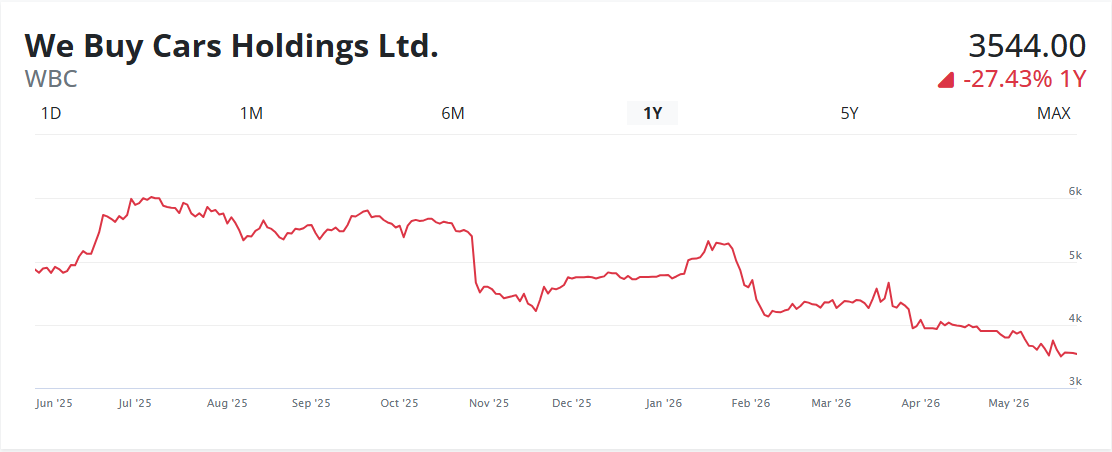
However, WeBuyCars fortunes have dropped off over the last year as the company struggles to adapt to growing market pressures, investor expectations, and new competition.
Its share price saw a steep drop in November 2025, and while it was on the verge of recovery at the end of January 2026, its value plummeted again in February due to the outbreak of the war in Iran.
The conflict in the Middle East led to a surge in fuel prices in South Africa which, in turn, led to a massive drop in consumer demand for new vehicles.
Between January and May 2026, WeBuyCars share price dropped 31% from R52.85 to R36.51.
As a result, its market cap declined from approximately R22 billion to R15 billion.
High fuel prices are not the only factor, however, as WeBuyCars is one of several South African companies struggling to compete with the influx of new Chinese car brands.
These cars are significantly cheaper than their legacy rivals, so much so that it is possible to buy something like a brand-new Chery Tiggo SUV for the price of a used VW Polo hatchback.
Consumers have cottoned on to this fact, and the pre-owned market has seen a decline in sales as motorists return to the new-car sector in search of a better deal.
For WeBuyCars, this has resulted in a loss of value, shareholder dilution, and an adjustment in shareholder expectations.
Poised for a comeback

Chief Investment Officer at MP9 Asset Management, Aheesh Singh, explained that WeBuyCars’ business model is very different to its peers because it only sells second-hand cars, and the margins it commands are relatively high compared to selling a brand-new vehicle.
In an interview with Business Day TV, Singh said that if the company maintains its sales volume over the next year or two, valuations should remain elevated.
“But it’s a very sensitive stock to the consumer’s pocket,” said Singh.
Jean Pierre Verster, CEO at Protea Capital Management, concurred, stating that WeBuyCars business model is quite adaptable.
“Because they turn their inventory so quickly, they can adapt based on the feedback they get from the market,” he said.
“A year and a half ago, they tried going for more expensive cars that weren’t as old as their previous target market, and it started to work and they made very nice margins on those higher value cars.”
“But then they got burned a bit, so they have retreated back now to more lower value, older cars.”
Essentially, their quick turnover allows the company to adapt its strategy to match the current market without getting stuck with unsold inventory.
Verster said the dip in WeBuyCars valuation is defensive, and that there is an opportunity when there is a weakness in the share price, given the flexibility of the business.
WeBuyCars share price over the last year


 Loading ...