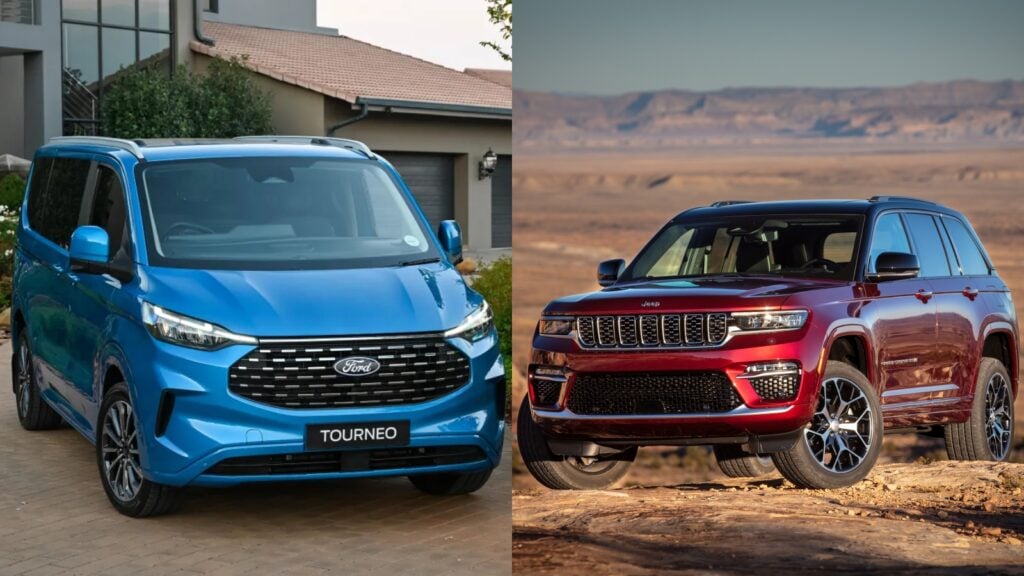
The National Consumer Commission (NCC) has notified South African consumers of recalls for more than 600 faulty Ford models and 82 Jeep SUVs.
Ford Motor Company of Southern Africa informed the NCC of the recall of 633 Ford Transit and Ford Tourneo Custom models sold in South Africa between 1 March 2025 and 20 May 2026.
At the same time, Stellantis South Africa informed the commission of its own recall of 82 Jeep Grand Cherokee models that were made available from 2021 to 2023.
Regarding the Ford recall, the American auto giant explained that faulty units could experience gradual deterioration in wiper function or a sudden, complete loss of operation.
“This condition may reduce or eliminate windshield visibility under certain driving conditions, increasing the risk of an accident,” noted the NCC.
The faulty Jeep Grand Cherokee models, on the other hand, may have had their rear coil springs incorrectly installed.
“The rear coil spring may detach from the vehicle while driving, causing a hazard to drivers and occupants of other vehicles,” explained the NCC.
“The vehicle may crash without prior warning and/or may result in injury to other road users.”
Consumers who own the models in question have been urged by the NCC to report to their nearest authorised dealership for inspection.
It noted that the necessary repair work will be carried out at no additional cost to the consumers.
Those with additional questions relating to the recall are encouraged to direct these to the NCC at [email protected].
40,000 passenger vehicles recalled in South Africa so far this year

In 2026 alone, car manufacturers have issued recall notices of nearly 40,000 individual units, whereas in the entirety of 2025, the NCC recalled 50,000 individual vehicles.
This has created what the Automobile Association (AA) of South Africa called a “road safety failure”.
“The scale of these recalls reveals a systemic failure and weakness in vehicle pre-market quality assurance, manufacturing oversight and regulatory verification,” the AA noted at the time.
“Although vehicle recalls currently serve an essential role in addressing latent safety defects, they are inherently reactive in their nature and therefore inadequate as a safeguard.”
It has been argued that South Africa’s vehicle recall system has proven that most notices arrive too late, and only once defective vehicles are already in circulation, being driven by unsuspecting owners.
“Instead of preventing danger, the recall system responds to it, exposing drivers, passengers and pedestrians alike to avoidable risks,” the AA declared.
The largest single recall so far this year has been VW’s recall of thousands of Polo Vivo units sold nationally between February 2025 and February 2026.
The recall of 25,729 individual units represents more than half of all vehicles recalled in South Africa so far this year.
Notice was issued regarding concerns relating to the height of a rivet used in the Vivo’s handbrake lever assembly.
If the rivet did not meet the required manufacturer specifications, it could prevent the handbrake from engaging correctly, or in rare cases, it may have also caused the handbrake to disengage without warning.
The second-largest recall in terms of total units was issued by another major manufacturer, when Toyota recalled the Toyota Crown, Land Cruiser 300, Prado, RAV4, and bZ4X electric SUV, as well as several Lexus models.
In total, 6,525 vehicles were recalled by the Japanese automaker due to parking assist issues, with 4,858 Toyota units affected, as well as 1,667 from Lexus.
This was also the second combined recall of the year issued by the two automakers, which share platforms and components across their vehicle line-ups.




 Loading ...