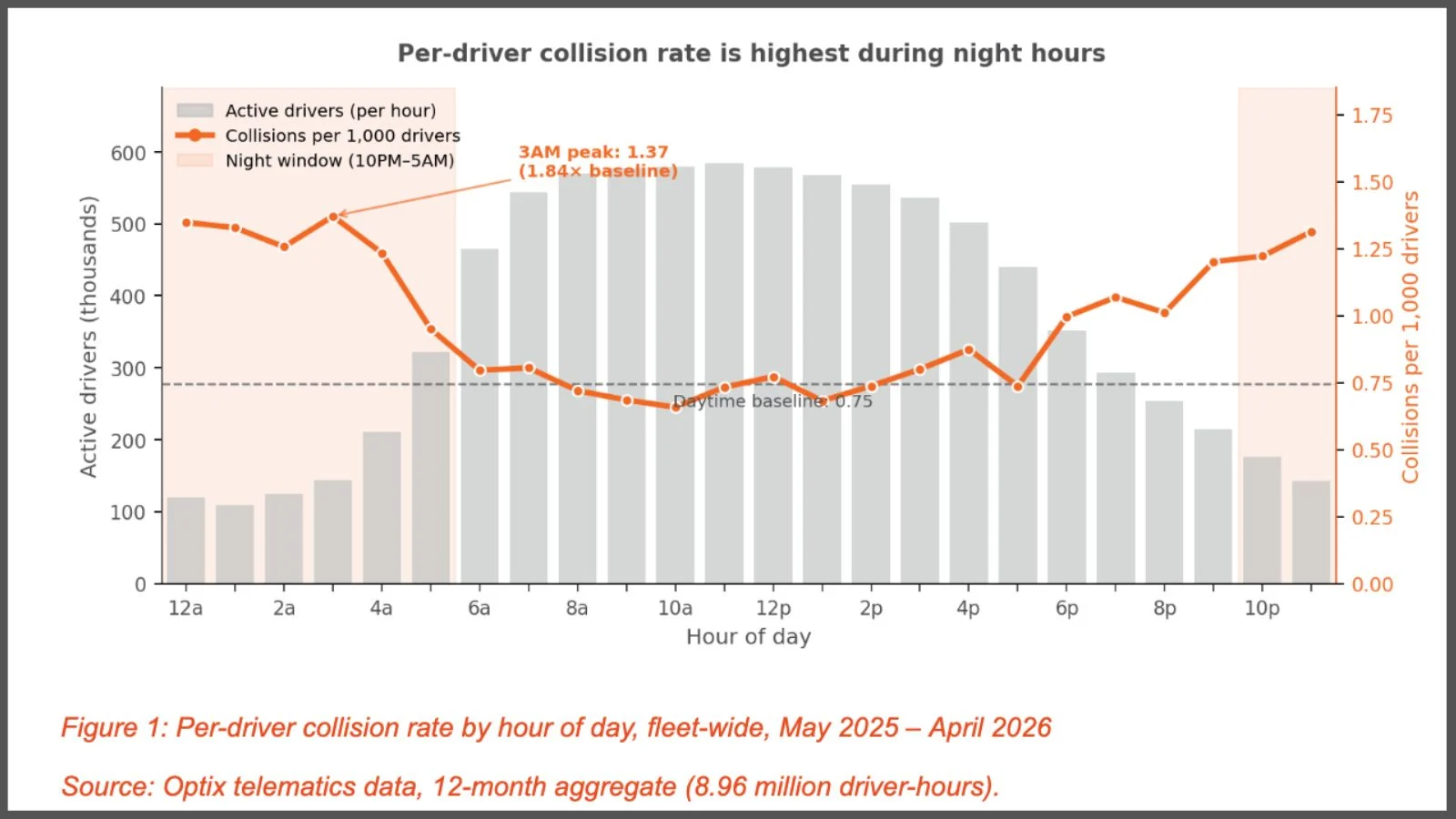
New data shows that the most dangerous time to be on the road in South Africa is at 03:00, with drivers facing nearly double the risk of being involved in an accident compared to any other time.
This was revealed in a report published by Optix Intelligence, a fleet safety intelligence and driver behaviour management company in South Africa.
Optix Intelligence analysed more than 8.9 million driver-hours and 16.1 million recorded driving events across the twelve months between May 2025 and April 2026.
Rather than measuring crashes against overall traffic volume, the company calculated collisions per 1,000 active drivers to draw a clearer picture of individual risk.
According to the data, the safest time to be on the road in South Africa is around 10:00 in the morning, when the collision rate is only 0.66 collisions per 1,000 drivers.
However, the risk gradually increases as the day goes on, rising in the afternoon and evening, before spiking sharply after midnight and peaking at 03:00 with 1.37 collisions per 1,000 drivers.
The report noted that this peak is 1.84 times the daytime baseline, adding that the hours between 23:00 and 01:00 also recorded collision rates over 1.30 per 1,000 drivers, which is far more dangerous than daylight travel.
According to Optix Intelligence, the pattern is not unique to its fleet, since published research and RTMC fatality statistics show the same trend, with night-time accounting for the majority of road fatalities.
The report pointed to a combination of human biology and South Africa’s poor road conditions to explain the increased danger associated with nighttime driving.
The company explained that one of the main reasons for this increased danger is the body’s natural internal clock.
“The human body operates on an internal 24-hour clock that regulates alertness, body temperature, hormone release, and cognitive performance,” noted Optix Intelligence.
During the body’s nighttime circadian dip, between around 02:00 and 06:00, alertness, reaction time and decision-making all decline, and a driver’s ability to respond to unexpected events degrades sharply.
The report revealed that while biology plays a major role, South Africa’s road environment further increases the danger of overnight travel.
The effect of South Africa’s poor road conditions

According to Optix’s report, many rural and regional roads lack street lighting, forcing drivers to rely solely on their cars’ headlights to illuminate the road about 60 to 120 metres ahead.
However, when travelling at highway speeds, motorists are left with very little time to react to unexpected hazards.
The report also highlighted poor road conditions, including potholes, faded lane markings, missing reflective road studs and damaged or stolen road signs, that become harder to spot after dark.
Similarly, livestock and wildlife are a significant hazard, especially on major routes, including the N1, N3, N7, N11 and N12, as well as many provincial roads.
At night, dark-coloured cattle, goats and donkeys can wander onto unlit roads, making them near-impossible to spot until it is too late.
Another major concern, especially in rural communities, is the shared use of roads by vehicles, pedestrians and livestock, with many pedestrians in particular crossing at unmarked locations.
The report noted that broken-down vehicles, trucks on road shoulders and unmarked obstructions are common along many stretches of road, creating further risks for night-time motorists.
A 2025 study of Western Cape Emergency Medical Services data, covering January 2021 to May 2024, reinforces these findings.
It also found that 51.5% of all road traffic fatalities occurred at night, that identified hotspot areas carried more than double the mortality risk, and that pedestrians accounted for 65.3% of all fatalities.
The RTMC’s 2024/25 festive season report found that pedestrians accounted for 41% of all road deaths during the holiday period, which is when overnight and long-distance travel is at its peak.





 Loading ...
-facelift-2-2025.10.webp)