Oil fell for a third day on optimism that a deal can be reached to reopen the Strait of Hormuz, potentially freeing up Persian Gulf supplies.
Brent slid below $79 a barrel, while West Texas Intermediate was near $75 after losing more than 10% in the prior two sessions.
Qatar said on Tuesday that an interim proposal had been drafted, and both Washington and Tehran signalled progress in talks to reopen the waterway.
US President Donald Trump struck an optimistic tone, telling reporters in Los Angeles that “negotiations were good,” talks were “moving along very nicely”, and more would be known within 48 hours.
Separately, Axios reported the US, Iran and Oman were nearing an interim, 60-day accord to reopen the conduit, with Washington aiming for an announcement later Wednesday.
The proposal would see no tolls or fees paid, with inbound vessels using a northern lane, and outbound traffic a southern one.
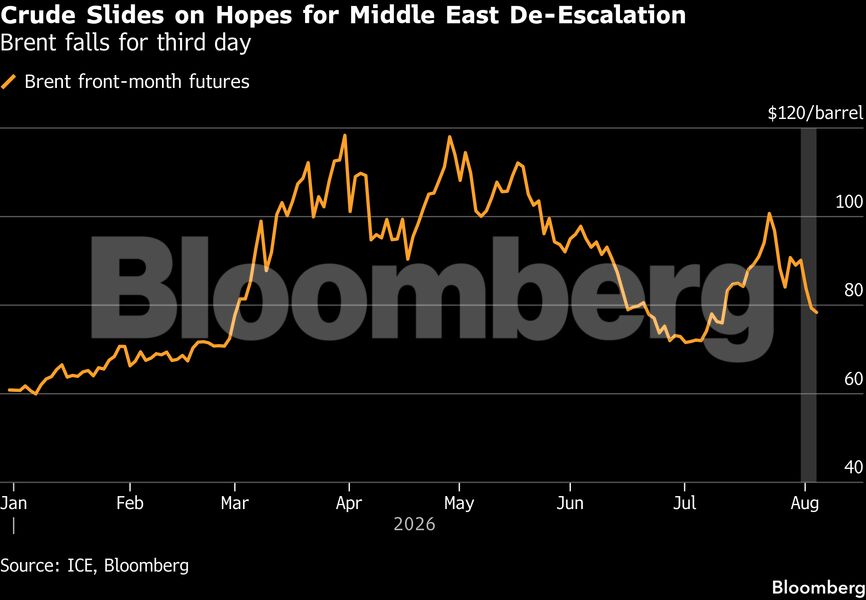
Oil has slumped over the past two weeks as US President Donald Trump said he postponed new strikes on Iran to give talks more time.
Even if a short-term deal to normalise commercial shipping in the strait is reached, it might still fail to end the war conclusively or resolve Trump’s concerns about the Islamic Republic’s nuclear program.
“Now that passions have cooled somewhat, perhaps there is a chance a deal can be agreed to,” said Robert Yawger, director of the energy futures division at Mizuho Securities.
“I still expect a bad deal to ultimately get done, which will allow the US to declare some kind of victory, but leave a lot of loose ends, including the nuclear deal.”
The previous US-Iran ceasefire lasted less than a month before collapsing over Hormuz. That helped drive a roughly $32 a barrel swing in Brent last month as the conflict reignited and spread to the Red Sea, before another pause in late July to allow diplomatic efforts to continue was shattered.
Trump discussed efforts to de-escalate US-Iran tensions with Qatar’s Emir Sheikh Tamim Bin Hamad Al-Thani in a call on Tuesday, according to the Gulf state’s government. A White House official confirmed the call without offering more details.
“We’re having very good discussions, they don’t like to admit that,” Trump told Fox News in an interview recorded Tuesday night concerning talks with Iran. He added, however, that “if they don’t make a deal, it’s going to be too bad.”
In a sign of potential progress, Iran is considering allowing European nations to remove mines from the strait, according to diplomats familiar with the matter.
Separately, the country’s foreign ministry said discussions between Tehran and Oman had been positive and centred on safe routes in the waterway, according to state-run IRIB News.
Meanwhile, Saudi Arabia held talks with Yemen’s Houthi militants through Omani mediators as it seeks to prevent the conflict from widening, according to people familiar with the matter.
The OPEC member is continuing to prepare military options should negotiations fail, they said.
Elsewhere, US crude inventories rose 2.7 million barrels last week, while stockpiles at Cushing, Oklahoma — the delivery hub for WTI — increased by 2.4 million barrels, according to the American Petroleum Institute.
If confirmed by official data later Wednesday, that would be the biggest rise in Cushing since March, and would help push levels back above the 20 million-barrel level widely considered the operational minimum.




 Loading ...
-facelift-2-2025.10.webp)