
New plan to make taxis safer and with better drivers in South Africa


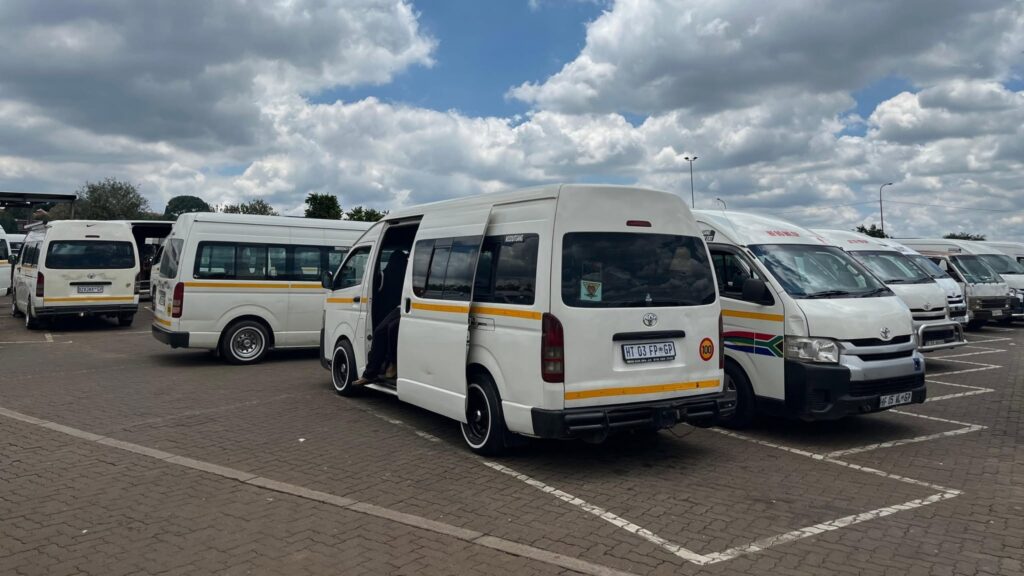
Several interventions aimed at strengthening the minibus taxi industry will soon be implemented in the City of Johannesburg (CoJ) to improve the way the sector operates.
This comes after taxi body Gibela Namela and Jozi My Jozi (JMJ) signed a memorandum of understanding to improve the systems that support public transport in the city.
The MoU was signed following 18 months of extensive discussions between the parties.
Interventions proposed under the memorandum include work to make taxi ranks safer and cleaner, as well as to support taxi operators’ well-being and develop their skills.
The partnership also aims to create a more structured operating environment to benefit the industry and the millions of people who rely on it every day.
“The taxi industry is one of Johannesburg’s most important economic sectors,” explained Innocent Mabusela, CEO of Jozi My Jozi.
“In the lead-up to the historic signing of this MoU, we have spent many months engaging with industry leadership because lasting solutions have to be developed with the people who operate the system every day.”
Technology is set to play a central role in supporting the new business model, which will establish a Smart Mobility Transit system.
Programmes that will form part of the rollout plan include:
- Project Dignity for taxi rank cleaning and upkeep
- Project Protect for improving security at taxi ranks
- Project Heal that focuses on taxi drivers’ mental and physical health
- Project Learn for driver skills development
Themba Gcabashe, Gibela Namela Holdings’ Business Development Executive, said that the city’s taxi industry believes the partnership will lead to many valuable initiatives and change the industry’s landscape.
City of Johannesburg Transport Executive Director Lutando Maboza added that the city will support the partnership’s endeavour to improve the overall public transport user experience.
South Africa plagued by a lawless taxi industry

According to Brendan Benfield, an associate of the Free Market Foundation, high vehicle fatality rates in South Africa result from drivers, including taxi operators, treating the rules of the road as suggestions.
Benfield recently wrote an opinion piece on the issues plaguing road safety in South Africa, claiming that, since the 1990s, the minibus taxi industry has played a major role in the collapse of the country’s driving etiquette.
“Traffic lights became optional; emergency lanes became driving lanes; stopping in the middle of roads became normal; aggressive intimidation of other motorists rapidly became part of daily life on South African roads,” he wrote.
In his piece, Benfield spoke of a friend who remarked that once people publicly observe others breaking the law without consequence, they would eventually begin to imitate that behaviour themselves.
He added that it was hard to argue with this observation 30 years later, since it has become clear that the law is not consistently enforced on our roads, but rather slowly being erased from the public’s mind.
“The lawlessness has become democratised. South Africans have learned from one another that rules are optional and enforcement is unlikely,” he said.
Benfield wrote down several driving offences he witnessed on his daily commute, including:
- Illegal U-turns
- Blocking intersections
- Cars driving through red lights
- Turning lanes used as straight lanes
- Emergency lanes used as normal lanes
- Passengers dropped off in active traffic
- Recklessly cutting across multiple lanes
He highlighted that law enforcement officials are not around to capture these offences, but can be relied upon to set up roadblocks at midday to check licence discs, driving licences, and outstanding traffic fines.
This sends a clear message that it is easier for the government to generate revenue from law-abiding middle-class motorists than it is to confront dangerous road users.
Benfield argued that South Africa’s problems have nothing to do with speeding, but rather with lawlessness, including drunk driving, pedestrian negligence, corruption, and driver intimidation.


 Loading ...
-facelift-2-2025.10.webp)
