Chery is gearing up to launch a new car brand in South Africa, which will make its official debut in 2026.
Earlier this year, TopAuto attended the 2025 Shanghai Auto Show, where it was announced that the Chinese automaker iCar would make its way to South Africa.
iCar is another sub-brand of the Chery Automotive Group, which specializes in new-energy vehicles (NEVs) primarily targeted at younger audiences.
This week, the company’s national brand and marketing manager, Shannon Gahagan, confirmed that iCar is scheduled to land on our shores in the first quarter of 2026, albeit with one important difference.
In South Africa, iCar and its various models will be officially rebranded as iCaur, presumably for trademark reasons, since there is another well-known company that is fond of giving its products names that start with a small “i.”
The brand is still pronounced “iCar,” so the “u” in the name is essentially just a stylistic (and legal) distinction.
“As the world embraces a new era of clean mobility, South African motorists deserve access to electrified vehicles that are as expressive as they are intelligent,” said Gahagan.
“iCaur brings a new energy to the market, combining striking design with advanced EV technology and a playful, user-centric spirit. We’re here to make electric motoring more personal, more joyful and, importantly, more accessible.”
The company revealed that it is in the process of finalizing its retail network, which will initially target the country’s key metropolitan hubs.
It stated that it aims to have at least 15 dealerships by the time of its launch in Q1, 2026.
Gahagan commented that iCaur is backed by the Chery Group, and that South Africa represents a key milestone for the automaker’s global expansion, particularly in African markets.
First look at iCaur

The carmaker stated that further details on its South African vehicle lineup will be revealed closer to its launch window next year.
However, TopAuto had the chance to preview a few of the company’s models on a trip to China earlier this year, where we attended the Shanghai Auto Show and the Chery Tech Festival in Wuhu.
The one nameplate that is all but confirmed for our market is the iCaur 03, which was previously expected to launch as the Jaecoo J6 in South Africa.
Jaecoo is another sub-brand of the Chery Group, and the the company initially planned to introduce iCaur under the Jaecoo banner to simplify its product lineup across its various marques.
However, Chery’s leadership later had a change of heart, reasoning that iCaur’s vehicles are different enough to warrant an official introduction as a separate brand.
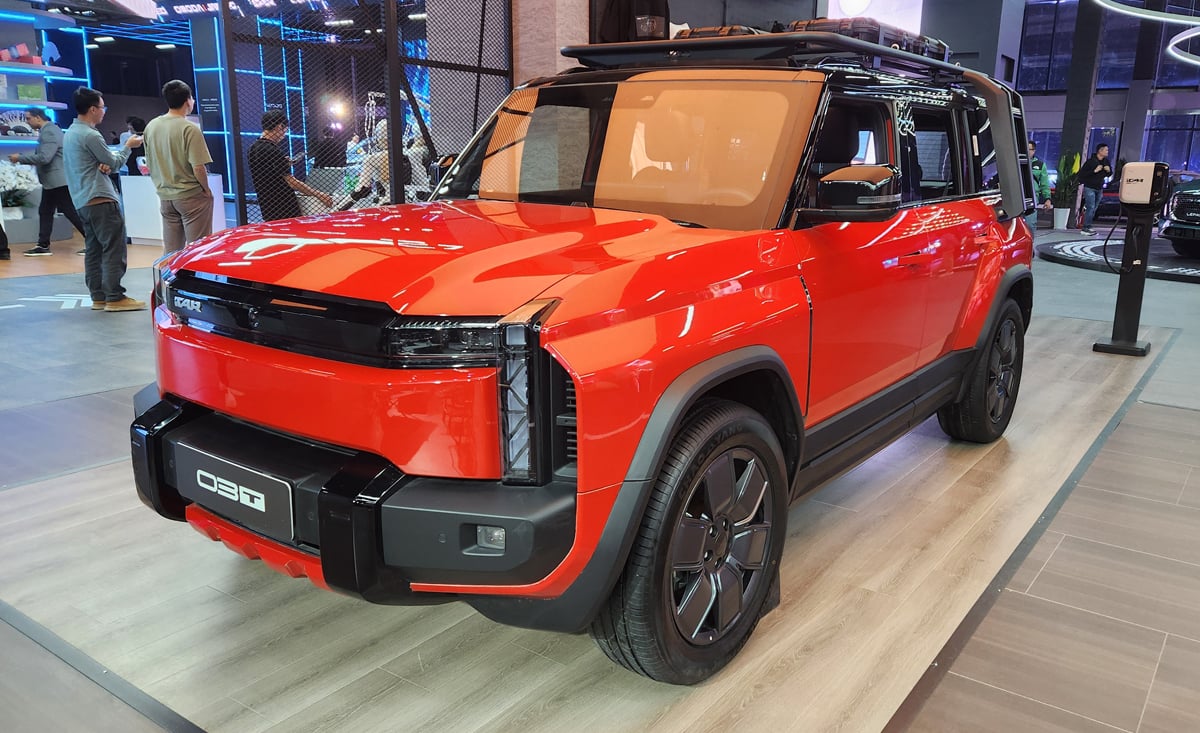
iCaur’s vehicles all follow a “retro-futurist” design that pays homage to the classic 4x4s of yesteryear, which is on full display with the 03.
In China, the vehicle is sold with two different electric motor options.
The base models use a single, front-mounted e-motor that produces 125kW and 220Nm, while the top-end units gain a second e-motor over the rear axle, giving them an all-wheel-drive system with 205kW and 385Nm.
The 03 also has three different battery sizes that determine the car’s range:
- 50.63kWh – 400km
- 66kWh – 472km
- 70kWh – 500km
Also worth noting is that iCaur’s models support V2L (vehicle to load) charging, meaning the battery can be used to power small appliances while camping.
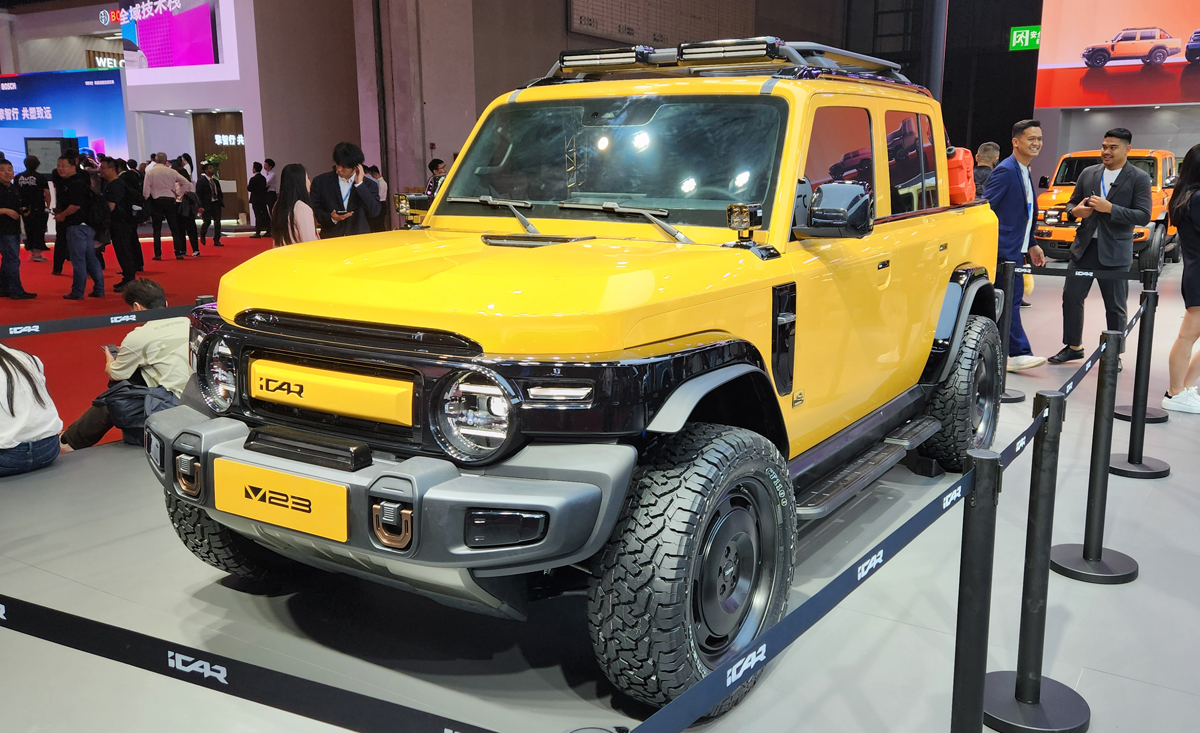
The other vehicle showcased by the brand is the iCaur V23, which is available as both an SUV and a bakkie.
The V23 is intended to have more of an off-road focus compared to the 03, which is intended for urban centres.
The bakkie version of the car (currently referred to as the V23 “Project”) trades the boot for a small but deep load bed, which includes integrated mounting points for accessories like storage containers.
Like the 03, the V23 is available in two-wheel and four-wheel-drive configurations that deliver an output of 100kW and 155kW, respectively.
Batteries start with a 59.9kWh cell good for 400km, though buyers can opt for a larger 81.8kWh block with 550km on tap.
At the Auto Show, a representative also mentioned that the V23 will eventually be made available as a range-extender hybrid, which uses a combustion engine as a generator for the battery powering the motors.
The advantage of a range-extender hybrid is that it has a much greater range than a traditional electric vehicle at over 1,000km.
Unfortunately, these models are still very early in development, so it will be a long time before we get to see them in action.
iCar 03 preview in Wuhu, China



iCar V23 at the 2025 Shangai Auto Show






 Loading ...