Hyundai crash test sparks new vehicle safety concerns in South Africa


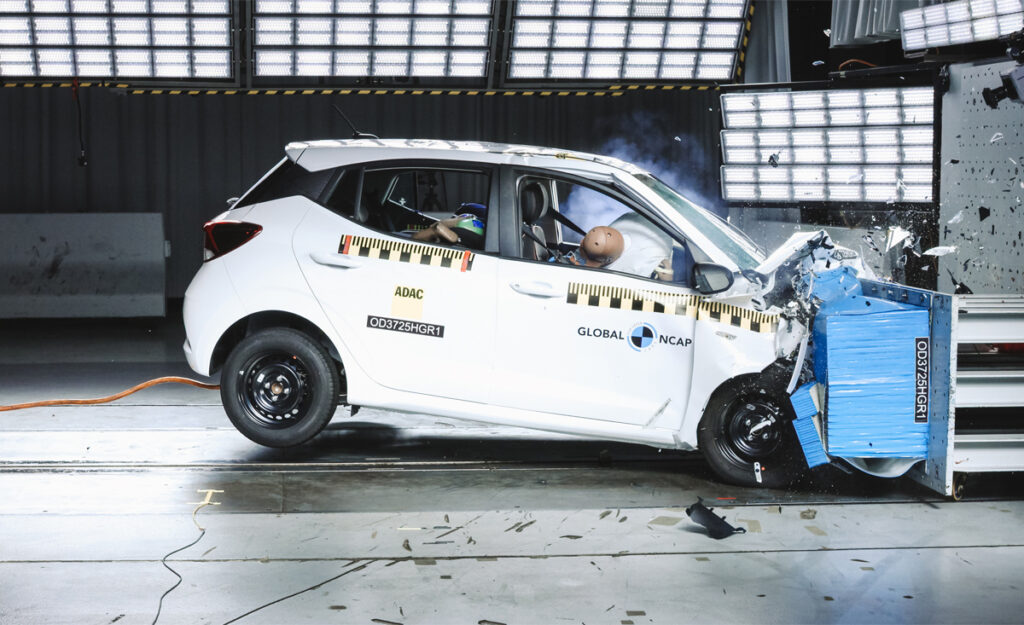
Following the poor results achieved by the Hyundai Grand i10 during crash safety tests, the Automobile Association (AA) has urged motorists to make smarter choices when making purchases.
The Grand i10 recently received a zero-star rating for adult occupant protection under the Global New Car Assessment Programme (NCAP) #SaferCarsForAfrica programme.
The passenger vehicle also received a three-star rating for child occupant protection.
Since then, the AA says it has been inundated with calls and queries from owners of the Grand i10, as well as the local motoring community at large.
These calls include requests for the AA to discourage the purchasing of cars with poor NCAP performance.
The association has since had to clarify the purpose of its #SaferCarsForAfrica programme, although it welcomed the level of engagement and growing public awareness around vehicle safety.
The programme was launched in 2017 by Global NCAP, in partnership with the AA and FIA Foundation.
It exists to independently assess the safety performance of popular, entry-level vehicles sold in Africa.
According to the AA, the programme was established in response to several challenges within the African vehicle market.
The first issue is that of outdated minimum safety regulations, particularly the standards put forth by the South African Bureau of Standards (SABS).
These focus primarily on compliance and do not take real-world crash performances into consideration.
Another hurdle identified by the AA is the inadequacy of local certification and vehicle approval frameworks, which do not evaluate structural integrity or active safety technologies.
Disparity in safety specifications and what the AA calls “double standards” at the source results in vehicles sold in African markets being sold with fewer safety features than those in Europe.
The AA clarified that it anonymously purchases vehicles locally, before shipping them to be tested independently by ADAC crash testing facilities in Germany.
These vehicles are subjected to rigorous impact tests, and restraint systems and safety equipment are comprehensively assessed.
While the association does not ban or endorse vehicles, its testing has exposed safety shortcomings in several vehicles, empowering consumers to make informed decisions.
Several car manufacturers in the country have, in the past, withdrawn numerous models with unsafe safety ratings or have upgraded safety specifications in response to poor ratings.
What to do

The AA has urged motorists who own vehicles that have performed poorly in crash tests to use the Global NCAP results as a guideline to consider transitioning to safer brands or models.
“It is also important to note that these crash test results do not mean a vehicle is deemed illegal to drive,” the association noted.
“These NCAP tests transparently indicate how well it is likely to protect occupants in the event of a collision.”
Amongst the calls received by the AA were several requests to test more vehicles, which it said involves high costs and logistical complexity.
“As a result, the programme prioritises high-volume and high-risk models, which means not every vehicle on sale locally can be immediately assessed,” the AA clarified.
It did, however, declare its commitment to expanding safety testing coverage across model ranges available across the continent.
The AA’s long-term strategy is focused on establishing an African NCAP programme, which will assess continental vehicle safety and be run by the local AA.
“This initiative aims to localise testing capacity for the continent, under the auspices of the global NCAP committee,” the association said.
“Merits will further include reduced overall costs, a broader scope of assessment, and an acceleration in safety transparency across the continent.”
These poor results have created an opportunity for government regulators to prioritise the safety of motorists and revise South Africa’s minimum vehicle safety standards.
According to the AA, many vehicles with demonstrably poor crash test performance still meet what the AA and Global NCAP regard as outdated and archaic minimal local safety requirements.
It declared that raising baseline safety regulations would ensure that no vehicle sold in South Africa falls below an acceptable level of occupant protection.
AA CEO Bobby Ramagwede clarified that the association exists to serve motorists, not vehicle manufacturers.
“Powered by both our members and the South African motoring community at large, we will continue to expose safety irregularities,” he declared.




 Loading ...