
What a 5-star safety rating means for cars in South Africa


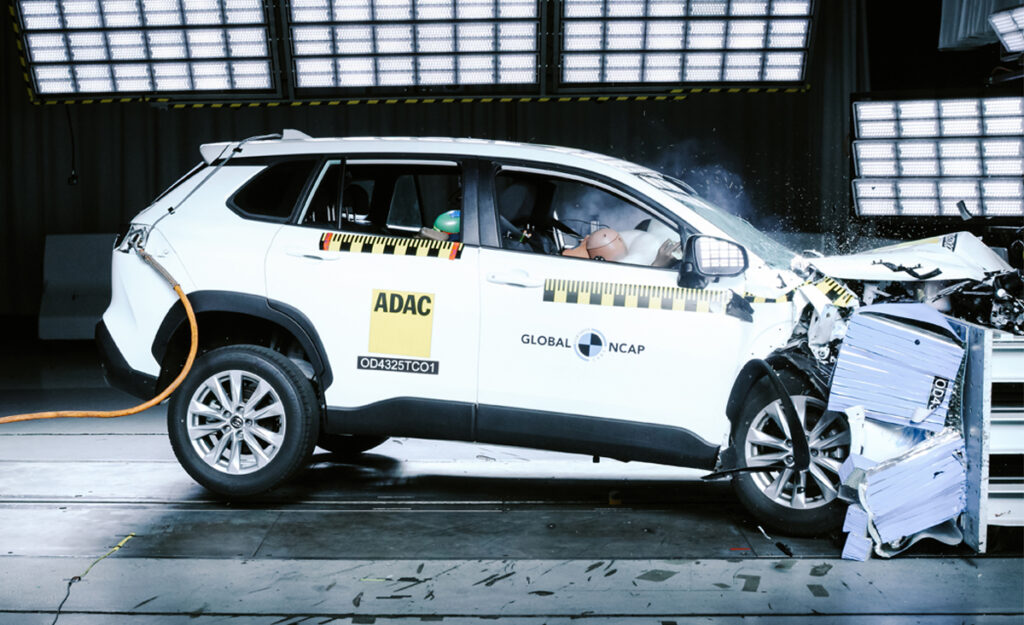
Seemingly, every new car launch in South Africa is accompanied by the words “five-star safety”. While this should inspire some confidence in the vehicle’s safety, ratings vary depending on the body that issues them.
It also needs to be noted that South Africa currently does not conduct its own crash testing, despite the National Regulator for Compulsory Specifications (NRCS) overseeing an Automotive Department.
This department is responsible for regulating compulsory standards that apply to motor vehicles and certain replacement components of motor vehicles.
It is also responsible for evaluating manufacturers and the compliance of vehicles manufactured, built, modified or imported with legislation, standards, and specifications relevant to South Africa.
Additionally, the South African Bureau of Standards (SABS) conducts its own testing, which the Automobile Association (AA) said is largely focused on compliance rather than real-world crash performance.
In 2017, the AA partnered with Global NCAP and the FIA Foundation to establish the SaferCarsForAfrica programme to independently assess the safety of popular vehicles sold in Africa against international standards.
The programme was established to address three persistent challenges in the African market, which include outdated minimum safety regulations and a poor local homologation framework.
Crucially, the AA has noted differing safety specifications and potential double standards in vehicles sold both locally and abroad.
It said that identical models, often produced on the same assembly line, are sold in Africa with fewer critical safety features than versions sold in developed markets, like Europe.
Different safety regulators, including Euro NCAP, Bharat NCAP in India, ANCAP for Australia, ASEAN NCAP in the Southeast Asian markets, and even Chinese brand-specific regulations, do not meet local needs.
The AA’s CEO, Bobby Ramagwede, noted that ratings are specific to their market, and for a rating to be recognised locally, the vehicle needs to be assessed under the #SaferCarsForAfrica campaign.
Global NCAP CEO, Richard Woods, added, “South African consumers need independent and accurate information to inform their purchasing decisions.”
“Transparency and accountability on vehicle safety, not marketing smoke and mirrors, is fundamental to consumer safety”.
How these ratings are calculated

Tests are conducted at an Allgemeiner Deutscher Automobil-Club (ADAC), Europe’s largest automobile association, testing facility.
To evaluate a vehicle’s suitability for African driving conditions, it is put through rigorous testing and given a score from 0.00 to 27.00, and a rating between zero and five stars in various categories.
This includes a frontal impact crash test at 64km/h, a side impact assessment for passenger protection, Child Restraint System (CRS) checks, occupant safety tests using dummies, and pedestrian protection at 40km/h.
To achieve a rating, the following conditions must be met:
| Level of adult protection | Minimum accident score required | Electronic Stability Control (ESC) | Curtain Airbags | Pedestrian protection |
|---|---|---|---|---|
| 5 stars | 27.00 | Must be standard and proven with test certificate | Must be standard, with official pole test required | Official test required |
| 4 stars | 22.00 | Must be standard and proven with test certificate | Must be standard, with official pole test required | Test certificate required |
| 3 stars | 16.00 | Must be standard and proven with test certificate | Must be standard, with official pole test required | Test certificate required |
| 2 stars | 10.00 | Must be standard and proven with test certificate | None | None |
| 1 star | 4.00 | None | None | None |
| 0 stars | 0.00 | None | None | None |
Following the testing of the Chery Tiggo 7, which boasted a five-star Euro NCAP safety rating, Ramagwede highlighted the need for local testing.
He said their results, which awarded the vehicle a two-star rating, highlight a continuing pattern in which vehicles sold in Africa do not offer the same safety standards as other regions.
“We’ve said it before, and we’ll say it again, South African motorists deserve better, irrespective of the source or price point of a vehicle, with this two-star rating reinforcing the urgent need for all manufacturers to commit to equal safety for all markets.”
“This result underlines why Africa urgently needs stronger regulatory standards and greater manufacturer accountability,” Ramagwede added.
He further noted that the AA believes no vehicle should be sold locally without side head protection for front and rear rows.
“Safety should never be an optional extra, and certainly not reserved for markets outside Africa.”


 Loading ...
-facelift-2-2025.10.webp)
