


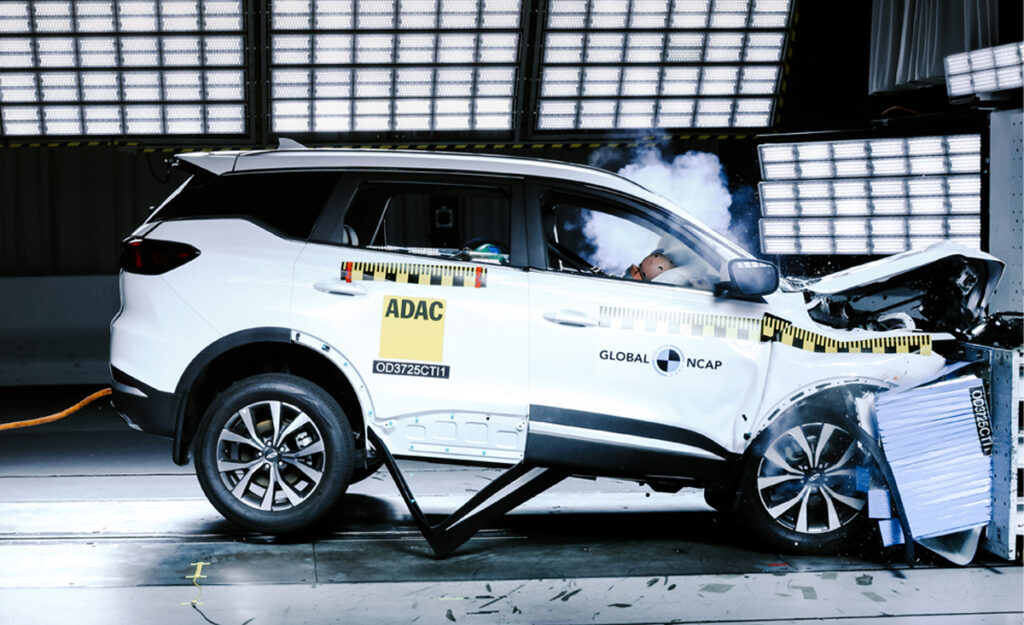
The Automobile Association (AA) has raised concerns about the safety of the Chery Tiggo 7 SUV, following its disappointing crash test results.
The Chinese car was recently crash-tested as part of the #SaferCarsForAfrica campaign, which seeks to highlight the discrepancy in the safety levels of cars sold in Africa compared to those in other markets.
The test was conducted by the AA in partnership with the Global New Car Assessment Programme (NCAP), which awards vehicles a score of up to five stars for both adult and child occupant safety.
The Tiggo 7 Pro, which has been on sale in South Africa for a few years, received a poor result with a two-star adult occupant protection rating and three stars for child occupant protection.
The reason for the low adult score stems from a lack of standard side head protection for the front and rear occupants.
The child occupant score, meanwhile, was let down by the fact that the Child Restraint System failed the installation for all front and rearward-facing positions, with the vehicle lacking the option to disconnect the passenger airbag when a rearward-facing child seat is placed in the passenger seat.
Importantly, these findings apply to the entry-level Tiggo 7 range currently on sale in South Africa.
“Tested by Global NCAP is the previous-generation Tiggo 7 Pro Distinction (currently on sale locally), while worth noting is that the current-generation Tiggo 7 Prime, the entry-point into the current-generation range, lacks the same highlighted safety features as the Tiggo 7 Pro Distinction,” said the AA.
Chery sells both the older Tiggo 7 Pro and the new Tiggo 7 range, the latter of which dropped the “Pro” from its name.
The AA expressed deep concerns over the results, stating that they were reflective of lower safety standards for cars sold in Africa.
Other issues flagged by the Chery’s NCAP report include the following:
- The footwell area and bodyshell were found to be unstable and not capable of withstanding further loadings
- Side pole impact was not performed as the car does not offer standard side head protection for front and rear rows (the lack of this kind of protection exposes the head to the risk of severe injury even in a low-speed side impact with a pole or tree)
- Electronic Stability Control (ESC) was standard, as were Seat Belt Reminders (SBRs) in all positions, although these did not meet Global NCAP requirements.
“The results clearly demonstrate shortcomings in the level of standard safety provided to adults in these models sold across African markets, including South Africa,” said the AA.
Misleading consumers

The AA expressed its disapproval of the industry practice of companies using different NCAP results to promote the safety of their cars in South Africa.
There is no NCAP model tailored for African markets, which means that all cars sold in South Africa are advertised using different ratings depending on the manufacturer and the model’s region of origin.
Examples of this include the Euro NCAP, Global NCAP, C-NCAP (Chinese), Bharat (Indian) NCAP, and ASEAN (Southeast Asian) NCAP.
This is significant because cars sold in different countries do not have the same standard features, even if they share the same name.
The European Hyundai i20, for example, is made in Turkey, while the version sold in South Africa is made in India, meaning it would be misleading to advertise the car in South Africa using a Euro NCAP rating.
“Global NCAP notes Chery SA’s recent dual-vehicle collision test which saw two Chery Tiggo 9 SUVs collide in a 50% offset head-on impact at 50 km/h in South Africa last year. These results and findings are not recognised by Global NCAP.”
“The AA encourages consumers to look for market-specific NCAP test results, conducted in an NCAP environment, and taking into account NCAP-specific testing criteria and parameters.
Global NCAP Chief Executive Officer, Richard Woods, said that tactics like this amounts to misleading the public on vehicle safety.
“A two-star rating for the Tiggo 7 Pro is very disappointing, but this poor result is seriously compounded by the publication of misleading information on crash test results from other markets,” he said.
“South African consumers need independent and accurate information to inform their purchasing decisions. Transparency and accountability on vehicle safety, not marketing smoke and mirrors, is fundamental to consumer safety.”
AA CEO Bobby Ramagwede added to these concerns, arguing that Chery’s recent media releases about the Tiggo 7 CSH’s five-star Euro NCAP rating is misleading to local consumers.
“We note with concern the recent crash test conducted by Chery SA locally, which we deem as both an unsafe exercise and one misleading based on the principles of the NCAP studies undertaken in this critical area of safety,” said Ramagwede.
“We further note recent media releases around the Tiggo 7 CSH and its five-star Euro NCAP rating – and again find this information one-sided as it does not flag the safety inadequacies of the entry-level models in this very range.”
“Euro NCAP ratings are also specific to that market, for a rating to be recognised locally the vehicle needs to be assessed under the #SaferCarsForAfrica campaign conducted by Global NCAP.”
The AA said it has been repeatedly asked by local consumers to start testing Chinese car brands for localized NCAP safety standards.
It said the Chery’s results highlight two key issues, starring with a continuing pattern in which cars sold in Africa do not offer the same safety standards as other regions.
It also warned of a common tactic where automakers avoid disclosing the broader safety picture across a vehicle’s range, as entry-level cars rarely offer the same level of protection as the top-end units but are not marketed as such.
““We’ve said it before and we’ll say it again, South African motorists deserve better, irrespective of source or price-point of a vehicle, with this two-star rating reinforcing the urgent need for all manufacturers to commit to equal safety for all markets,” said the AA.
“This result underlines why Africa urgently needs stronger regulatory standards and greater manufacturer accountability. The AA believes no vehicle should be sold here without side head protection for front and rear rows. Safety should never be an optional extra, and certainly not reserved for markets outside Africa.”
The Automobile Association said it will continue to push for stronger safety regulations and greater transparency from vehicle manufacturers.
It also called on carmakers to correct misleading NCAP findings, either on the assembly line or via a recall.


 Loading ...