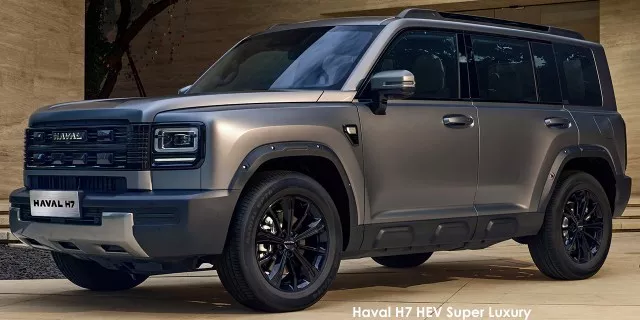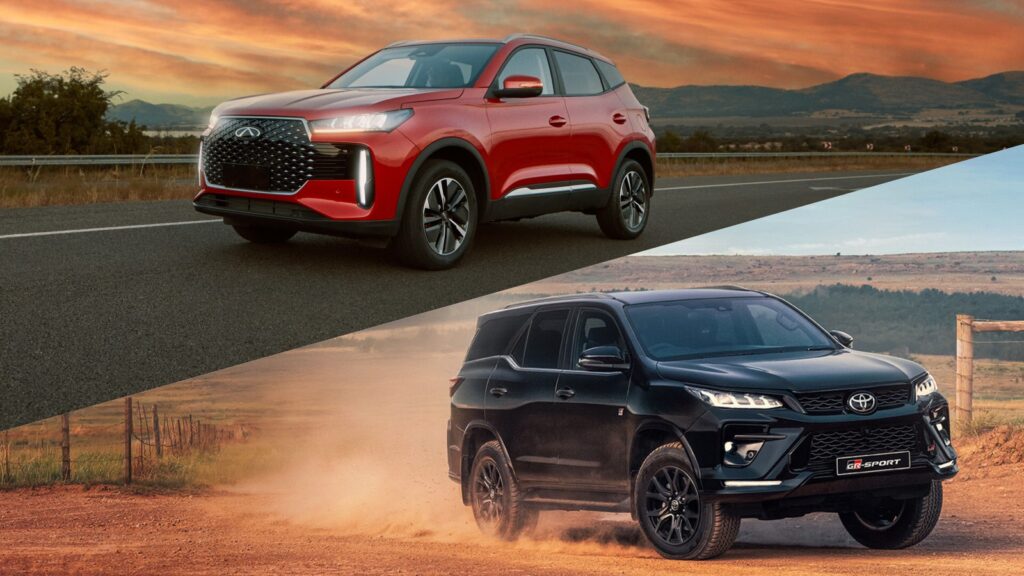
Car buyers in South Africa are increasingly likely to buy a crossover, and with the number of these landing on our shores rising rapidly, buyers must understand what sets them apart from SUVs.
Put simply, by crossover and SUV manufacturer Kia, “the key difference is an SUV is a body-on-frame built on a truck (bakkie) chassis, while a crossover is a unibody frame constructed on a car chassis”.
While this is the simplest way to distinguish the two, the difference in construction leads to several other key changes stemming from their differing platforms.
Another brand known for its SUVs and crossovers, Mitsubishi, explains that the body-on-frame design used by SUVs means the frame and body are built separately and joined during the manufacturing process.
It explains that these vehicles combine the features of a passenger car, like sufficient passenger and cargo space, with those of an off-road vehicle, including larger size and raised ground clearance.
SUVs, which are categorised as either mid-sized or full-sized, are built to handle tougher terrains and to haul larger payloads, making them the ideal choice for adventure-seekers.
Crossovers, on the other hand, can be classified anywhere from subcompact to full-sized, yet manufacturers often refer to them as “compact SUVs”.
Their unibody construction means the body and frame are built in a single unit, which is more similar to hatchbacks and sedans, providing better ride quality.
Thanks to its single chassis, a crossover tends to handle better and allows for easier manoeuvring in challenging on-road conditions.
Driving and performance in a crossover is also more comparable to a passenger car, while an SUV drives, handles and feels more like a bakkie.
A great deal to consider

Each of these vehicles exists to serve different markets, which becomes evident when comparing them directly, especially in terms of power, price, and capability.
Kia explains that SUVs tend to be rear- or all-wheel-drive and coupled with more powerful engines to carry not only their heavier frames, but also improve their off-road capability and hauling capacity.
Crossovers, on the other hand, are much more likely to be front-wheel drive, with smaller, more efficient motors, which makes them more suited to city or on-road driving.
Because of their size difference, Kia advises first-time drivers against buying an SUV, which is larger and more difficult to manoeuvre and park.
Instead, most drivers find crossovers easier to drive and park, thanks to their smaller, more familiar passenger car-sized frame.
Because they are lighter, crossovers tend to be more cost-efficient when filling the tank, making them more suited to urban commuters and families.
However, for motorists who live in more rural and isolated areas, especially those expecting to drive on dirt or gravel roads, or routes prone to flooding, SUVs with greater off-road ability make more sense.
The final consideration buyers need to take into account is the price difference, as SUV prices often far exceed the prices of crossovers.
While crossovers tend to be more expensive than other vehicles that can accommodate the same number of passengers, like sedans and hatchbacks, they are significantly cheaper than SUVs.
For example, the cheapest SUV in South Africa, the Changan Uni-S, is nearly twice the price of the country’s cheapest crossover, the Renault Kiger, not to mention much more powerful.
On the other end of the price spectrum, the difference is even greater, considering South Africa’s most expensive SUV, the Ferrari Purosangue, is six times the price of the most expensive crossover – the Porsche Macan GTS.





 Loading ...