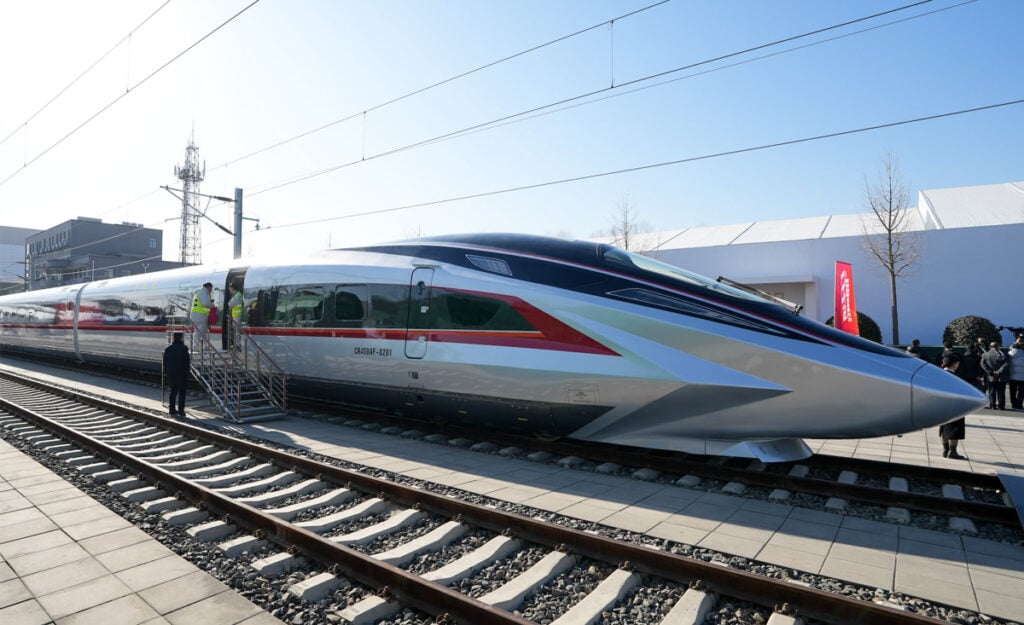
China’s bullet trains are fast, quiet, and punctual, and I’d easily use one over a plane if given the opportunity.
I recently got to experience China’s high-speed rail service on my trip to the 2026 Beijing Auto Show.
Travelling with iCaur, my group took a bullet train to travel from Beijing to Wuhu (Chery’s home city), for the second half of our trip to China.
The day got off to an early start, as we gathered in the hotel lobby at 05h45 to catch a bus and avoid Beijing’s morning rush hour traffic.
The drive from our hotel in Beijing’s CBD to the station was relatively short, and it wasn’t long before we were driving up an elevated road to reach the station’s front entrance.
The station itself feels more like an airport than your typical train station, as you need to pass through security before you are allowed in.
All bags must go through an x-ray machine, and passengers must pass through a metal detecter and undergo a pat-down from a security officer.
We were warned beforehand that powerbanks that do not have a CCC stamp (part of China’s new regulations on electronic devices) would not be allowed on, but I didn’t encounter any issues when bringing my 20,000mAh Samsung bank through security.
Once in the station, we hung around for roughly 30 minutes while our guides collected our tickets.
The station has metal seats, plenty of convenience stores and fast-food outlets, and a large central foyer with displays showing the time and platform numbers for trains in both Mandarin and English.
Normally, we would need to present our passport when going down the escalators to the platform, but because there was such a large group of Chery media guests travelling to Wuhu, the staff opened the gates for us to all get through in time.
The train itself is eight carriages long and has the distinctive nose you’d expect from a bullet train, which greatly improves its aerodynamics at high speeds.
Once on board, we stowed our bags in the large overhead shelves and took our seats. The train departed at 08h15 on the dot as scheduled.
The fabric seats are similar to what you’d find on an aeroplane, as they can recline and have a deployable tray on the back for things like food or a laptop.
Once we got going, I found the ride to be very smooth and quiet, even when travelling at speeds above 300km/h.
Each cabin has multiple screens playing silent ads, and there’s an overhead display at the front that shows the outside temperature, the train’s destination, and its current speed.
The train curves slightly when going around corners, though its very mild and there’s no risk of anything falling off your tray.
The cabins are clean and perfectly maintained, with no stains, grafitti marks, or torn seat covers.
Security patrol up and down the train, and not long after we were departed staff handed out a small bottle of water and a snack box containing some nuts, a matcha cake, a chocolate, and some sort of marshmallow filled with red bean paste.
Later on, we were given a choice of an orange juice or coke, and either a beef or chicken sandwich.
The bathrooms are a mixed bag, with one conventional toilet per car. There’s also a drop toilet (something that’s fairly common in China), though everyone in our group opted not to use it.
Our journey took us from the city, which is dominated by a skyline of identical apartment complexes, through rural farm areas and picturesque hillsides.
We were travelling on a dual track and would pass an oncoming train every so often, but given our relative speeds, it only took two seconds for the other train to pass.
The 1,100km journey from Beijing to Wuhu took approximately 6 hours with minimal stops at other stations.
When we did stop at other stations, we were only idle for 90 seconds before setting off again, and the PA system would make announcements in both English and Mandarin.
Overall, I found the experience to be very pleasant, and I would easily choose a bullet train over a flight in many instances, even if it takes a bit longer.
In South Africa, President Cyril Ramaphosa is pushing to make high-speed rail a reality with proposed routes from Pretoria to Polokwane, and from Joburg to Durban.
The Joburg-Durban corridor, in particular, could be incredibly popular if it is ever completed, assuming it’s well-maintained and is noticeably cheaper than an equivalent flight.
Taking a bullet train from Beijing to Wuhu in China





 Loading ...