How much it costs to run South Africa’s most popular bakkies at R32 per litre


With diesel prices in South Africa spiking again this month, local bakkie drivers are spending thousands of rands just to get around, including those who own the country’s favourite bakkies.
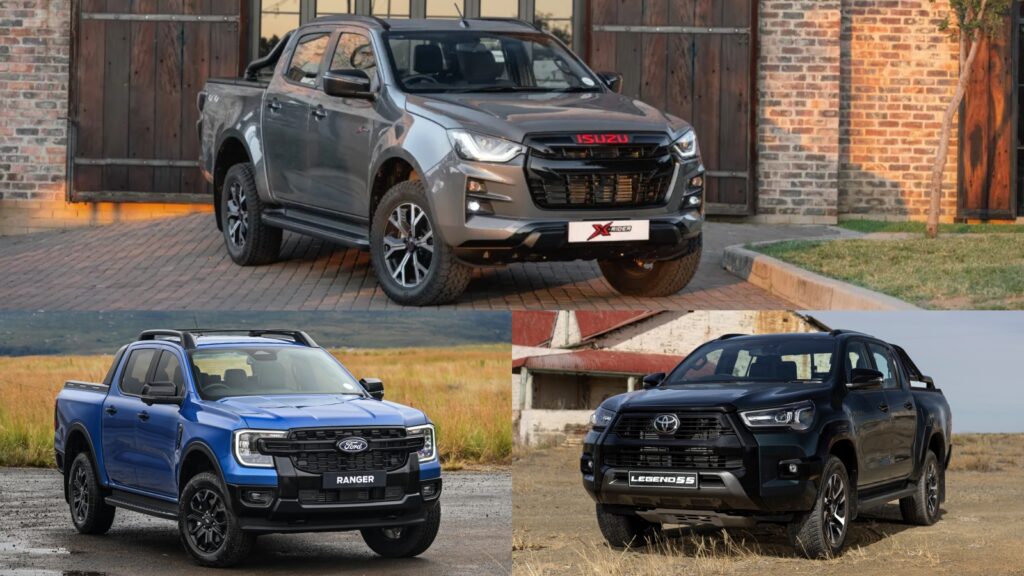
In April, the Toyota Hilux was once again the best-selling bakkie domestically, followed by its close rival, the Ford Ranger, while the Isuzu D-Max completed the podium.
All three of these offer buyers a wide range, from single-cab workhorses to high-performance double-cabs, and both petrol and diesel options.
That being said, each is most popular in its diesel guise, which is unfortunate given that the wholesale price of the fuel reached R32 per litre this month – the highest it has ever been.
Despite the government’s intervention, diesel bakkie drivers are still spending more than R2,500 to fill their fuel tanks.
The D-Max, in its cheapest turbo-diesel double-cab guise, is fitted with a 76-litre fuel tank, which means it costs R2,423 to fill inland, thanks to the R31.88 per litre diesel 0.005% price.
The other two bakkies, in similar spec, are fitted with 80-litre tanks instead, which is a marginal difference, yet still requires an extra R127 to fill, at R2,550 for a full tank.
Of the three, the Ranger boasts the lightest fuel consumption, burning an average of 6.8 litres every 100km, while the Hilux uses 7.1l/100km, and the D-Max comes in as the least efficient, with 7.3/100km.
As a result, the Isuzu has the shortest claimed fuel range of 1,041km, while the Toyota claims 1,127km, and the Ford, with the best fuel consumption, claims to have an average range of 1,177km.
With many estimates suggesting the average South African motorist travels between 1,000km and 1,500km per month, most bakkie owners should be able to manage their month’s travel on a single tank of diesel.
What it costs to run a diesel bakkie in South Africa

Because each of these bakkies is offered in a range of guises, which includes different engines, drivetrains, transmissions, and cab configurations, owners will have to consider all of these factors when calculating fuel costs.
Below is a table compiled using the cheapest double-cab diesel bakkies in each of Toyota, Isuzu, and Ford’s stables, fitted with a manual gearbox and rear-wheel drive.
| Distance | Toyota Hilux | Ford Ranger | Isuzu D-Max |
|---|---|---|---|
| 500km | R1,131.74 | R1,083.92 | R1,163.62 |
| 1,000km | R2,263.48 | R2,167.84 | R2,327.24 |
| 1,500km | R3,395.22 | R3,251.76 | R3,490.86 |
| 2,000km | R4,526.96 | R4,335.68 | R4,654.48 |
| 2,500km | R5,658.70 | R5,419.60 | R5,818.10 |
| 3,000km | R6,790.44 | R6,503.52 | R6,981.72 |
Very seldom will a motorist travel as much as 3,000km or more per month, depending on where they live and what they do for a living.
That being said, there are bakkie drivers in South Africa who are currently spending up to R7,000 per month, or maybe even more.
The average bakkie driver should be spending somewhere between R2,167.84 and R3,490.86, depending on their driving habits and the condition of their vehicle.
This does not include other monthly running costs, which include insurance, maintenance, and general wear and tear.
These amounts are likely to climb again next month, when fuel prices increase, and fuel taxes are reinstated.



 Loading ...