


The last time the average South African motorist could fill their car for R200 was in August 2004, assuming they owned a vehicle with a 50-litre petrol tank.
This is according to Statistics South Africa (Stats SA), which published a 50-year analysis of the country’s petrol prices.
According to its findings, the R1 per litre mark was first breached in November 1985, increasing to R5 per litre twenty years later.
Since then, the price doubled in only three years, breaching the R10 level in 2008, with Christmas cheer dampened in December 2021 when petrol breached the R20 per litre mark for the first time.
Prices eased from R26,31 in July 2022, only for April and May of 2026 to reach record highs for inland 93-octane petrol prices.
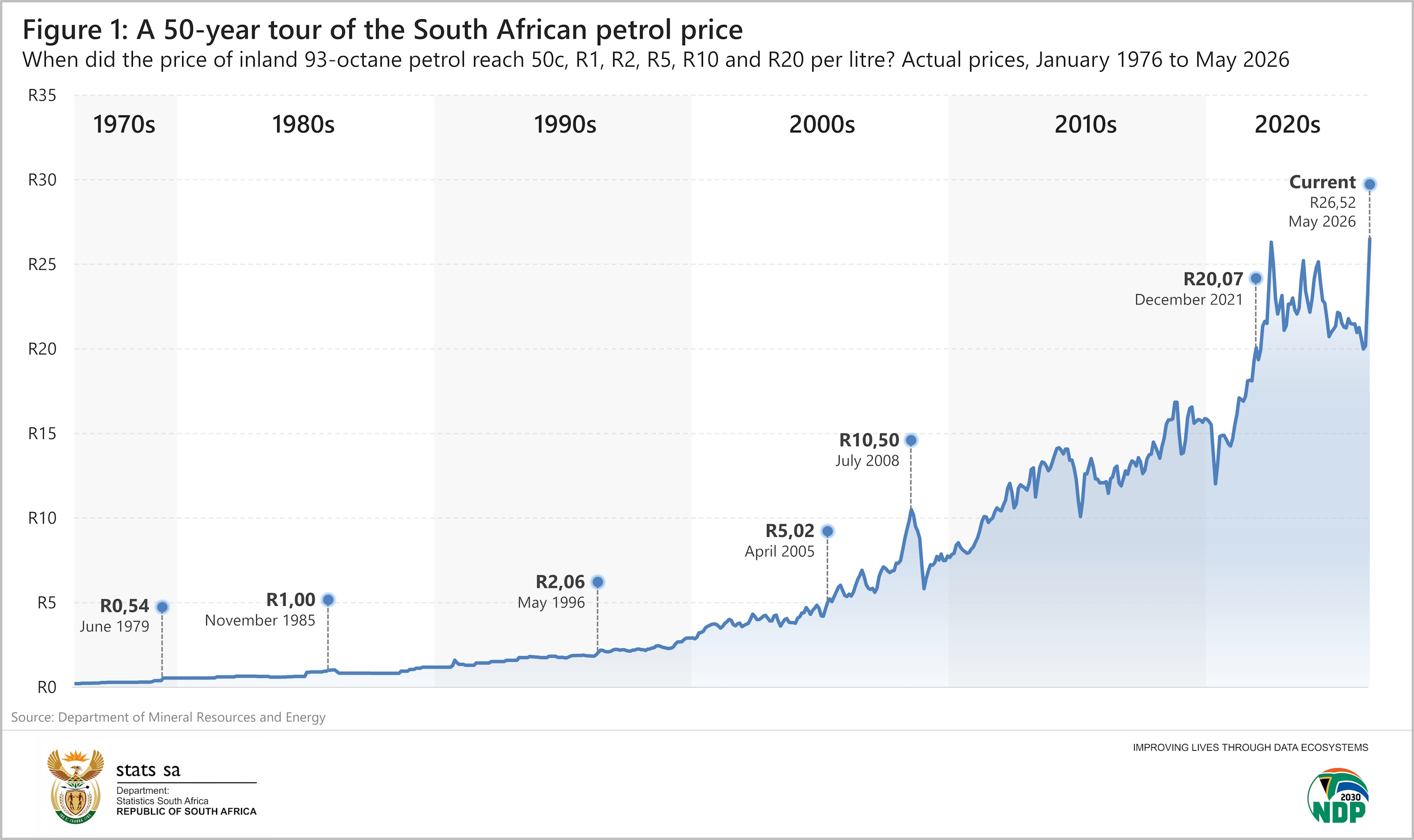
Against the backdrop of the ongoing Middle East conflict and its severe impact on local petrol and diesel prices, Stats SA looked at previous tumultuous periods in South Africa’s history and how they affected local petrol prices.
The easiest way to answer how hard recent increases hit local motorists is to adjust historic petrol prices and compare them to consumer prices in 2026.
That is because 10c in January 1980, for example, was far more valuable than 10c is today, and consumers could buy much more with that amount back then.
“An increase in petrol prices by 10c in 1980, or a 4c rise in 1971, would have been far more painful than a 10c rise today,” explained Stats SA.
“We can use the consumer price index (CPI) time series to convert historical prices into today’s money. This shows that 10c in January 1980 would be equivalent to R3,74 in 2026.”
Applying these fluctuations to reflect the changes in today’s South African rand value, in terms of percentage change, the increases in April and May 2026 were only the fifth- and sixth-largest increases in 50 years.
Filling a 50-litre petrol tank today
Compared to August 2004, South Africans are paying significantly more for both petrol and diesel, with fuel across all types costing more than R25 per litre this month.
Since the start of the month, this is what South Africa’s inland motorists have been paying for different kinds of fuel:
| Fuel type | Inland price |
|---|---|
| Petrol 93 | R25.42 |
| Petrol 95 | R25.58 |
| Diesel 0.05% (Wholesale) | R26.17 |
| Diesel 0.005% (Wholesale) | R26.70 |
As a result, R200 only gets less than eight litres of fuel in August 2026, compared to a full tank in 2004.
Below is a table that highlights how much it costs to fill up fuel tanks of various sizes at inland prices this month:
| Fuel tank size | Petrol 93 | Petrol 95 | Diesel 0.05% | Diesel 0.005% |
| 30-litres | R762.60 | R767.40 | R785.10 | R801.00 |
| 40-litres | R1016.80 | R1023.20 | R1046.80 | R1068.00 |
| 50-litres | R1271.00 | R1279.00 | R1308.50 | R1335.00 |
| 60-litres | R1525.20 | R1534.80 | R1570.20 | R1602.00 |
| 70-litres | R1779.40 | R1790.60 | R1831.90 | R1869.00 |
| 80-litres | R2033.60 | R2046.40 | R2093.60 | R2136.00 |
While this spike may not have been the worst in South Africa’s history, petrol is still R4.83 per litre higher than it was at the start of the year.
Should the conflict in the Middle East continue and global Brent crude oil prices continue to rise, this will certainly continue to impact South African motorists for some time.
That being said, global oil prices have steadied, and the rand is trading positively against the US dollar, which could see fuel prices stabilise when the Department of Mineral and Petroleum Resources announces them ahead of the next adjustment.



 Loading ...
Conversation
2 commentsIn the 1970s I could fill the tank on my VW Beetle for <R20