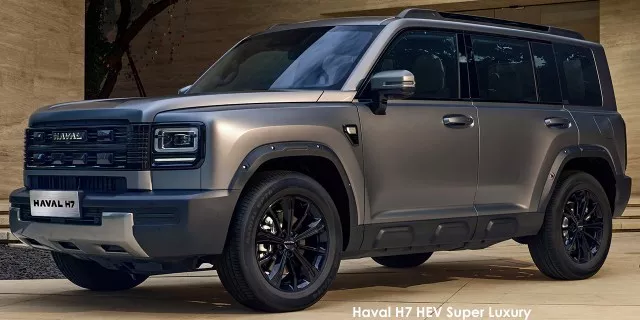
National government has pledged to support South Africa’s automotive industry, which has been struggling under difficult economic conditions for the past few years.
Minister of Finance Enoch Godongwana delivered his revised Budget Speech today, 12 March 2025, revealing that the government plans to aid local carmakers through various programmes that will encourage growth and address at least some of the issues that the industry is facing.
A new plan
In the official 2025 Budget Review, it is explained that the government aims to grow the economy by fostering productivity and re-establishing South Africa as a competitive marketplace.
To facilitate this, a total of R18.4 billion has been allocated over the medium term which will be used by the Department of Trade, Industry, and Competition to support various incentive programmes for different businesses.
Notably, it states that these programmes include “the automotive investment scheme, special economic zones, and industrial development support for electric vehicle production.”
The final point is especially important, as local carmakers have been pressing the government to introduce some kind of support system for electric vehicles (EVs) for years now.
Prior to the Budget Speech’s original air date on 19 February, Zero Carbon Charge (ZCC) called on the finance minister to introduce incentives for EV adoption.
South Africa is well behind the global curve on EVs at the moment, as it does not offer incentives such as purchase subsidies or tax rebates for consumers buying these cars.
As a result, automakers have been reluctant to introduce their more affordable EVs in South Africa as they would not be viable under these conditions, which means that nearly all EVs currently on sale are from premium brands where a R1-million price tag is less of a dealbreaker.
Unfortunately, the Budget Speech made no mention of either reducing or removing these duties for EVs, which means imported models are likely to still be very expensive.
However, it does mention that the government will support the local production of EVs, in reference to the 150% tax deduction on new-energy vehicles that President Cyril Ramaphosa signed into law at the end of 2024.
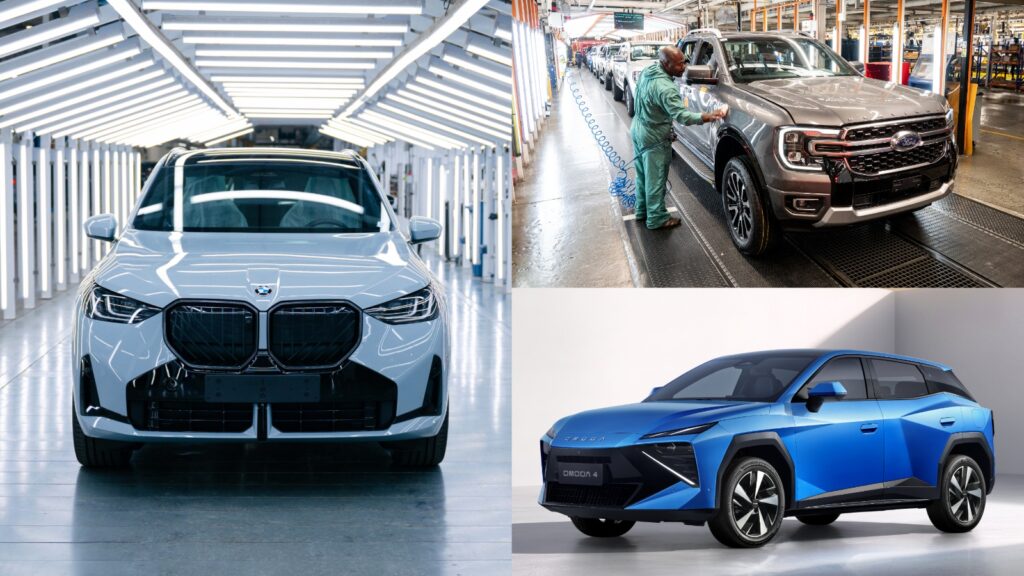
This tax rebate will apply to original equipment manufacturers (OEMs) like VW, Ford, Nissan, Toyota, BMW, Mercedes-Benz, and Isuzu, or any other OEMs who do not yet have a local manufacturing presence, who want to establish new assembly lines for electric and hydrogen-powered cars.
It is also worth mentioning that Ramaphosa previously tried to convince Elon Musk to establish a Tesla factory in South Africa, supporting the notion that the government wants to turn the country into a global EV hub.

The other important takeaway from the Budget Speech is that government is committed to its automotive investment scheme and special economic zones.
The investment scheme’s mission statement is as follows:
- Increase plant production volumes
- Sustain employment and/or strengthen the automotive value chain.
- Strengthen and diversify the sector through investment in a new and/or replacement models and components
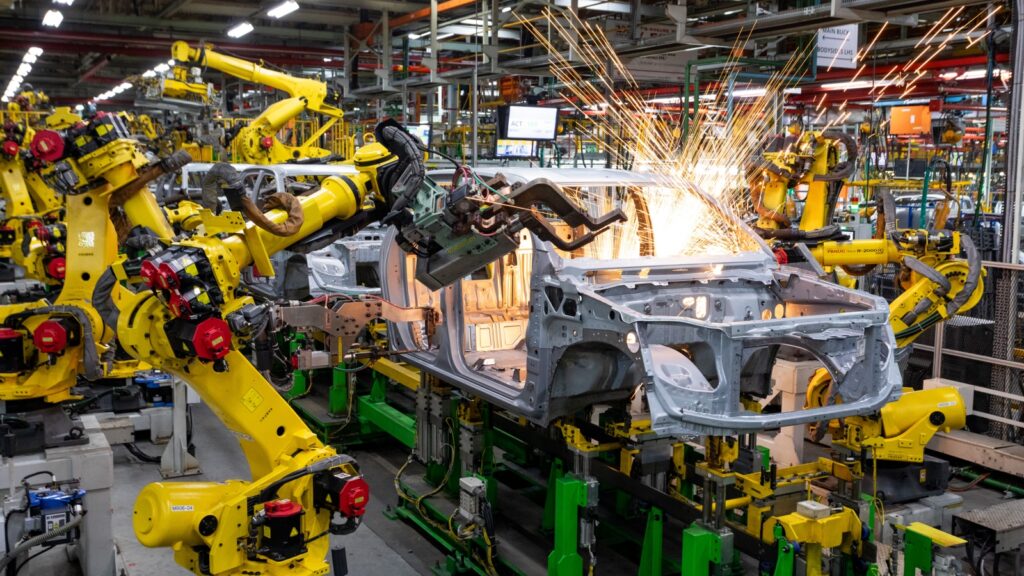
This will be done through the use of a non-taxable cash grant of 20% of the value of qualifying investment in productive assets by OEMs.
OEMs need to achieve a minimum production volume of 50,000 units per annum to receive this grant, which must be met within 24 months of the initial production date and maintained thereafter.
The grant is meant to subsidize local carmakers, which are no longer competitive with their overseas branches.
Ford, for example, has warned that its plant in Pretoria is now consistently outperformed by its sister factory in Thailand, and VW has expressed similar concerns with its Eastern Cape facility, which is being overlooked for investment in favour of other African markets.
In late January, Toyota South Africa Motors CEO Andrew Kirby warned that government intervention is urgently required to protect the local auto sector, which are steadily losing market share to cheaper imported brands.
This is in reference to the fact that several Chinese automakers have launched here in the last two years, which are rapidly gaining popularity owing to their cheaper price tags relative to legacy competitors.
Other imported badges like Mahindra and Suzuki are also seeing a huge uptick in sales, to the point where Suzuki has officially overtaken VW as the nation’s second best-selling brand despite the latter’s home-field advantage.
The automotive investment scheme is meant to address these concerns and re-establish South Africa as a manufacturing powerhouse, which ties into its plans for special economic zones (SEZs).

SEZs are areas designated for industrial development that attempt to promote foreign investment through the use of incentives such as free trade agreements.
One such SEZ is the Coega Economic Zone in the Eastern Cape, where two carmakers are building new factories.
One company, Stellantis, has already started construction on a new bakkie facility, while Foton has its own plans to set up an assembly line alongside another Chinese brand BAIC.
Two more SEZs are also in the works, one of which is the Nkhomazi Special Economic Zone in Mpumalanga, while the other is the Namakwa Special Economic Zone in the Northern Cape – at least one of which is likely to be earmarked for an automotive facility.



 Loading ...