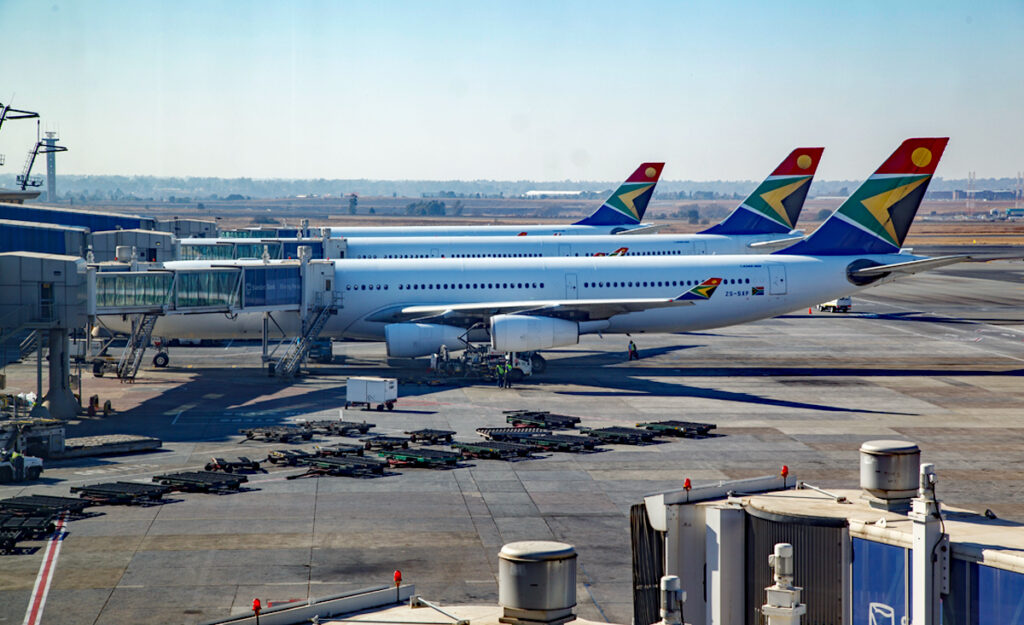
The South African airline industry faces rapid deterioration due to ailing airport infrastructure and navigation systems, leading to massive costs.
This is according to Aaron Munetsi, CEO of the Airlines Association of Southern Africa (AASA) – an organisation that represents 17 African airlines, including Airlink, FlySafair, and South African Airways.
It also has 40 associate members including Boeing and Airbus, the world’s largest aircraft manufacturers.
“We’ve been having several challenges with both the operations at our airports and from the aviation navigation services provider,” Munetsi said on the Money Show.
He also noted that delays and flight cancellations due to dysfunction within the country’s air traffic navigation services have led to costly setbacks for the airlines.
A major issue he highlighted is with the country’s Instrument Flight Procedures – the tool that guides pilots as they fly between airports.
These procedures must be validated by the South African Civil Aviation Authority (SACAA), and when it doesn’t happen, it prevents certain operations from being carried out.
Additionally, capacity and management issues create further challenges for pilots and frustrations for passengers.
Earlier this year, it came to light that various issues were impacting operations at the King Phalo and George airports in the Western and Eastern Cape, respectively.
This included malfunctioning Instrument Landing Systems (ILS), resulting in problems with low-visibility landings and preventing pilots from landing aircraft at night or during murky conditions, such as in misty or rainy weather.
Consequently, many of these flights had to be cancelled or combined.
At the ground level, things aren’t much better either, as Munetsi noted that basic procedures such as Standard Instrument Departures and Terminal Arrival Routings are poorly managed.
This results in congestion on the ground with long aircraft queues waiting for take-off, which has a knock-on effect that increases turnaround times and impacts other scheduled routes.
“When an aircraft does not take off and is idling, it is burning fuel. When routes are delayed, passengers are inconvenienced,” explained Munetsi.
He also noted that airlines still have to meet their commitments, requiring them to look after passengers.
“Either by putting them on another airline, or if there’s no other flight, put them up in a hotel. That all comes to us as airlines. That’s our responsibility.”
Aggravating this situation is that while airlines are held accountable, the service providers they rely on are not.
Instead, airlines pay service providers for a service they aren’t providing while covering expenses to ensure passenger safety and comfort.
He warned that the combination of these factors is unsustainable for the South African airline industry, and if they aren’t addressed, the problems facing the sector will only worsen.
Potential improvements

Airports Company South Africa (ACSA) is addressing certain infrastructure issues with maintenance and capital expansion programmes across its airports.
ACSA owns nine of South Africa’s largest airports and is a key pillar of the country’s flight industry.
These programmes aim to address problems facing airport infrastructure, such as sewerage systems, ablution facilities, and fire escapes.
The upgrades will also target key operational areas to ensure airports can accommodate future growth.
These upgrades include:
- People Movers
- Terminal and Roofing Works
- Passenger Loading Bridges (PLBs)
- Uninterrupted Power Supply (UPS)
- Fuel Systems and Fire Infrastructure
- Instrument Landing and Weather Systems
- Jet Fuel Infrastructure at OR Tambo International Airport
ACSA Chief Executive Officer, Mpumi Mpofu, has noted that the current projects support the aviation sector’s long-term growth and operational resilience.
“It reflects our return to financial sustainability and our ability to reinvest in critical infrastructure that will serve the aviation industry and the broader economy for years to come.”
The programmes are slated for completion between late 2025 and 2027.




 Loading ...

-2026.10.webp)