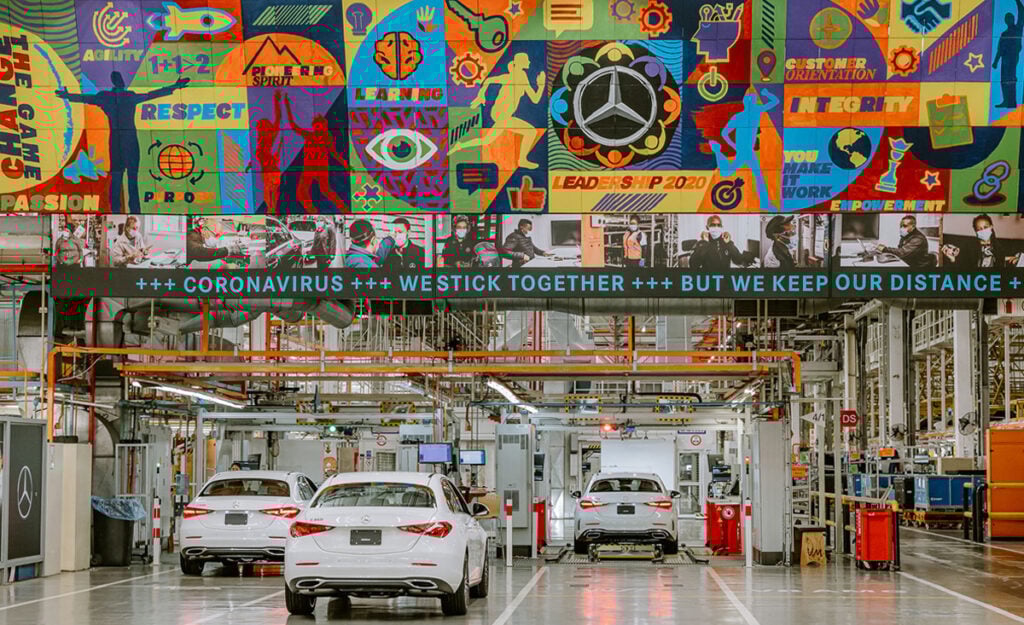
Mercedes-Benz is reportedly worried about the future of its production plant in East London due to the economic challenges presented by the upcoming US tariffs.
This has been reported by MEC Mlungusi Mvoko, who voiced his concerns over MBSA indicating to him that it may close its East London factory, at a briefing by the Eastern Cape and Northern Cape Provincial Treasuries.
The United States is set to impose a 30% tariff on certain South African exports on 1 August 2025, adding to the 25% tariff implemented in April and the flat 10% universal tariff.
As a consequence of these massive tariff hikes, the South African automotive industry has been severely impacted.
The National Association of Automobile Manufacturers of South Africa (Naamsa) has reported that vehicle exports to the United States declined by 82% in the first half of 2025.
This amounts to just 2,875 units shipped to the US between January and June, down from 16,112 in 2024 during the same period.
Naamsa also found that there has been a 75% year-on-year drop in experts for the first quarter in 2025 and an 87% decline for the second quarter.
These drastic declines in export numbers have called into question whether Mercedes-Benz South Africa (MBSA) can continue to operate locally.
“You cannot imagine East London without Mercedes-Benz, MBSA exports almost 90% of their cars to the US. In our interaction with them, they said that given these tariffs, it would be difficult,” Mvoko said.
Mvoko noted that the company said it may need to reconsider its operations in South Africa, adding that they had raised the potential for MBSA to consider other export markets.
Job loss concerns due to tariffs
George Sebulela, the African United Business Confederation (AUBC) president, has stated that the automotive industry is essential to South Africa and is one of the country’s largest employers.
He explained that South Africa is a significant automotive exporter, and due to the tariffs, the companies that rely on exports will now face higher operating costs.
This could lead to reduced production, job losses, and a decline in foreign investment.
Sebulela additionally noted that BMW and Volkswagen also have major manufacturing operations in South Africa and rely on export markets like the United States.
These companies are now all at risk, which could result in massive losses in jobs and revenue across multiple industries.
This includes sectors besides the automotive industry.
“South Africa exports a large volume of products to the US, including citrus, wine, macadamia nuts, platinum, manganese, and machinery.”
Another concern is falling investor confidence in South Africa, with these losses potentially leading to foreign investors choosing regions with better assurances for returns.
While there is still a window for negotiations before the 30% tariff hike, the concern is that even if they prove successful, the damage to critical sectors will be too severe to repair in the short term.




 Loading ...