South Africa’s car manufacturers will finally receive support from the government to upgrade their facilities to build new energy vehicles (NEVs).
The local automotive industry has been lobbying for this change for years, warning that failure to support the transition will result in South Africa falling behind in the global shift to electrified vehicles.
Starting on 1 March 2026, automakers will be able to reclaim tax equal to 150% of their investments into the facilities and machinery earmarked for NEV manufacturing.
NEV is an industry term that refers to cars with traction batteries, like hybrids and electric vehicles (EVs), as well as hydrogen-powered models.
The incentives will last for the next 10 years, with the tax-deductible portion of the investment capped at R500 million for the first financial year.
President Cyril Ramaphosa first announced the tax incentive in 2024, which was a welcome move even if the industry wished it had taken place years earlier.
Ramaphosa noted that the incentives were critical to protect the auto industry, which directly employs over 115,000 people and supports an additional 500,000 jobs at various points in the local supply chain.
South Africa can’t sit this one out

While it is easy to dismiss NEVs as an impractical option for the local market, the reality is that South Africa can’t afford to remove itself from the global transition to electric transport.
The vast majority of cars assembled here are produced for export to key markets like Europe, which have strict emissions policies and are still pushing for mass hybrid and EV adoption, even if these goals are being eased as a result of industry pressure.
Roughly 65% of the cars purchased in Europe in 2025 were hybrid or fully-electric, while sales of internal combustion engine (ICE) models dropped from 46% to 35% between 2024 and 2025.
If South Africa fails to produce NEVs to cater to export markets, it will deal a crushing blow to local manufacturers.
Similarly, it will place South Africa in an awkward position where international carmakers are primarily producing NEVs that are unsuitable for our market, resulting in a dwindling selection of outdated ICE models.
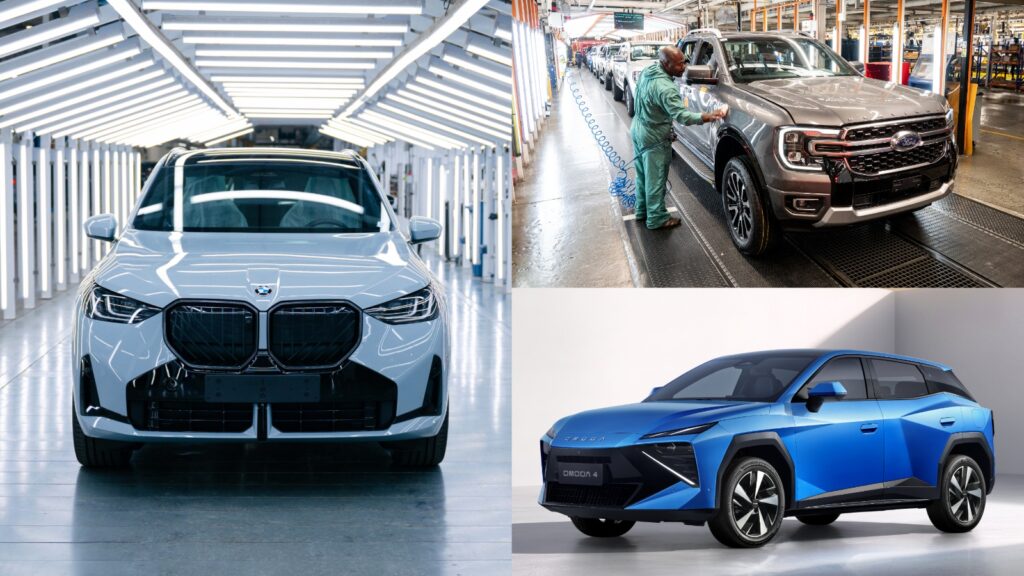
This impending scenario has placed enormous pressure on original equipment manufacturers (OEMs) like BMW, Toyota, Ford, and VW, which only have a handful of hybrid options like the Toyota Corolla Cross, Ford Ranger, and BMW X3.
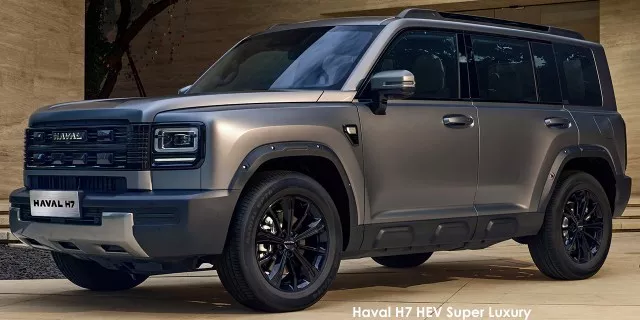
This pressure is even being felt at home, as Chinese imports from brands like BYD, Chery, and Haval are starting to dominate the hybrid and electric segments.
Toyota South Africa Motors (TSAM) CEO Andrey Kirby previously called for a reduction in taxes for locally-made vehicles to allow them to better compete against Chinese imports.
All of this is taking place in a landscape where OEMS have already had to invest billions of rands to make up for shortfalls with local infrastructure.
Automakers have had to install generators and solar solutions to combat load-shedding, and most companies now rely on truck fleets to transport components and finished cars to and from the ports due to the collapse of Transnet and the rail network.
South Africa is no longer number one

The consequences of these compounding problems are already starting to be felt, as South Africa is no longer the largest vehicle producer on the continent.
This title now belongs to Morocco, which produced 1 million cars by December 2025, compared to the 549,9000 South Africa managed in the first 11 months of the year.
Morocco’s output has skyrocketed thanks to government support for EV production and sales, including tax incentives for manufacturers and subsidies for consumers.
Other African countries that introduced NEV incentives before South Africa include Ethiopia, Tanzania, Kenya, Uganda, Zambia, and Benin.
Another issue is that most of South Africa’s power still comes from coal plants.
While the solar industry has seen incredible growth over the last few years, this is mostly relegated to the private sector, as roughly 85% of Eskom’s power is still generated from burning coal.
Werksmans Attorneys highlighted this issue, warning that cars exported from South Africa will receive penalties if they are produced in a way that emits high carbon emissions.
This will make South African exports less competitive than those made in countries with cleaner grids, including Morocco.




 Loading ...