
Hyundai responds to concerns about Grand i10 safety in South Africa


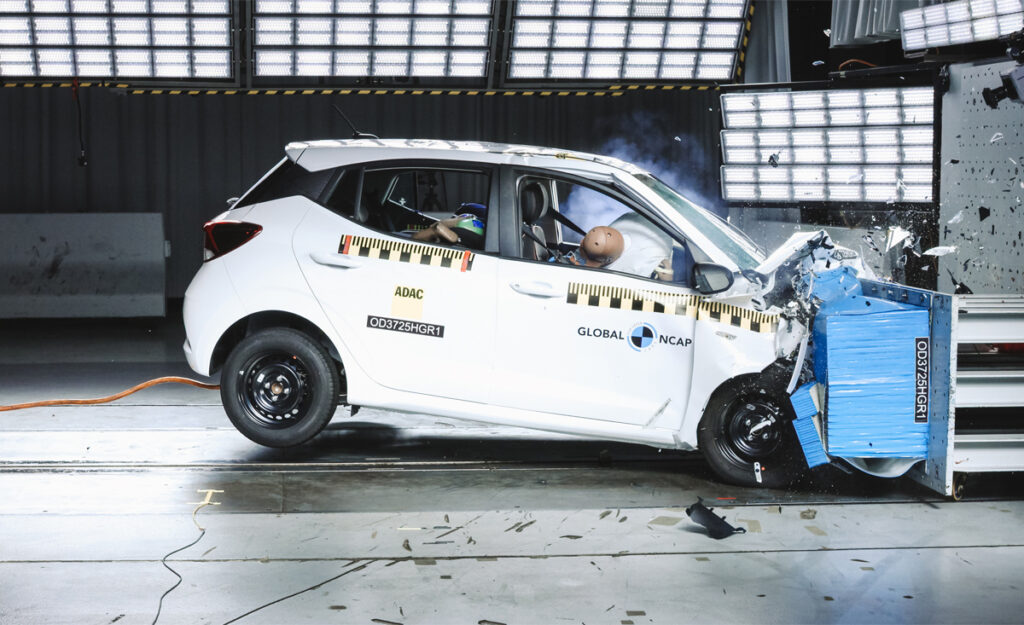
Following a report by the Automobile Association of South Africa (AA) regarding occupant safety in the Hyundai Grand i10, Hyundai South Africa has stood by its safety standards.
The AA reported that the Grand i10 received a zero-star rating for adult occupant protection, as well as only a three-star rating for child occupant protection from the Global New Car Assessment Programme (NCAP).
According to the AA, the model offers only basic safety equipment, such as driver and passenger airbags and does not come standard with side body or head protection.
The association also highlighted that the Grand i10 is not fitted with Electronic Stability Control (ESC).
These are features the AA says are “widely recognised as essential for modern vehicle safety.”
Furthermore, it said the hatchback offers dangerously weak chest protection for the driver in the frontal impact test, and found that severe and potentially fatal chest injuries are likely in the side impact test.
Findings also indicated an unstable bodyshell and footwell, leading to poor structural integrity that cannot withstand further impact forces.
The AA said the vehicle offers no standard side body or head protection, and that a Seat Belt Reminder (SBR) fitted only for the driver leaves other occupants unprotected.
Standing by its safety standards

The South Korean automaker’s local branch has now responded to the findings and reaffirmed its commitment to driver and occupant safety in all of its models.
Hyundai Automotive South Africa stated that the Hyundai Grand i10 meets all the safety and homologation requirements applicable as stipulated by the National Regulator for Compulsory Specifications (NRCS).
It said that for a vehicle to be approved for use on South Africa’s roads, it must first meet 53 NRCS compliance requirements, which Hyundai said the Grand i10 meets.
These requirements include braking performance, frontal impact protection, door latch integrity, child restraint anchorage systems, airbags and other regulated safety features.
“Safety is deeply embedded in Hyundai’s global and local product philosophy,” declared Stanley Anderson, CEO of Hyundai Automotive South Africa.
“The Hyundai Grand i10 has been engineered to meet all South African road and safety requirements, and the NRCS confirmation provides credible assurance to our customers and stakeholders that these standards have been independently verified.”
He added that while additional independent assessment ratings are useful reference points, they do not replace or override South Africa’s regulatory standards.
“Hyundai Automotive South Africa remains engaged with relevant regulators and industry bodies to continue to deliver vehicles that meet the needs of South African motorists,” Anderson noted.
He also stated that Hyundai South Africa is working closely with its global original equipment manufacturer to respond to increasing safety requirements.
The brand’s Communications Manager told TopAuto that Hyundai takes vehicle safety extremely seriously, and that it adheres to and in some instances exceeds statutory and regulatory requirements.
He added that Hyundai South Africa is in regular communication with the Hyundai Motor Company regarding safety standards and continued optimisation of vehicle specifications.
“Hyundai Automotive South Africa would support any extension of current safety standards by the NRCS as a requirement for launching and selling vehicles in South Africa.”



 Loading ...