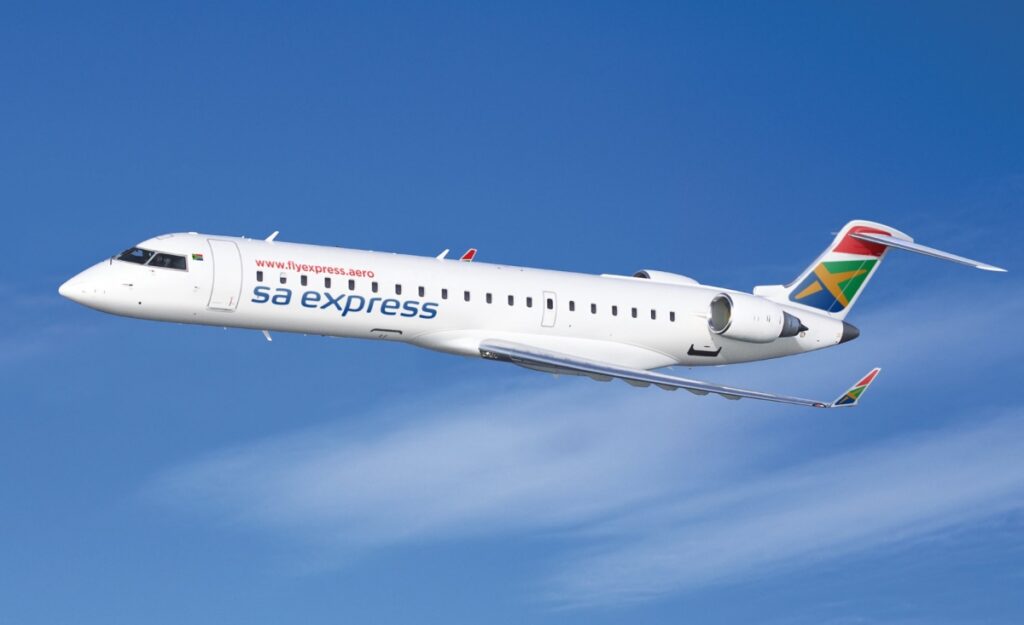
South Africa’s state-owned domestic airline, SA Express, was liquidated in 2022 following years of insolvency, and has now had its name and brand identity – valued at R150,000 – put up for sale.
Liquidators are merely two steps away from concluding the process, as reported by our sister publication, BusinessTech, which will be completed once a sale is concluded.
The appointed liquidator, Aviwe Ndyamara, told the Select Committee on Public Petitions and Executive Undertakings that the airline’s attempt to procure post-commencement financing led to its final liquidation.
Had it been successful, this would have enabled the company to trade regardless of business rescue proceedings.
One attempt to rescue the failing airline was when employees banded together to purchase the airline’s tangible assets, amounting to around R50 million.
Despite this, the Air Services Council cancelled SA Express’s licences in July 2022, leaving the airline with no tangible assets and liabilities nearing R1 billion.
According to Ndyamara, liquidators worked closely with the then-Department of Public Enterprises, hoping to preserve as much value in the company to be sold off to recover debts.
Much of this debt is still owed to ex-employees, 55 of whom are still owed dividends of around R4,500 each, totalling almost R250,000 in outstanding payments.
Ndyamara explained that around 90% of the administration has been completed, and that the only major hurdle is the sale of the airline’s brand and intellectual property.
“Purely looking at the brand and intellectual property as a residual asset, the transaction is not yet finalised. We’re not quite certain when we will conclude this transaction,” he said.
Liquidators project that the administration will be completed by April, should the outstanding items be resolved within the next two months.
Taking responsibility

Following consultations with the liquidator, the Select Committee on Petitions and Executive Undertakings raised concerns that former airline directors may not face consequences for their role in its collapse.
As well as liquidators, the committee also met with the South African Human Rights Commission and business rescue practitioners to determine the impact of the airline’s liquidation, particularly on workers.
The committee said it is considering a petition from former SA Express employees calling on the National Council of Provinces (NCOP) to intervene in what they call the government’s failure to challenge the liquidation.
They say that workers were not paid salaries, overtime, leave, or retrenchment benefits following business rescue and liquidation proceedings.
The committee’s Chairperson, Ofentse Mokae, noted that this raised serious concerns about accountability and the protection of workers.
He added that the state appeared to have distanced itself from responsibility through departments such as Transport, National Treasury and Public Enterprises.
“This matter raises important questions about whether the liquidation process prioritised assistance to workers,” said Mokae.
“When a public entity collapses, employees must be protected, rather than executives being prioritised.”
The committee expressed its concern over the gaps in legislation that could leave workers vulnerable when state-owned entities are liquidated.
It said that because SA Express was a state-owned entity, its handling of proceedings is “deeply concerning”.
“While relevant departments were involved, their lack of urgency in resolving the challenges faced by affected workers leaves much to be desired,” Mokae said.
Another concern is that liquidators are struggling to find former employees, despite inheriting the company’s records.
“It should not be difficult to locate the affected employees,” noted Mokae.
The committee will deliberate and finalise its report on the petition before submitting it to the NCOP who will then consider it for adoption.





 Loading ...